

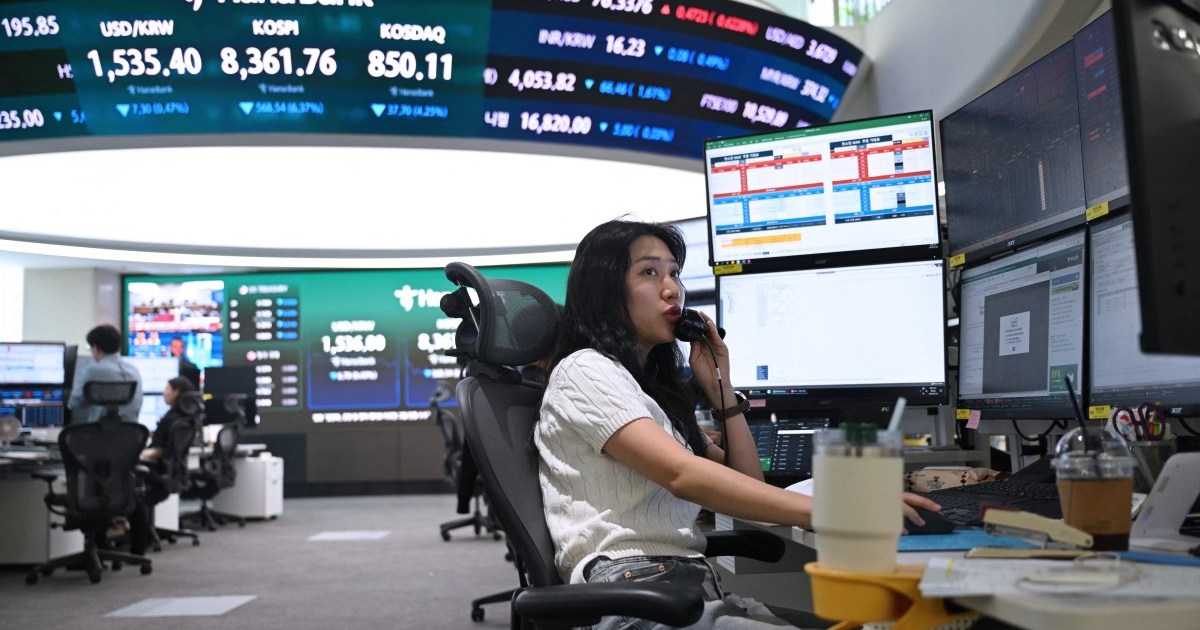
Kathmandu— South Korea’s stock market experienced a boom earlier this year driven by enthusiasm for artificial intelligence and related semiconductor stocks, attracting a wave of first-time investors. Many, like Eun-bi, a civil servant hoping to fund her wedding, invested heavily in companies such as SK Hynix and US-listed semiconductor funds. However, when the KOSPI index fell nearly 40 percent from its June peak, these investors faced substantial losses, jeopardizing their financial plans and prompting scrutiny of government policies aimed at boosting market accessibility.
Market Surge and Investor Enthusiasm
South Korea’s benchmark KOSPI index doubled in the first six months of 2023, rising 101.14 percent by the end of June, fueled by surging demand for memory chips from companies like Samsung Electronics and SK Hynix. The index reached an intraday peak of 9,385.59 on June 19th before reversing course. This rally coincided with a push by President Lee Jae Myung to revitalize South Korea’s stock market and make it more accessible to citizens, encouraging widespread investment.
Volatility and Market Correction
Despite some recovery since July, the KOSPI remains volatile, diving nearly 6 percent on Tuesday following a 1.55 percent drop the previous day. While up approximately 50 percent year-to-date, it is still 30 percent below its all-time high. The downturn has been exacerbated by heavy borrowing, with margin loans reaching 28.9 trillion won ($20.7bn) at the end of July – down from a peak of 38.6 trillion won ($27.6bn) as brokerages liquidated holdings.
Government Policies Under Scrutiny
The Lee administration’s efforts to broaden market access, including approving the sale of riskier leveraged investment products like exchange-traded funds (ETFs) tracking Samsung and SK Hynix shares, have come under fire. Authorities tripled the minimum cash balance required for trading leveraged single-stock ETFs on July 31st, accelerating previously planned stricter regulations. Critics argue these policies contributed to the market’s volatility and amplified investor losses.
Political Repercussions and Expert Analysis
President Lee’s approval rating has fallen to 43 percent in a recent survey, attributed in part to the stock market decline and controversy surrounding the leveraged ETF approvals. Cho Kuk, founder of the Rebuilding Korea Party, criticized the introduction of single-stock leveraged ETFs as a “policy failure,” arguing they trapped young investors in a risky situation. Benjamin Engel, an assistant professor at Dankook University, noted that fluctuations in the KOSPI will likely become a more significant factor in Korean politics moving forward. Bora Kim, head of Asia at Leverage Shares, pointed out that many Korean retail investors are already familiar with leverage and that the launch of leveraged ETFs on popular stocks clouded their judgment.
Investor Sentiment and Future Outlook
Eun-bi, who experienced significant losses, expressed a desire to diversify her investments in the future. Despite her setbacks, she does not blame the government for the market downturn, noting similar leveraged products are available internationally. She plans to monitor the market’s performance before converting her remaining holdings back into cash prior to her wedding.
The KOSPI's volatility continues to be a key concern for investors and policymakers alike, with ongoing analysis focused on identifying factors contributing to the swings and mitigating future risks.
(With inputs from Al Jazeera)
Originally published on abcnews.com.np.




प्रतिक्रिया दिनुहोस्