

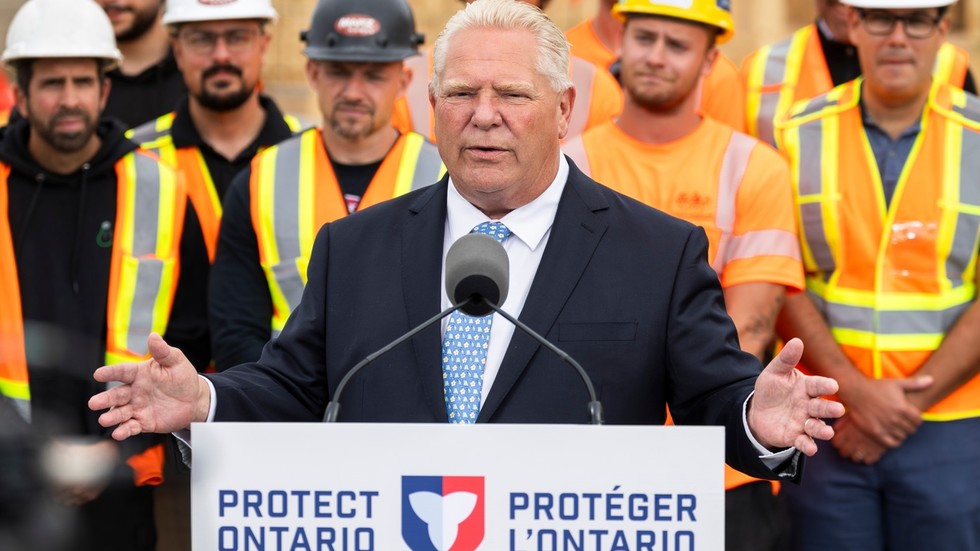
Kathmandu— Escalating tensions over tariffs have led Canada’s Ontario Premier Doug Ford to threaten cutting electricity and critical mineral exports to the United States, following the announcement of new levies on Canadian goods by President Donald Trump last week. The exchange occurred after trade talks collapsed, with Trump imposing a 50% tariff on around $20 billion worth of Canadian imports effective Saturday, and promising further tariffs on cars, trucks, auto parts, and steel starting January 1, 2027. Ford stated Ontario could raise electricity prices or halt exports entirely, while Trump dismissed the threats as “bluster” and personally attacked the premier.
Escalating Trade Tensions
The current dispute stems from collapsed trade negotiations between Canada and the United States. Following the breakdown of talks last Friday, President Trump announced significant tariffs on Canadian imports, prompting a swift response from Ottawa. Mark Carney, Canada’s representative in the negotiations, stated that the U.S. “asked too much and offered too little,” leading to the implementation of dollar-for-dollar retaliatory tariffs beginning September 8.
Ford's Electricity Threat
Ontario Premier Doug Ford escalated the rhetoric on Monday, asserting that “everything’s on the table” and vowing to take any necessary action. He specifically highlighted Ontario’s ability to disrupt electricity supplies to the U.S., noting they power 1.5 million homes and businesses. Ford warned Trump that if he continues attempts to dismantle Canadian manufacturing, “he better have a pack of batteries.” He also suggested Ottawa consider restrictions on oil, potash, and strategic minerals.
U.S. Dependence on Canadian Power
While Canada is the largest foreign supplier of electricity to the U.S., overall national dependence remains relatively low. Data from the US Energy Information Administration shows that in 2025, the U.S. imported approximately 24.5 terawatt-hours of Canadian electricity and exported around 16 terawatt-hours back, resulting in a net reliance of roughly 0.2% of total consumption. However, dependence is significantly higher in border states like New York, Michigan, and Minnesota, where consistent access to Canadian power is crucial during peak demand periods. The growing energy demands from AI data centers are also adding strain on regional grids.
Previous Retaliatory Measures
This isn’t the first time Ontario has wielded the threat of electricity restrictions as leverage in trade disputes. In March 2025, Ford imposed a 25% surcharge on electricity exports to three U.S. states before suspending it after Trump threatened further tariffs on Canadian steel and aluminum.
The situation remains fluid, with both sides maintaining firm positions. Further negotiations or escalation of trade measures are anticipated in the coming weeks as Canada and the United States navigate this increasingly contentious dispute.
(With inputs from RT)
Originally published on abcnews.com.np.






प्रतिक्रिया दिनुहोस्