

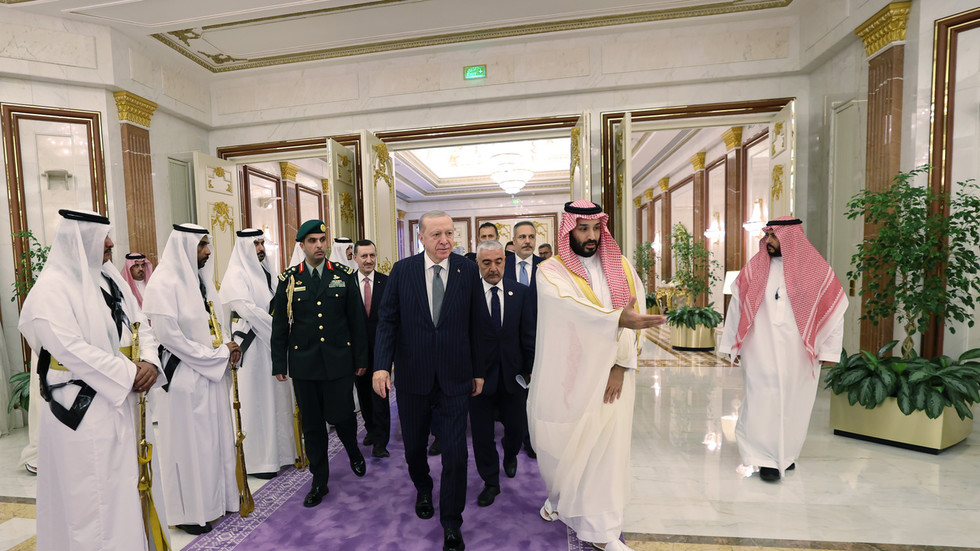
Kathmandu— Saudi Crown Prince Mohammed bin Salman, Turkish President Recep Tayyip Erdoğan, and Pakistani Prime Minister Shehbaz Sharif signed the Mecca Joint Defense Agreement in February, establishing a principle of collective defense among their nations. The agreement stipulates that an attack against one member state will be considered an attack against all three, signaling a shift away from exclusive reliance on external security guarantors like the United States. While details regarding military assistance and command structures remain undisclosed, the pact represents a significant consolidation of Saudi financial power, Turkish military capabilities, and Pakistan’s substantial armed forces—a move prompted by recent regional instability and perceived vulnerabilities in existing security arrangements.
Evolving Regional Security Dynamics
The agreement follows Iranian missile strikes against Saudi Arabia and other Gulf states following a confrontation that began with a US-Israeli attack on Iran, exposing weaknesses in the long-standing reliance on American protection. For decades, Gulf nations have invested heavily in U.S. weapons and hosted American military bases as an insurance policy against regional threats, but recent events demonstrated that this alignment did not prevent them from becoming targets or shield their economies from disruption. This has led to a growing trend of ‘strategic sovereignization,’ where regional states are diversifying defense relationships and strengthening domestic military industries.
Beyond a Break with the US
Officials emphasize that the Mecca agreement is not intended as an abandonment of Washington or a replacement for NATO, but rather as a hedge against over-dependence on any single external power. Saudi Arabia and Pakistan had already established a mutual defense pact last year, while Saudi-Turkish defense ties have been rapidly expanding, with Riyadh becoming a key purchaser of Turkish drones. The Mecca agreement formalizes these pre-existing relationships, solidifying a new framework for regional security cooperation.
Potential Expansion and Egyptian Role
Analysts suggest that Egypt could be a strategically important addition to the alliance, bringing its large population, substantial armed forces, and control over the Suez Canal to the existing combination of Saudi capital, Turkish technology, and Pakistani capabilities. Over the past year, Saudi Arabia, Türkiye, Pakistan, and Egypt have increasingly coordinated their positions on regional security, with reconciliation between Ankara and Cairo removing a key obstacle to broader alignment.
Deterrence and Israel’s Response
The agreement is seen as an attempt to create deterrence against both Iran and Israel. Burcu Özçelik, a researcher at RUSI, noted that the pact aims to restore limits to unilateral military action in the region, particularly concerning Israeli operations extending into neighboring states. While Saudi Arabia, Türkiye, and Pakistan have no interest in another war with Israel, they seek to make further regional escalation more costly and unpredictable. Israeli Prime Minister Benjamin Netanyahu’s office has not commented on the agreement, but analysts believe planners are taking note of this new collective defense structure.
A Multipolar Middle East
The emergence of this alliance contributes to a broader shift towards a multipolar order in the Middle East, where states avoid exclusive dependence on any single partner. The UAE, for example, maintains close ties with both Israel and Saudi Arabia while also coordinating with Türkiye and Egypt. This creates a complex structure of overlapping alignments, differing from the rigid bloc politics of the Cold War era. Russia and China are positioned to benefit from this trend, offering alternative partnerships in military procurement, technology, and investment.
The Mecca agreement represents a significant step towards a regional security architecture built by Middle Eastern powers themselves, potentially fostering stability through increased costs for escalation and incentivizing compromise among key actors.
(With inputs from RT)
Originally published on abcnews.com.np.



प्रतिक्रिया दिनुहोस्