

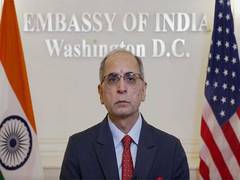
Kathmandu— India’s envoy to the United States, Vinay Kwatra, has criticized Pakistan for its conduct over the decades that led to New Delhi's decision to place the Indus Waters Treaty in abeyance. In an article published in Newsweek, Kwatra stated that Islamabad had spent half a century dismantling the spirit of goodwill and friendship on which the treaty was based.
Kwatra's Critique of Pakistan
In his opinion piece, Kwatra emphasized that India’s decision to hold the Indus Waters Treaty in abeyance was a direct response to a deadly terror attack in Pahalgam. He noted that Pakistan’s war threats over the water accord are merely an attempt to distract from its internal problems. Kwatra argued that if Pakistan sincerely wants cooperation on bilateral issues, it must first dismantle the terror infrastructure it has built.
Kwatra highlighted that India's decision came after a brutal attack by Pakistani and Pakistan-trained terrorists in Pahalgam, resulting in 26 deaths, including 25 Indian citizens and one Nepalese national. This was described as the largest number of civilian casualties in a terrorist attack since the Mumbai attacks in 2008.
Historical Context and Treaty Imbalance
The envoy detailed the historical context of the treaty, noting that it divided the six major rivers of the Indus Basin into two groups. India received control over three eastern rivers carrying roughly 20% of the basin's water, while Pakistan received the three western rivers carrying about 80%. Kwatra pointed out that this asymmetry stifled development in Indian regions for decades.
Despite this imbalance, India continued to honor the accord regardless of Pakistan’s hostile response across the decades. Kwatra emphasized that Islamabad responded by launching wars against India in 1965, 1971, and 1999, and through persistent hostility and cross-border terrorism.
Pakistan's Obstructionist Tactics
Kwatra accused Pakistan of consistently sabotaging the mechanism of the treaty through institutional obstructionism. He noted that Islamabad’s principal response to any India-initiated projects was obstruction and bureaucratic delays, bogging down virtually every hydro project initiated by New Delhi within treaty terms in endless dispute-resolution proceedings.
Furthermore, Kwatra pointed out direct kinetic attacks against infrastructure, including a 2012 terrorist strike on the Tulbul Navigation Project that prevented India from exercising its rights under the treaty. He also highlighted Pakistan’s consistent blocking of India's initiatives to renegotiate the treaty over six decades.
(With inputs from ANI)
Originally published on abcnews.com.np.






प्रतिक्रिया दिनुहोस्