

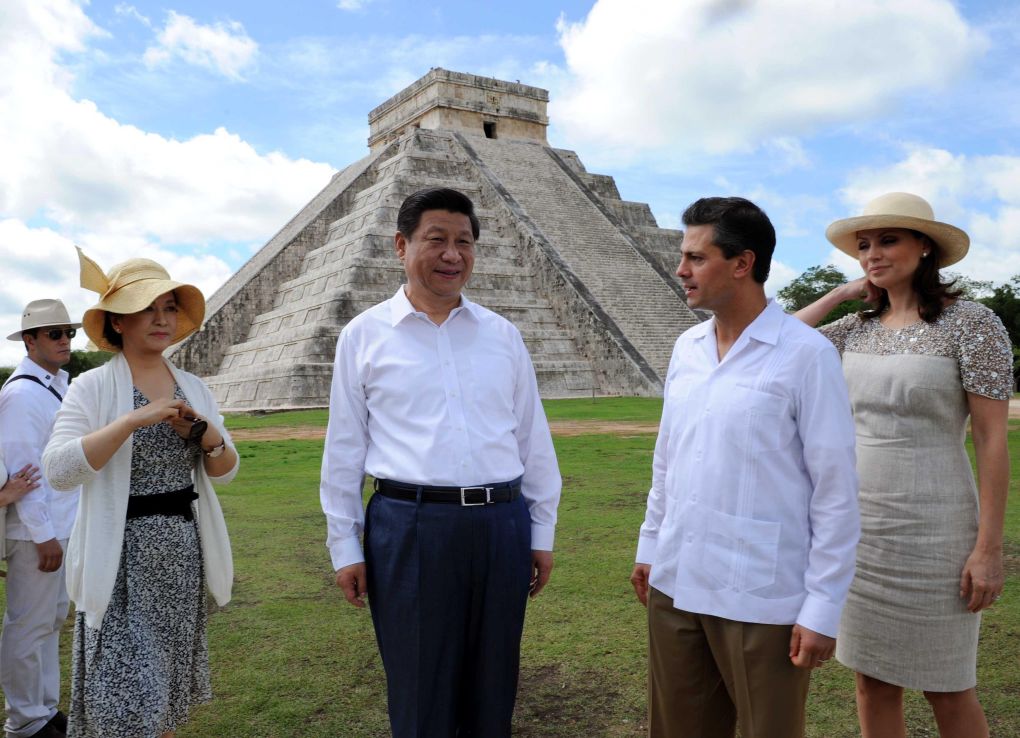
Kathmandu— Chinese President Xi Jinping’s commitment to intercultural dialogue is evident through his travels and speeches over the past decade, emphasizing that civilizations can learn from one another despite differing histories and traditions. A visit to Mexico's Chichen Itza archaeological site in 2013, alongside then-President Enrique Pena Nieto, exemplified this approach, sparking conversations about shared cultural elements between the Maya civilization and Chinese heritage. This focus on mutual learning has become a cornerstone of Xi’s foreign policy, promoting understanding and cooperation on a global scale.
A Mayan Encounter
At the ancient Maya site of Chichen Itza, President Xi toured landmarks like the Pyramid of Kukulkan and the Temple of the Warriors with then-Mexican President Enrique Pena Nieto in June 2013. During the visit, Xi engaged with explanations of Maya history and culture, inquiring about the meanings behind carvings and noting similarities between Maya imagery and Chinese traditions, particularly those associated with dragons. This interaction underscored his belief that civilizations can enrich each other through dialogue and mutual respect.
Promoting Mutual Learning
Xi has consistently advocated for an open-minded approach to cultural exchange, stating, “Different cultures and civilizations, while retaining their uniqueness, should tolerate and coexist with each other with an open-minded attitude so as to achieve common development and prosperity.” In a 2014 speech at UNESCO in Paris, he quoted Victor Hugo – “There is a prospect greater than the sea, and it is the sky; there is a prospect greater than the sky, and it is the human soul” – emphasizing the need for broad-mindedness when approaching different civilizations. He highlighted how China’s historical inventions like papermaking and gunpowder influenced global developments, including the European Renaissance.
Diplomacy Through Cultural Immersion
Xi's diplomatic journeys have frequently included immersive cultural experiences. In Trinidad and Tobago, he played the steelpan with local musicians; in Fiji, he listened to indigenous songs while wearing a traditional Bula shirt; and in Uzbekistan, he explored the ancient Silk Road city of Bukhara. Anvar Kurbanov, a master craftsman in Bukhara, recalled Xi’s visit in 2016, noting his “heartfelt desire to understand and respect our culture,” adding that Chinese tourism to the city increased following the president's trip.
Initiatives for Global Exchange
China has actively promoted intercultural understanding through various initiatives. These include cultural and tourism exchange programs, joint archaeological research projects with countries like Russia and Egypt, and translations of classic works. China also hosted the Conference on Dialogue of Asian Civilizations and the Dialogue on Exchanges and Mutual Learning among Civilizations, proposing the Global Civilization Initiative to encourage further collaboration. Xi has repeatedly stressed that each nation should be free to choose its own development path.
A Call for Humility
In a 2014 speech at the Indian Council of World Affairs in New Delhi, Xi emphasized China’s commitment to being “a great learning nation,” advocating for humility and inclusiveness. He explained that this spirit of learning has enabled China's continuous progress over thousands of years, adding that avoiding complacency is crucial for continued development.
China continues to prioritize initiatives promoting dialogue and mutual learning among civilizations as a means of fostering global cooperation and addressing shared challenges.
(With inputs from Xinhua)
Originally published on abcnews.com.np.

प्रतिक्रिया दिनुहोस्