

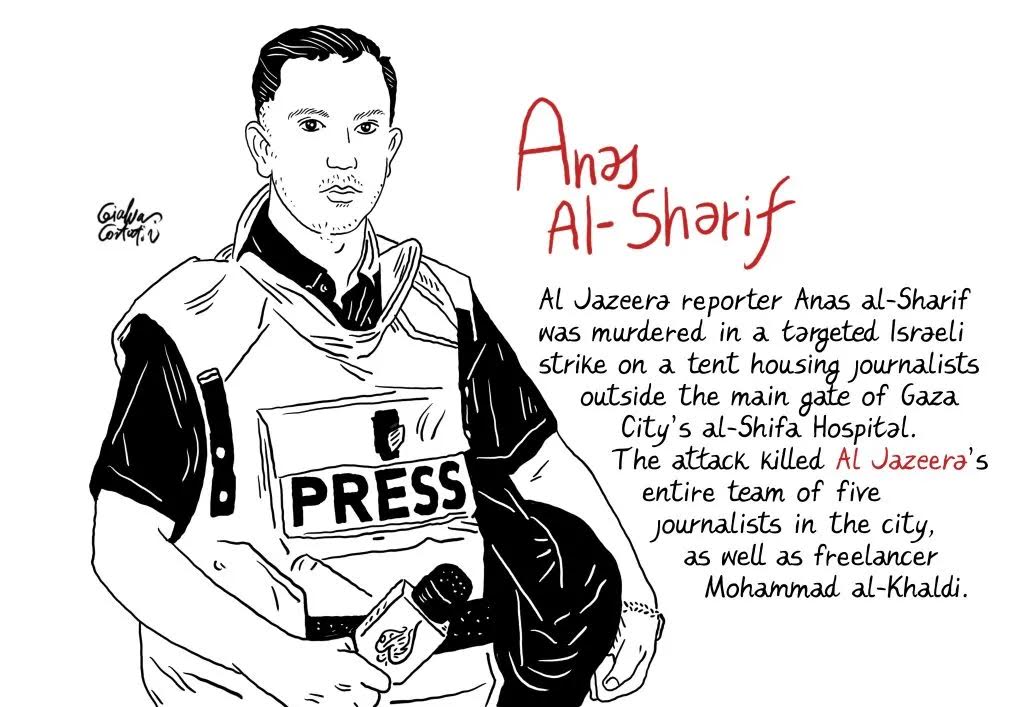
Kathmandu— One year ago this week, Israeli military forces killed Anas Al-Sharif, a young Palestinian journalist working in Gaza who continued to report amidst bombardment and displacement. His death was not an isolated incident but part of what observers describe as a systematic campaign to eliminate those documenting events on the ground—a deliberate component of the ongoing conflict that has resulted in the deaths of nearly 300 Palestinian and Lebanese journalists since October 2023. These reporters, many wearing press vests and working for local or international outlets, have been killed while reporting on the destruction of civilian infrastructure and the escalating humanitarian crisis.
Unprecedented Toll on Journalists
The scale of journalist deaths in Gaza surpasses that of major twentieth-century conflicts combined, according to analyses from Brown University’s Costs of War project. More journalists have been killed in Gaza than in the U.S. Civil War, World War I, World War II, the Korean War, the Vietnam War, the wars in the former Yugoslavia, and the post-9/11 war in Afghanistan—combined. The Committee to Protect Journalists documents at least 209 journalists killed by Israeli forces in Gaza and in Israeli detention centres, while Palestinian press associations estimate the figure is even higher, reaching into the mid-to-high 260s.
Targeted Killings and a Pattern of Violence
Shireen Abu Akleh, an American-Palestinian journalist for Al Jazeera, was shot in the head by an Israeli soldier in Jenin in May 2022—over a year before the current conflict. Investigations concluded she was deliberately targeted, though the Israeli government initially shifted blame and faced no accountability. This killing foreshadowed what would become a widespread practice: journalists are being killed in their homes, in press cars, while live-streaming from hospitals, and even within media offices that had been identified as civilian spaces.
Resilience Amidst Devastation
Despite the immense risks, many journalists continue to report from Gaza. Wael Al-Dahdouh, Al Jazeera’s long-time Gaza bureau chief, has suffered profound personal loss—his wife, two children, and grandson were all killed in Israeli strikes—but continues to broadcast. “If we don’t continue reporting,” he said, “there will be no one left to tell the story.” Younger reporters like Nour Khaled have also stepped up, choosing to remain in Gaza City despite the dangers.
Documenting the Killings and Demanding Accountability
Palestinian institutions, including the Palestinian Journalists’ Syndicate and the Shireen Observatory, are meticulously documenting the deaths of journalists. These organizations maintain regularly updated lists of those killed, providing a crucial record of the violence. Demonstrations have been held globally, including in New York City, demanding accountability for these killings and highlighting what activists say is Western media's role in justifying the ongoing conflict. Roland Bennett, president of the Tree Water Initiative, stated, “Remembering Anas means refusing to let the record be buried.”
International Response and Double Standards
The international response has been largely muted, with Western governments offering few strong condemnations despite advocating for press freedom domestically. The same nations that demanded accountability for journalist deaths in Ukraine have remained cautious when it comes to addressing the killings of Palestinian journalists, a perceived double standard that critics say underscores a broader political bias.
The work of these remaining journalists serves as both documentation of the ongoing conflict and an act of resistance against attempts to silence their voices. Their persistence ensures that the record of events in Gaza remains unbroken.
(With inputs from CounterPunch)
Originally published on abcnews.com.np.

प्रतिक्रिया दिनुहोस्