

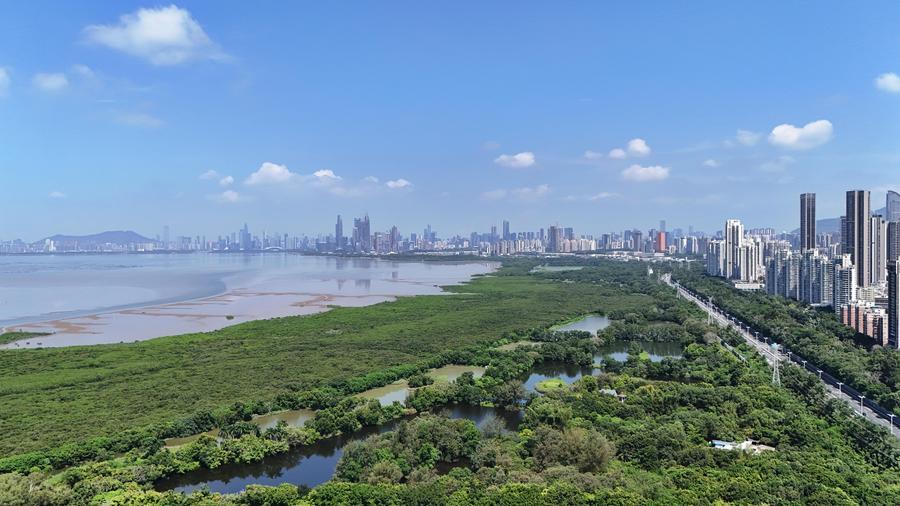
Kathmandu— Each year, millions of migratory birds undertake arduous journeys along the East Asian-Australasian Flyway (EAAF), facing numerous threats as they travel between breeding and wintering grounds. Stretching from Alaska and Russia to Southeast Asia and Australia, this flyway relies heavily on China – positioned at its midpoint – as a vital resting place and hub for cross-border conservation efforts. Reserves like Guangdong Neilingding Futian National Nature Reserve near Shenzhen Bay provide critical habitat, while collaborative initiatives between countries are strengthening protection along the entire route.
China’s Role as a Key Hub
The East Asian-Australasian Flyway is considered one of the world's busiest migratory routes, and China plays an irreplaceable role in its health. The Guangdong Neilingding Futian National Nature Reserve exemplifies this commitment; despite being located within a densely urbanized area, it provides essential wintering and stopover habitat for birds traveling along the EAAF. Senior engineer Yang Qiong explains that these birds need ‘refueling stations’ to replenish energy during their long flights, often stopping in Shenzhen Bay for one to two weeks.
Sister Wetlands Foster Collaboration
The Futian reserve benefits from a strong partnership with the neighboring Mai Po Nature Reserve in Hong Kong. These “sister wetlands” are ecologically connected and work together to enhance biodiversity and conservation efforts. Wen Xianji, director of Mai Po, notes that their experience in wetland management has been shared through training programs for conservation professionals across the region. Georgina Fernandez, head of the Sibugay Wetland Nature Reserve in the Philippines, praised Mai Po’s advanced monitoring systems and its ability to balance public access with ecosystem preservation after attending a training program there.
International Cooperation is Essential
Protecting migratory birds requires a unified approach, as no single country can effectively safeguard them alone. Jennifer George, chief executive of the EAAF Partnership, emphasizes that “joint protection is essential because each country protects one part of a shared life cycle.” This sentiment is echoed by the recent launch of the International Mangrove Center (IMC), an intergovernmental organization dedicated to mangrove protection, which held its first council meeting in Shenzhen. China has also signed bilateral agreements with countries like Australia, South Korea, Russia and New Zealand to monitor and protect endangered species.
A Cradle of Birdlife and Ecological Progress
China’s commitment extends beyond regional partnerships; the country boasts the largest total wetland area in Asia and the fourth globally. President Xi Jinping has emphasized a modernization approach that harmonizes humanity with nature, promoting high-quality development in wetlands conservation. Experts like Pyae Phyo Aung from Nature Conservation Society-Myanmar highlight China's success in habitat restoration, citing national nature reserves as key examples. Kisup Lee, a South Korean ornithologist, points to the systematic ecological restoration of sites like Tiaozini Wetlands and Dongtan Wetland as attracting increasing numbers of rare migratory birds.
With ongoing conservation efforts and strengthened international collaboration, China continues to play a pivotal role in safeguarding the East Asian-Australasian Flyway and ensuring the survival of millions of migratory birds.
(With inputs from Xinhua)
Originally published on abcnews.com.np.






प्रतिक्रिया दिनुहोस्