

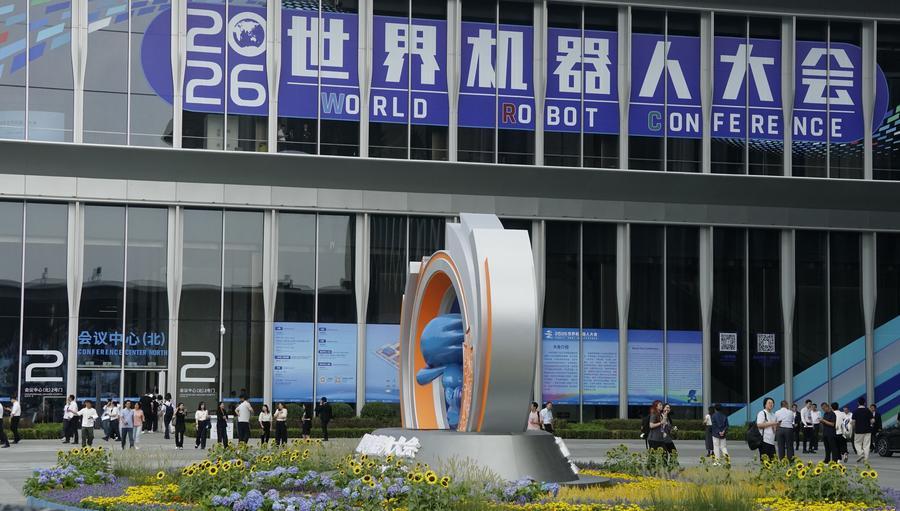
Kathmandu— The 2026 World Robot Conference (WRC) currently underway in Beijing is highlighting a significant shift for China’s robotics industry: a move from showcasing technological feats to demonstrating practical commercial applications. Over 300 exhibitors from 26 countries are displaying over 3,000 products, including more than 300 debuts, focused on real-world problem solving in areas like logistics and manufacturing. The conference underscores China’s ambition to become a leader in embodied intelligence, with government support and increasing investment driving rapid growth in the sector.
Rapid Commercialization of Humanoid Robots
At the WRC, UBTECH presented a coordinated workflow featuring ten humanoid robots lifting, stacking, and sorting goods – demonstrating a complete smart logistics process. Galaxea showcased a system where robots autonomously fulfill orders by navigating warehouses and packaging items, already operational in Beijing and other cities. Luo Tianqi, chief financial officer of Galaxea, explained that the technology offers an economically viable solution to nighttime warehouse staffing challenges.
Industry Growth and Investment
China’s robotics sector generated over 300 billion yuan (approximately $44.24 billion USD) in revenue in 2025, with average annual growth exceeding 20 percent over the past five years. Revenue for the first half of 2026 reached 165.5 billion yuan, a year-on-year increase of 24.5 percent. Unitree Robotics recently became the first humanoid robot maker listed on China’s A-share market, signaling further investment and confidence in the industry. The country has also established over 70 embodied-intelligence training grounds, with an additional 46 planned or under construction.
Expanding Applications Across Industries
Nearly ten major automakers, including BYD and SAIC, are currently testing embodied-intelligence systems on production lines for tasks such as material handling and parts loading. Xu Xiaolan, chairwoman of the Chinese Institute of Electronics, noted that these robots are also being deployed in high-risk environments for disaster relief, flood response, and hazardous industrial inspections. Wang Xingxing, founder and CEO of Unitree Robotics, stated his company’s robots are undergoing testing on auto assembly lines and within its own factories, with AI research focused on improving practical task performance.
Government Support and Future Outlook
The Chinese government has prioritized “embodied intelligence,” including it in the 2025 government work report and outlining plans for future industries in the 15th Five-Year Plan (2026-2030). This includes mechanisms to boost funding and share risks within emerging sectors. While a true “GPT moment” – where robots can complete most tasks with simple commands – is still predicted to be years away, Wang Xingxing anticipates this breakthrough could occur within two to three years in an optimistic scenario.
Industrial Chain Collaboration
This year’s WRC emphasizes collaboration across the entire industrial chain, bringing together AI developers, component suppliers (like 3D-vision and battery manufacturers), robot makers, and end-users. This collaborative approach aims to accelerate research and development cycles and facilitate faster innovation.
The continued growth of China's robotics sector is expected to be fueled by ongoing government support, increasing investment, and the expansion of real-world applications across various industries.
(With inputs from Xinhua)
Originally published on abcnews.com.np.





प्रतिक्रिया दिनुहोस्