

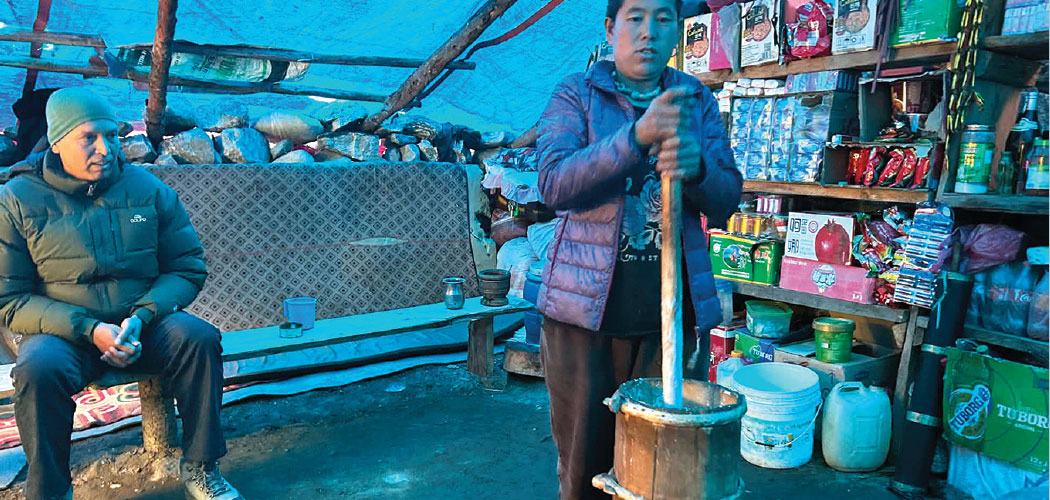
Kathmandu— In the mountainous district of Humla, Nepal, a traditional wooden pot known as the Toljum – used by livestock farmers to make buttermilk – is facing extinction. The decline mirrors a broader shift away from traditional livestock practices among local communities, threatening not only the vessel itself but also related cultural and economic activities. Residents report that these pots, once commonplace in every household, are now increasingly rare, damaged, or out of use as fewer families maintain large herds of animals.
A Vanishing Tradition
Namgyal Lama, a resident of Yari village, explained that the wooden Toljums were formerly ubiquitous throughout Humla. He noted that families once possessed multiple pots to accommodate their larger livestock holdings, with some owning up to three. Today, many households no longer have even one in regular use. The decreasing number of animals directly correlates with the reduced need for daily buttermilk production, a staple traditionally made within these vessels.
Cultural and Economic Impact
The decline of the Toljum extends beyond its practical function; it also represents a loss of cultural heritage and economic opportunity. Sobarna Rokaya, from Simkot Rural Municipality, highlighted that the diminishing practice of livestock farming is putting the traditional pot at risk. Beyond buttermilk production, related products like butter, ghee, churpi (a hardened cheese), and cheese are also experiencing declining output. The Toljum itself once served as a source of income for local artisans, with a single vessel fetching up to 5,000 Nepalese Rupees.
Monsoon Season Use Remains
Despite the overall decline, some farmers continue to utilize the Toljum during the monsoon season. During this time, livestock are moved to higher-altitude pastures, and the pots remain essential for making buttermilk in these remote locations. Residents recall a time when the sound of churning buttermilk within the wooden vessels could be heard from considerable distances, a testament to its former prevalence.
The future of the Toljum remains uncertain as traditional livestock farming continues to diminish in Humla district, potentially leading to the complete loss of this cultural artifact and associated practices.
(With inputs from RN)
Originally published on abcnews.com.np.




प्रतिक्रिया दिनुहोस्