

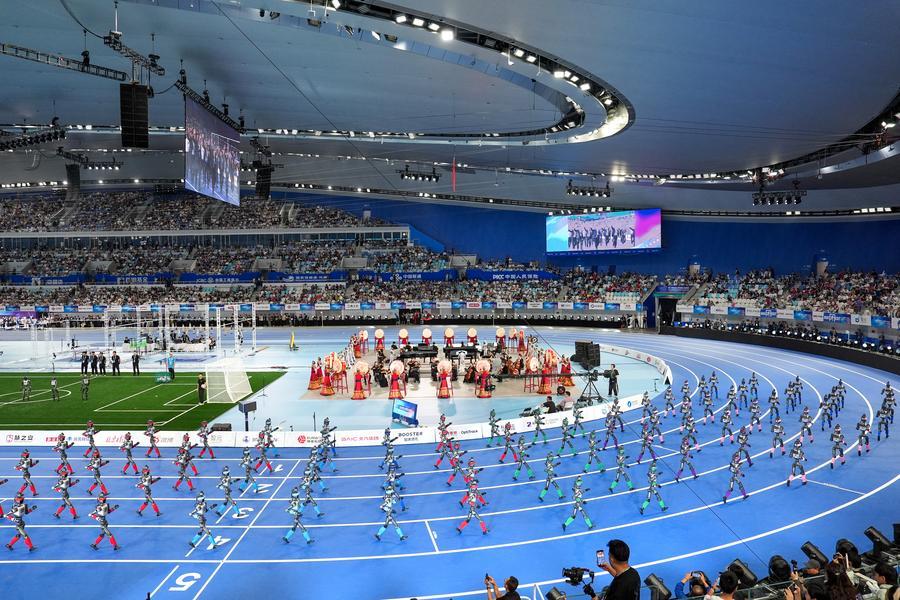
Kathmandu— Humanoid robots achieved record-breaking performances in recent races held at the World Humanoid Robot Games in Beijing from August 22nd to 26th, signaling rapid progress in the field of embodied intelligence. Beyond athletic feats, robotics entrepreneurs are now prioritizing the translation of these advancements into tangible productivity gains for industries like manufacturing, logistics, and even domestic services, moving away from purely demonstrative technology towards real-world problem solving.
From Stumbles to Strides
The World Humanoid Robot Games represent a significant leap forward since its inaugural edition last year. Previous iterations were marked by robots struggling with basic movements and often failing to complete courses, as captured in viral videos. This year’s event showcased markedly improved athletic ability, with robots surpassing human records in 100-meter and 400-meter races.
Beyond Demonstration: The Push for Practicality
The focus is shifting from showcasing robotic potential to delivering measurable results. Organizers added 21 scenario-based contests this year designed to test robots in realistic environments such as factories, hotels, homes and logistics facilities. Tasks include industrial assembly, housekeeping, emergency rescue, and library work – jobs characterized by repetition, physical demand, or inherent danger. Robotics entrepreneurs recognize that securing orders requires demonstrating practical value.
Innovation Driven by Real-World Challenges
The challenges presented by these real-world scenarios are driving innovation in robot design and programming. Teams are developing lighter structures to improve motion flexibility and “lifelong learning mechanisms” that allow robots to adapt to wear and tear and maintain consistent performance. One judge noted a significant improvement in basic tasks like folding clothes, with robots now able to neatly fold and store items – a feat largely absent last year.
Integration of Hardware, AI, and Application
Industry leaders emphasize that the future of humanoid robotics lies in integrating three key elements: advanced hardware, sophisticated embodied AI foundation models, and practical industrial applications. Companies like Galbot are deploying robots in demanding environments such as battery manufacturing facilities at CATL, where they support high-efficiency workflows. They’ve also partnered with SAIC Motor and Bosch to explore further integration into smart manufacturing processes. The company's approach centers on a unified system combining perception, decision-making, and execution, reducing the need for task-specific programming.
Global Collaboration and Open Innovation
China is actively fostering international collaboration in embodied intelligence. The recently launched “Global Robot Application Exploration Program,” initiated by the World Robot Cooperation Organization and the Chinese Institute of Electronics, will provide free robot trials and secondary development opportunities for 1,000 scenarios annually. Representatives from Britain and South Korea have highlighted potential areas for cooperation, including AI-driven transformation, physical intelligence, and smart manufacturing.
Establishing Standards and Ethical Considerations
Xu Xiaolan, chairwoman of the Chinese Institute of Electronics, stressed the importance of establishing international standards for safety and ethics in embodied intelligence. She called for joint efforts to build a secure, open, and inclusive system for evaluation and certification, ensuring that technological advancements ultimately benefit humanity.
The World Robot Conference continues to drive innovation in the field, with ongoing initiatives aimed at bridging the gap between research and industrial application and fostering a global ecosystem of collaboration.
(With inputs from Xinhua)
Originally published on abcnews.com.np.





प्रतिक्रिया दिनुहोस्