

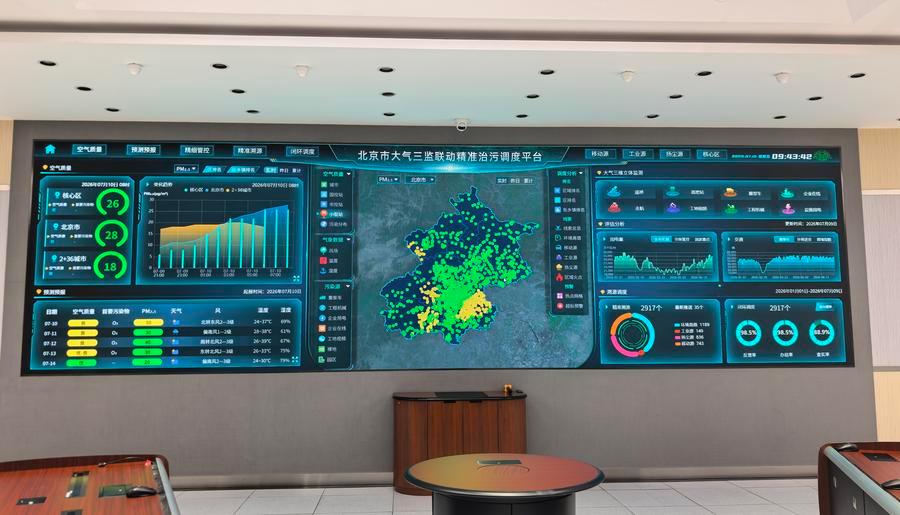
Kathmandu— Beijing has made significant strides in improving air quality, transitioning from 58 heavily polluted days in 2013 to just one in 2025 and achieving a nearly 70% reduction in PM2.5 concentrations—a key indicator of air pollution—over the same period; this progress is largely attributed to the city’s comprehensive system integrating environmental monitoring, scientific analysis, policymaking, regional cooperation, and law enforcement, all increasingly powered by digital technologies.
Monitoring Network Expansion
Beijing has established a multi-level air quality monitoring network comprised of 35 standard stations continuously measuring six major pollutants, supplemented by over 1,000 compact sensors deployed in communities and townships to provide more localized data on air quality variations. The Beijing Municipal Ecological and Environmental Monitoring Center, responsible for monitoring the city’s environment since its establishment as one of China's earliest ecological institutions, developed an analytical system capable of identifying approximately 125 components of PM2.5, enabling researchers to trace pollution sources.
Targeted Pollution Source Analysis
The center has conducted four rounds of PM2.5 source analysis studies in collaboration with other institutions, released in 2014, 2018, 2021 and 2025; the latest analysis revealed that regional transport contributes 57 percent of Beijing’s PM2.5 pollution, while vehicle emissions and residential sources account for a significant portion of the remaining 43 percent from local sources. Li Yunting, technical director at the center, explained that source analysis provides “a scientific basis for policymakers to target key emission sources.” This data has informed policies such as promoting new-energy vehicles and adopting advanced dust control techniques.
Smart Environmental Governance System
Beijing has implemented a data-driven environmental governance system linking monitoring, regulation, and enforcement through an innovative model integrating artificial intelligence, the Internet of Things, satellite remote sensing, and vehicle-mounted technologies onto a unified platform. Zhang Likun, director of the smart system division at the center, noted that this system consolidates information previously scattered across different departments, enabling off-site enforcement and cross-sector collaboration. The platform utilizes over 30 intelligent algorithms to analyze data, identify pollution risks, and forward issues to enforcement departments.
International Recognition
Beijing’s advancements in air quality management have garnered international attention; the United Nations Environment Programme has highlighted Beijing's experience as a model for other cities. Clean Air Asia featured the city’s smart governance system as a case study in its “China Air 2025” report, and it was also presented at the 2026 Better Air Quality Conference, receiving the Certificate for Clean Air Best Practice Sharing.
As PM2.5 concentrations reach relatively low levels, Beijing is focusing on more targeted, science-driven approaches to achieve further improvements in air quality as part of China’s broader Beautiful China Initiative.
(With inputs from Xinhua)
Originally published on abcnews.com.np.



प्रतिक्रिया दिनुहोस्