

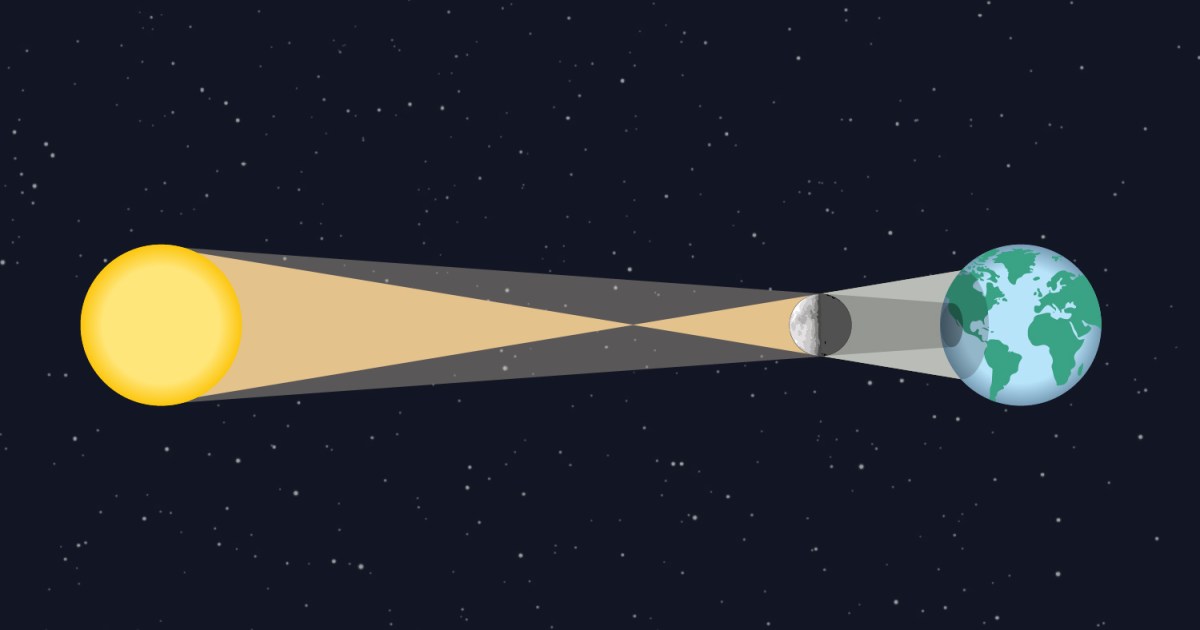
Kathmandu— Millions of people across Europe are poised to witness a rare celestial event on Wednesday: a total solar eclipse. Starting at 15:34 GMT, the moon will begin blocking the sun, plunging areas from northern Russia and Greenland through Iceland, Spain, and Portugal into temporary darkness for up to two minutes. A partial eclipse will be visible across much of Western Europe, parts of North Africa, Canada, and the northern United States, with approximately 980 million people potentially able to observe at least a portion of the phenomenon depending on weather conditions.
Eclipse Timeline and Visibility
The eclipse’s progression will begin with a partial phase at 15:34 GMT. Totality – when the sun is completely obscured – will first occur at 16:58 GMT, reaching its maximum duration of two minutes and 18 seconds near the center of its path around 17:46 GMT. Totality is expected to reach Reykjavik, Iceland, around 17:48 GMT and Spain around 18:27 GMT before ending globally at 18:34 GMT. The partial eclipse will conclude at the last location on Earth at 19:58 GMT.
European Viewing Opportunities
While a total eclipse will be limited to northern Russia, Greenland, Iceland and parts of Spain and Portugal, much of Europe will experience a significant partial eclipse. Cities like Paris are expected to see approximately 92 percent coverage, London around 91 percent, and Berlin about 85 percent. However, for cities further east, the sun may set before the peak of the eclipse, limiting visibility.
North American Visibility
Viewers in Canada and the United States will only be able to observe a partial eclipse. St John’s, Newfoundland, is expected to have around 53 percent coverage, while Montreal and Toronto will see approximately 18 and 8 percent respectively. In the US, Fairbanks, Alaska, will experience the deepest partial eclipse with about 37 percent coverage, followed by Anchorage at 28 percent.
Safe Viewing Practices
Looking directly at the sun, even during a partial eclipse, can cause severe eye damage. Experts strongly advise using certified eclipse glasses or handheld solar viewers with undamaged filters throughout most of the event. It is safe to remove eye protection only during the brief period of totality when the moon completely covers the sun, and it should be immediately replaced as soon as any sunlight reappears. Ordinary sunglasses are not sufficient for safe viewing.
Capturing the Event
Photographers aiming to capture the eclipse must also protect their equipment. Cameras require a proper solar filter during all phases except for the few minutes of complete totality, when the filter can be removed. Failure to use a filter can damage the camera’s sensor.
NASA will provide a livestream of the eclipse starting at 17:15 GMT on Wednesday. The next total solar eclipse is scheduled for August 2nd of next year, crossing southern Spain, North Africa, Saudi Arabia and Yemen.
(With inputs from Al Jazeera)
Originally published on abcnews.com.np.





प्रतिक्रिया दिनुहोस्