

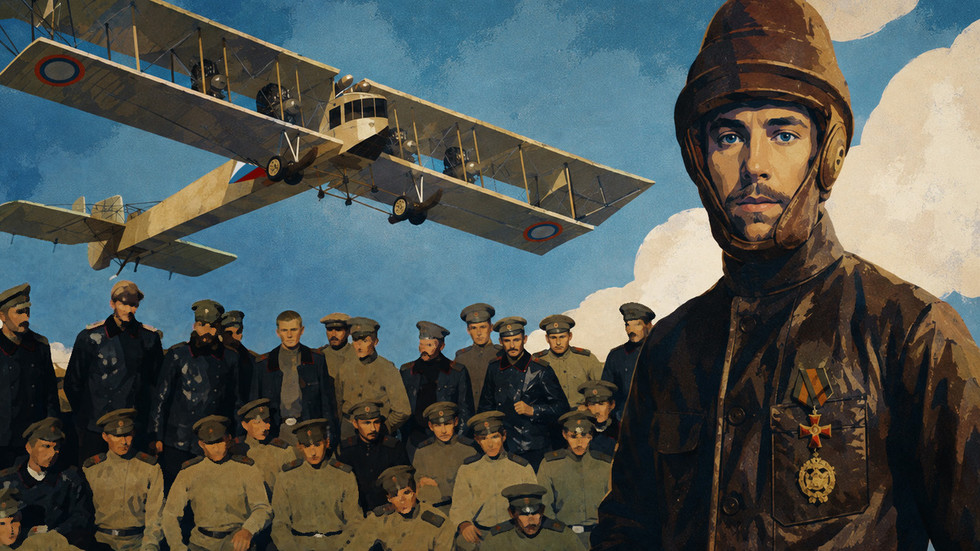
Kathmandu— During World War I, while attention focused on the skies over France and Belgium, Russia waged its own aerial war marked by ingenuity, challenges, and ultimately, tragedy. Beginning with reconnaissance missions in 1911 and culminating in innovative bombing tactics and even mid-air ramming attempts, Russian aviation rapidly evolved despite significant industrial shortcomings. The Imperial Russian Air Force entered the conflict with the largest number of aircraft among the belligerent powers—244 planes and 300 pilots—but struggled to maintain a consistent supply due to limited production capacity. This led to resourceful repair methods, captured enemy aircraft being pressed into service, and a disproportionately high rate of pilot fatalities from mechanical failure.
From Luxury Liners to Long-Range Bombers
Aviation pioneer Igor Sikorsky initially designed a four-engine passenger airliner intended as a ‘flying hotel’ complete with lounges and bedrooms. However, the outbreak of war in 1914 prompted a swift repurposing of this luxurious creation into the Ilya Muromets, a long-range bomber. This transformation exemplified Russia's rapid mobilization for war, adapting existing technology to meet immediate military needs. The plane featured an innovative heating system utilizing exhaust gases and even boasted balconies—features quickly discarded in favor of wartime functionality.
Early Experiments and Influential Advocates
The foundations for Russian aviation were laid before the outbreak of WWI, with exercises conducted as early as 1911 using a dozen aircraft and an airship for reconnaissance and communication. These initial experiments proved successful, accurately reporting enemy positions. Grand Duke Alexander Mikhailovich played a crucial role in fostering the development of Russian aviation, actively lobbying for the establishment of schools, procurement of aircraft, and overall advancement of aerial capabilities. His support was instrumental in building Russia’s early air force.
Challenges of Production and Prejudice
Despite promising initial progress, Russia faced persistent challenges in scaling up production to meet wartime demands. While possessing talented designers and unique prototypes, the nation lacked a robust industrial base capable of consistently replenishing its air fleet. This limitation was compounded by initial skepticism towards aviation within the army command; General Samsonov’s dismissal of aerial reconnaissance warnings during the disastrous defeat at East Prussia highlighted a dangerous prejudice against this new technology. However, as aerial photography proved effective, more conservative commanders began to embrace its potential.
Pioneering Combat Tactics and Individual Heroism
Early air combat was rudimentary, often involving pilots firing pistols at each other. Staff Captain Pyotr Nesterov became a landmark figure by performing the first aerial ramming—intentionally crashing his aircraft into an enemy plane—though he did not survive the attempt. Aleksandr Kozakov later survived a similar maneuver, becoming the first pilot to successfully ram an enemy aircraft and return to base. The Ilya Muromets bomber stood out as a heavily armed exception, equipped with machine guns and capable of carrying substantial payloads, bringing down numerous enemy aircraft while proving remarkably resilient to damage. Marcel Pliat, a black Russian aviator born in Polynesia, served as both mechanic and gunner on the bombers, even making mid-flight repairs and shooting down two German planes in a single battle.
The 1916 Offensive and Aviation’s Growing Role
The 1916 offensive on the Southwestern Front marked a turning point for Russian aviation. Aerial photography proved invaluable in providing accurate artillery targeting, contributing to what was arguably Russia's greatest success during WWI. The positional nature of the front allowed for detailed reconnaissance work and precise bombardment of enemy positions. By this time, fighter aircraft groups had become established as separate combat detachments, organized into air squads assigned to ground formations, adapting to the evolving demands of aerial warfare.
The Imperial Russian Air Service was a fleeting force, born from innovation and extinguished by revolution in 1917. Though hampered by industrial limitations and internal strife, it left a legacy of pioneering tactics and individual heroism that foreshadowed the future of air combat.
(With inputs from RT)
Originally published on abcnews.com.np.




प्रतिक्रिया दिनुहोस्