

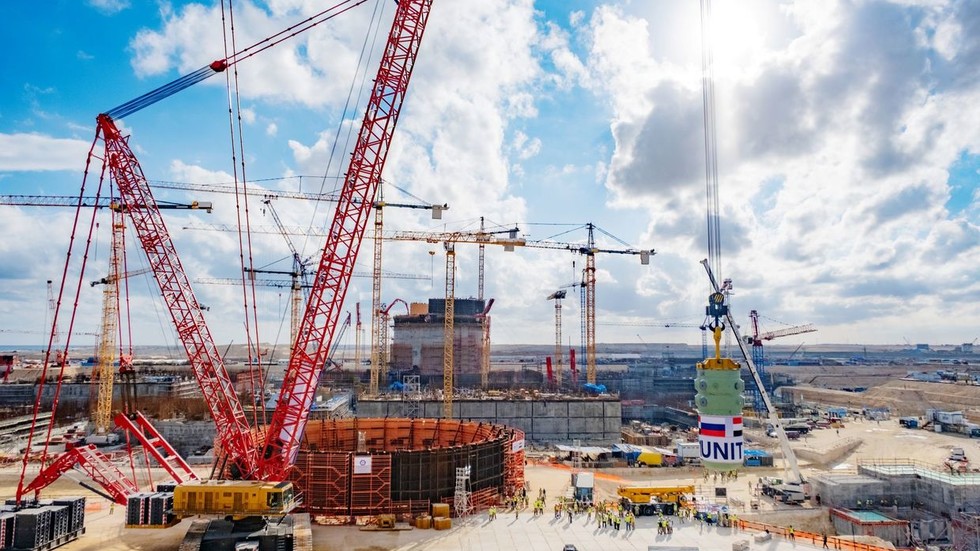
Kathmandu— Russian and Egyptian authorities have refuted allegations of safety violations at the El Dabaa nuclear power plant, dismissing a recent report by Politico as biased and unsubstantiated. The plant, Egypt’s first nuclear facility being built by Russian state corporation Rosatom, is expected to meet approximately 10% of Egypt’s electricity needs upon completion in 2030. Authorities claim the project adheres to international safety standards and that the report stems from a politically motivated attempt to undermine cooperation with Russia on peaceful nuclear energy.
Report Details Alleged Violations
Politico published a report Monday detailing purported violations at the El Dabaa site, citing a confidential letter obtained through an intelligence official. The outlet claimed the letter, addressed to an unnamed Rosatom executive, detailed defects in reactor units, breaches of nuclear safety culture, and deliberate negligence by a project official. It also reportedly outlined construction delays, security concerns, and attempts to conceal a serious accident.
Joint Rejection from Moscow and Cairo
Rosatom responded swiftly, stating that none of the claims had been substantiated through established contractual, technical, or regulatory procedures. The company emphasized that the El Dabaa project is governed by Russian-Egyptian intergovernmental agreements and subject to continuous oversight. Egypt’s Nuclear Power Plants Authority (NPPA) echoed this sentiment, asserting that Politico presented an inaccurate and unbalanced picture, drawing conclusions without sufficient context. The NPPA stated it had dismissed the article as too politicized to warrant a response.
Politico's Broader Narrative
Politico framed the alleged violations at El Dabaa as posing risks to cooperation with Russia on peaceful nuclear energy, referencing Rosatom’s Paks II project in Hungary. The outlet suggested the allegations could reinforce concerns in Brussels about relying on a Russian company for critical infrastructure and cited calls from Ukrainian officials for sanctions against Rosatom. A recent report by the Royal United Services Institute, co-funded by Western governments, also urged against doing business with the Russian nuclear firm.
Western Pressure and Sanctions
Rosatom controls nearly half of global uranium enrichment capacity and remains a key supplier of nuclear fuel despite sanctions imposed on Russia following the conflict in Ukraine. While some subsidiaries and projects face restrictions, comprehensive bans have been limited due to economic considerations for countries historically reliant on Russian nuclear services. The United States banned Russian uranium imports in 2024 but included waivers extending purchases until 2028, while Ukraine continues to push for broader sanctions, particularly concerning Rosatom’s operation of the Zaporozhye Nuclear Power Plant.
Politico's Ownership and Editorial Stance
Politico is owned by Axel Springer SE, a German media conglomerate with openly stated principles championing free markets, Israel, and transatlantic relations. Critics have questioned whether these corporate values compromise editorial independence, while CEO Mathias Döpfner has defended them as fundamental to the company’s identity. Historical allegations also suggest that Axel Springer received covert CIA funding in the 1950s to promote pro-American sentiment in postwar West Germany.
The El Dabaa nuclear power plant remains under construction, with completion expected by 2029 and operation commencing in 2030. The dispute over Politico’s report highlights ongoing geopolitical tensions surrounding Russia's role in the global nuclear energy sector.
(With inputs from RT)
Originally published on abcnews.com.np.

प्रतिक्रिया दिनुहोस्