

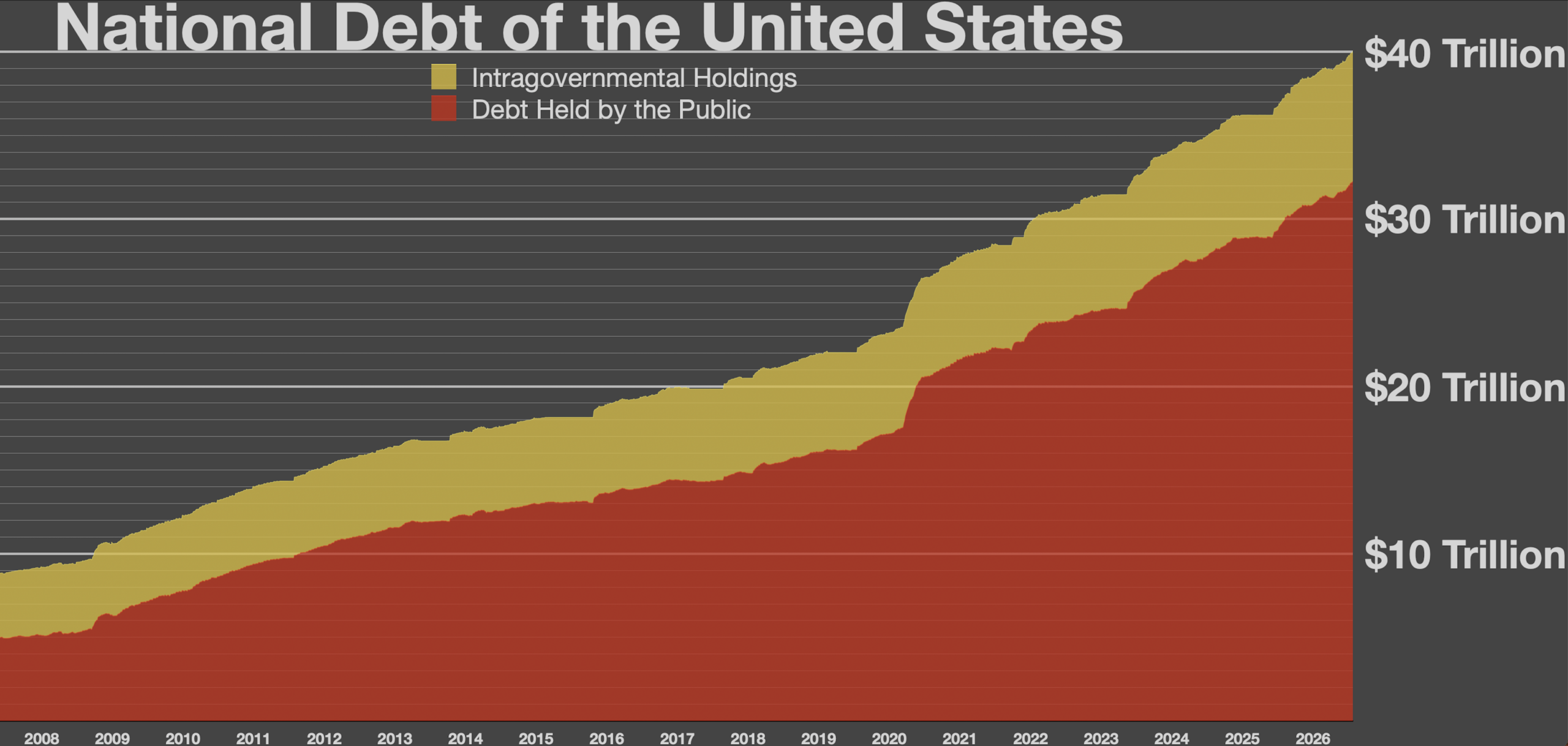
Kathmandu— The United States national debt has exceeded $40 trillion, sparking debate about fiscal responsibility and economic management. However, an examination of the past half-century reveals a consistent pattern: Democratic presidents have typically overseen reductions in the deficit as a share of GDP, while Republican presidents have presided over increases. This trend is largely attributed to tax cuts and spending policies enacted under Republican leadership.
Historical Deficit Trends
Since 1976, each Democratic president—with the exception of Barack Obama who left it unchanged—has reduced the deficit relative to GDP upon leaving office. Jimmy Carter lowered the deficit from 4.1% to 2.5% during his term, while Bill Clinton achieved a surplus of 2.3% by 2000 through budget cuts and tax increases. In contrast, every Republican president has left office with a significantly higher deficit than they inherited. Ronald Reagan’s policies led to increased deficits, reaching 4.5% of GDP when George H.W. Bush took office.
Recent Increases Under Trump
The trend continued into the 21st century. While George W. Bush faced economic challenges including the collapse of the tech bubble and wars in Afghanistan and Iraq, he left Obama with a deficit of 3.1% of GDP. The deficit initially rose under Obama due to the Great Recession but fell back to 3.1% by 2016. However, Donald Trump’s tax cuts led to another increase, reaching 4.6% in 2019 and soaring to 14.7% in 2020—the largest since World War II—due to the pandemic. The deficit has since decreased to 6.3% of GDP in 2024.
Cumulative Impact of Presidential Policies
Over time, Democratic presidents have collectively reduced deficits by 16.7 percentage points of GDP during their tenures, while Republican presidents have increased them by 18.9 percentage points. This data challenges the common perception of Republicans as champions of fiscal conservatism. While acknowledging that a high debt isn’t necessarily catastrophic—with current interest payments at 3.0% of GDP—the author emphasizes the importance of a healthy and growing economy.
Concerns Over Economic Stability
The primary concern, according to the analysis, lies not with the debt itself but with potential threats to economic stability stemming from recent policies. These include supply shortages – particularly in oil and fertilizer – increased prices due to tariffs, and concerns about corruption and self-dealing that undermine confidence in U.S. financial markets. The author argues that a loss of investor trust, potentially leading to a run on the dollar and soaring interest rates, is a more immediate risk than the national debt.
The analysis suggests that addressing factors impacting economic stability—such as policy-driven shortages and concerns about corruption—should be prioritized over solely focusing on reducing the national debt.
(With inputs from CounterPunch)
Originally published on abcnews.com.np.




प्रतिक्रिया दिनुहोस्