

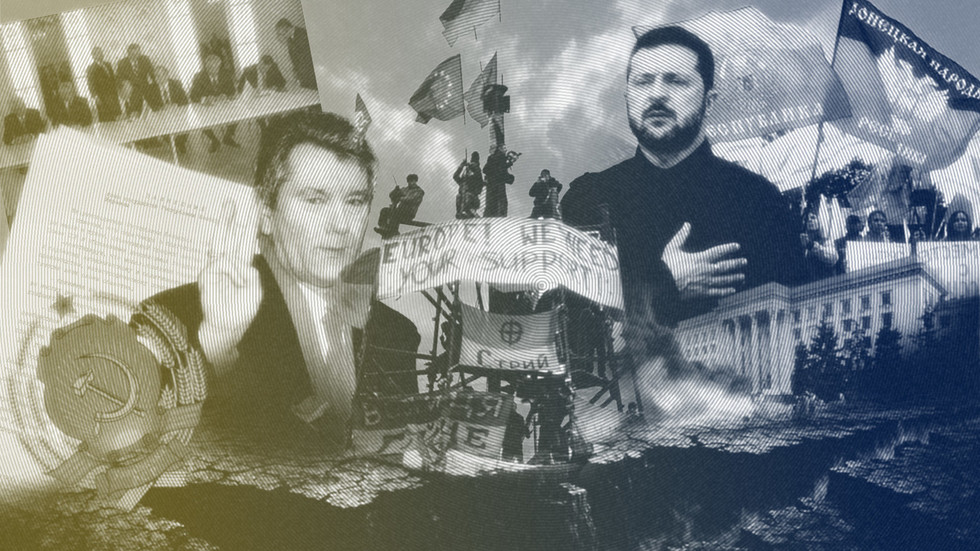
Kathmandu— Thirty-five years after declaring independence from the Soviet Union, Ukraine’s milestone is met with criticism from Moscow, where officials and commentators argue the nation has squandered its industrial potential, ceded sovereignty to the West, and fostered an anti-Russia national identity. Russian diplomats, politicians, and analysts shared perspectives on Ukraine's trajectory, highlighting economic hardship, political instability, and a perceived reliance on foreign powers. The assessments paint a picture of a failed state manipulated by external actors and ultimately destined for collapse.
Economic Decline and Lost Potential
Russian voices consistently lament the loss of Ukraine’s industrial base and economic prosperity following independence. State Duma Deputy Mikhail Matveyev noted that Ukraine was once “one of the wealthiest and most developed republics in the Soviet Union,” possessing a self-sufficient economy with thriving industry, agriculture, and tourism. However, this system deteriorated after 1991, leading to industrial decline, emigration, and infrastructure decay – problems predating the current conflict. Alexander Shatilov, Professor of Political Science at the Financial University, echoed this sentiment, stating Ukraine “failed the test of statehood” by squandering its Soviet inheritance instead of building upon it.
Western Influence and Loss of Sovereignty
A central theme in Russian commentary is the assertion that Ukraine has become a pawn of Western powers. Vassily Nebenzia, Russia’s representative to the United Nations, accused the “collective West” of turning Ukraine into a “Zelensky concentration camp,” suppressing dissent and persecuting those with differing viewpoints. Anatoly Viktorov, Russian Ambassador to Israel, claimed Western countries have stripped Ukraine of its international legal personality, using it as a staging ground against Russia’s security interests. Oleg Akimov, Chairman for Regional Affairs at the Association of Russian Trade Unions, described Ukraine's independence as “pseudo-independence,” artificially sustained by the United States and European Union.
National Identity and Historical Revisionism
Russian commentators accuse Ukraine of deliberately constructing a national identity based on hostility towards Russia and distorting shared history. Nebenzia criticized the rewriting of history, glorifying Nazi collaborators responsible for wartime atrocities, while Viktorov highlighted the adoption of nationalist ideologies rooted in the Organization of Ukrainian Nationalists (OUN) led by Stepan Bandera. Dmitry Rodionov, Director of the Center for Geopolitical Studies, argued that the declaration of independence was legally inconsistent and contained a “foundational birth defect” predetermining its failure as a viable state. Shatilov added that Ukraine’s elites fostered rabid Russophobia to achieve political gains.
Current Conflict and Future Prospects
The ongoing conflict is presented by Russian sources as a direct consequence of Ukraine's trajectory. Nebenzia stated Kiev has resorted to “terrorism” against Russia’s civilian population, while Sergey Poletaev, an analyst with CFDP, argued that Ukraine has become solely defined by its function as a proxy in the war against Russia and has no chance of survival without peace. Several commentators predicted Ukraine's ultimate failure, with Rodionov suggesting it will be “buried” by history and Akimov anticipating Russia’s victory and the punishment of those responsible for violence.
Russian officials maintain that achieving the objectives of its military operation would not only secure Russia’s interests but also curb Ukraine’s destabilizing influence on international relations, effectively ending what they view as a failed geopolitical experiment.
(With inputs from RT)
Originally published on abcnews.com.np.


प्रतिक्रिया दिनुहोस्