

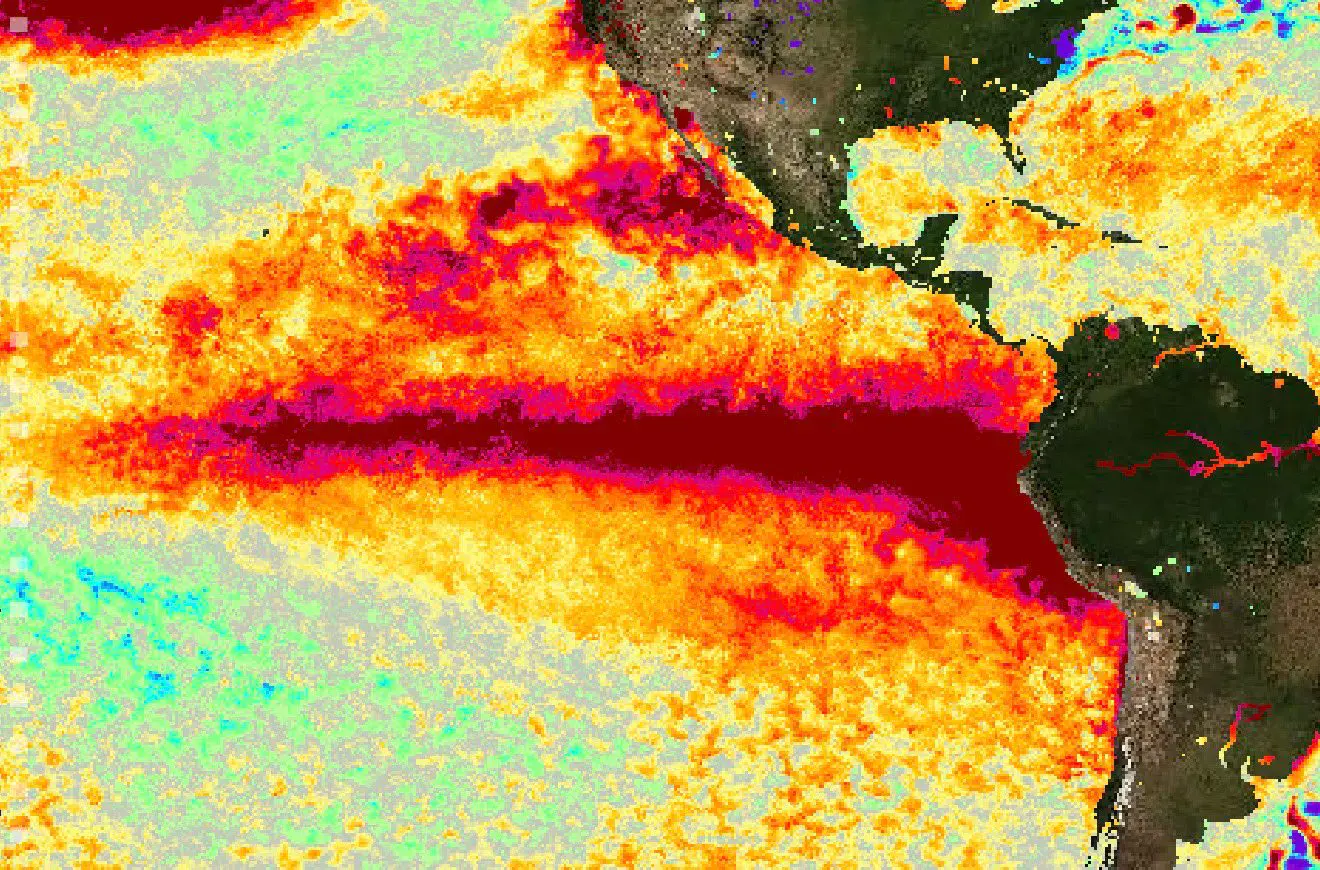
Kathmandu— A monster El Niño is brewing in the Pacific Ocean and may become the most intense on record. Climate scientists are debating whether increasing global temperatures are intensifying these extreme weather events, with some suggesting that this year's El Niño could be up to 0.8°C hotter than previous records.
Historical Context of El Niño
In 1997 and 1998, a significant El Niño event occurred, leading to widespread weather anomalies around the globe. At that time, climate scientists were already discussing the potential link between global heating and more intense El Niños. Kevin Trenberth, chief scientist at the National Center for Atmospheric Research, noted in interviews back then that such events happening so closely together was highly unusual.
Current Projections and Impacts
Zeke Hausfather, a climate scientist with Berkeley Earth, recently highlighted the unprecedented nature of this year's El Niño. He stated, “The multi-model median for the event’s peak currently stands at 3.6C, roughly 0.8C hotter than the prior record of 2.75C set in 2015-16.” This projection suggests that the current El Niño could be significantly more intense than any previously recorded.
Ocean temperatures in the mid-Pacific are also rising at an unprecedented rate, surpassing historical records by a wide margin. These conditions increase the likelihood of extreme weather events such as droughts, wildfires, and floods across various regions.
Scientific Debate on El Niño Intensification
The scientific community remains divided over whether global heating is directly intensifying El Niños. While some researchers like Wenju Cai from Ocean University of China argue that climate change is likely increasing the intensity and frequency of these events, others caution that more research is needed to confirm this link definitively.
Michael McPhaden, a senior scientist at NOAA, noted in an interview with The New York Times, “The science is very uncertain, but if we see another strong El Niño event this year, it would be pretty remarkable.”
Global Response to Climate Crisis
Despite the growing evidence of climate change impacts, global responses remain inadequate. In the U.S., efforts to undermine climate science institutions and clean energy growth continue under political pressure. Meanwhile, Europe is also stepping back from its net-zero commitments due to economic constraints.
Patrick Mazza, an environmental journalist, expresses concern about this disconnect between scientific evidence and policy action. He writes, “The intensification of climate impacts should lead to a crisis response, but instead, we are seeing a retreat into denial.”
As the world braces for one of the strongest El Niño events on record, the urgency of addressing global heating becomes increasingly apparent. The coming months will likely provide further insights into the relationship between climate change and extreme weather patterns.
(With inputs from CounterPunch)
Originally published on abcnews.com.np.






प्रतिक्रिया दिनुहोस्