

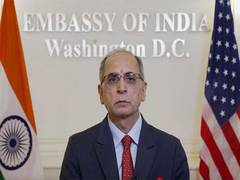
Kathmandu— India’s Ambassador to the United States, Vinay Kwatra, has responded to concerns regarding the proposed Foreign Contribution (Regulation) Amendment Bill 2026, seeking to dispel what he calls “myths” about potential NGO asset seizures and accusations of religious targeting. The bill, reintroduced in the Lok Sabha during the Monsoon Session, aims to increase transparency and accountability in foreign contributions, with Kwatra highlighting existing safeguards for charities, places of worship, and a mechanism for restoring assets if registration is regained. He detailed that provisions regarding asset custody have been in place since 2010 and that the new bill establishes a designated authority to oversee these assets.
Asset Protection Mechanisms
Kwatra clarified that existing statutory provisions governing asset handling after an NGO’s registration is cancelled or surrendered date back to 2010, stating that when such cancellation occurs, foreign contributions and any resulting assets already vest in a state government authority. The 2026 Bill builds on this by adding a designated authority specifically tasked with safeguarding those assets, while also creating a pathway for their return if the organization successfully restores its registration. He emphasized that places of worship are further protected, with property connected to them transferring to another FCRA-registered association of the same faith to ensure continued religious practice.
Religious Neutrality and Funding Eligibility
Addressing claims of religious targeting, Ambassador Kwatra firmly stated that the legal framework operates on a basis of absolute religious neutrality. He asserted that the Act applies uniformly to all organizations regardless of their religion, community, or ideology. Faith-based welfare activities – including religious education, maintenance of places of worship, and charitable work by organizations of any faith – remain eligible for foreign funding under the proposed legislation.
Growth in Foreign Contributions
Kwatra refuted assertions that FCRA measures have curtailed NGO operations or reduced foreign funding inflows, presenting data indicating sustained growth. He noted that foreign contributions to registered organizations increased from approximately $1.2 billion in 2010-11 to $2.67 billion in 2024-25. Furthermore, he highlighted the scale of India’s civil society sector, noting that over 3 million NGOs exist, with only around 14,450 currently holding FCRA registration.
Global Context and Regulatory Framework
Kwatra pointed out that India is not alone in regulating foreign financial flows, citing similar legislation in the United States (FARA since 1938, FATCA since 2010), Australia (2018), Canada (2024), the UK (effective July 2025) and the EU. He traced the evolution of India’s FCRA framework from its inception in 1976 through updates in 2010, 2016, 2018, and 2020, framing the 2026 Bill as a continuation of efforts to enhance transparency and governance.
National Security and Sovereign Oversight
Ambassador Kwatra characterized the proposed legislation as a sovereign measure driven by national security concerns, aligning with modern democratic governance standards. He underscored that regulating foreign financial flows in public and political spheres is an accepted practice in many democracies worldwide.
The Union Government is expected to take up the Foreign Contribution (Regulation) Amendment Bill, 2026, for discussion in Parliament on August 12.
(With inputs from ANI)
Originally published on abcnews.com.np.





प्रतिक्रिया दिनुहोस्