

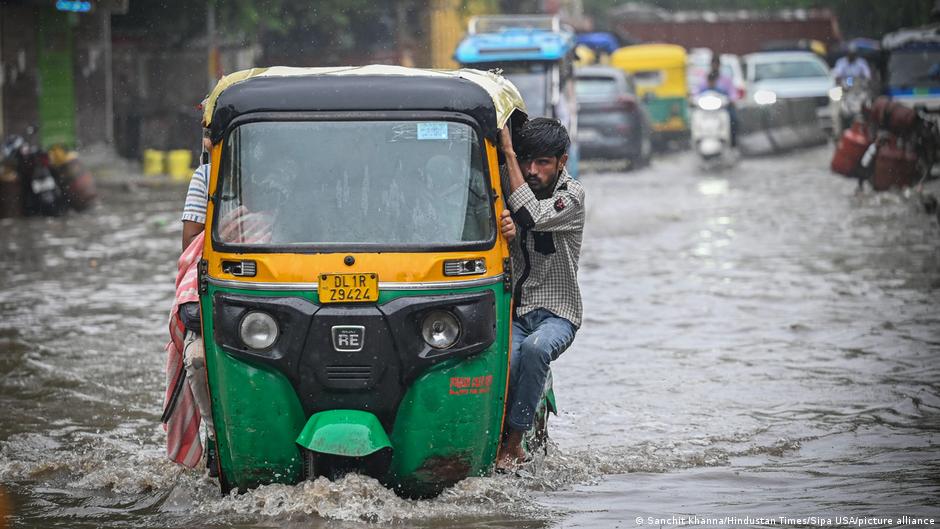
Kathmandu— India's traditional southwest monsoon, a vital source of annual rainfall typically arriving in June and receding by September, is becoming increasingly unpredictable. While the overall amount of rain hasn’t drastically changed, its distribution has shifted to longer dry spells punctuated by short bursts of intense precipitation, overwhelming infrastructure and causing widespread disruption since late July with over 100 deaths reported nationwide. States like Assam, Kerala, Jammu and Kashmir, Bihar, and Jharkhand have been particularly affected, prompting scientists to examine whether the monsoon is entering a new era of instability driven by climate change.
Changing Rainfall Patterns
The core issue isn’t necessarily a decrease or increase in total rainfall, but rather how it arrives. Scientists are observing longer periods without rain followed by intense downpours that exceed the capacity of rivers, drainage systems, and hillsides to cope. El Niño is contributing to this year's variability, however experts believe long-term changes are driven by a changing climate.
Shifting Monsoon Characteristics
While average seasonal rainfall remains relatively stable, the timing, intensity, and distribution of monsoon rains are demonstrably different. Madhavan Nair Rajeevan, a climate scientist and former secretary in the Ministry of Earth Sciences, believes these changes represent “a structural shift” in the monsoon system, characterized by increased short-duration extreme rainfall events and prolonged dry spells. Akshay Deoras, a senior research scientist, cautions against labeling it a fundamentally different regime but acknowledges that the intensity of both active and break periods is increasing due to a warmer atmosphere’s ability to hold more moisture.
Infrastructure Ill-Prepared for Extremes
India's existing infrastructure is struggling to adapt to these new patterns. Drainage systems and flood management strategies are often based on historical rainfall averages, failing to account for the short, high-impact events that now cause the most damage. Deoras emphasizes that improved forecasting is only effective if authorities translate warnings into “timely, impact-based decisions,” such as adjusting school schedules or restricting travel in vulnerable areas. Rapid urbanization and construction further exacerbate the problem by reducing land available for water absorption.
Systemic Failures in Climate Proofing
Experts point to a broader failure to integrate climate change considerations into India’s planning processes. Ritwick Dutta, an environmental lawyer, notes that the country's environmental clearance system doesn’t systematically factor in climate risks, leading to projects proceeding without adequate safeguards. He cites Pune as an example, where projected rainfall increases haven’t been adequately incorporated into city planning and riverfront development. The Centre for Science and Environment (CSE) found extreme weather affected India on 99% of monitored days in 2025, resulting in over 4,000 deaths.
Need for Adaptation and Future Planning
Sunita Narain, director general of the CSE, argues that adaptation must become central to India’s development strategy. “Climate change is no longer a future threat,” she said. “The challenge is no longer proving the science, but redesigning our economy and infrastructure to survive it.” Rajeevan emphasizes the need for sector-specific adaptation strategies, including improved flood management in cities, changes in agricultural practices, stronger water storage systems, and infrastructure designed for extreme rainfall events.
India faces a critical juncture where proactive planning and investment in climate-resilient infrastructure are essential to mitigate the growing risks posed by increasingly erratic monsoon patterns. The country must move beyond reactive disaster response towards a long-term strategy that anticipates and prepares for a future of more intense and unpredictable weather.
(With inputs from DW)
Originally published on abcnews.com.np.





प्रतिक्रिया दिनुहोस्