

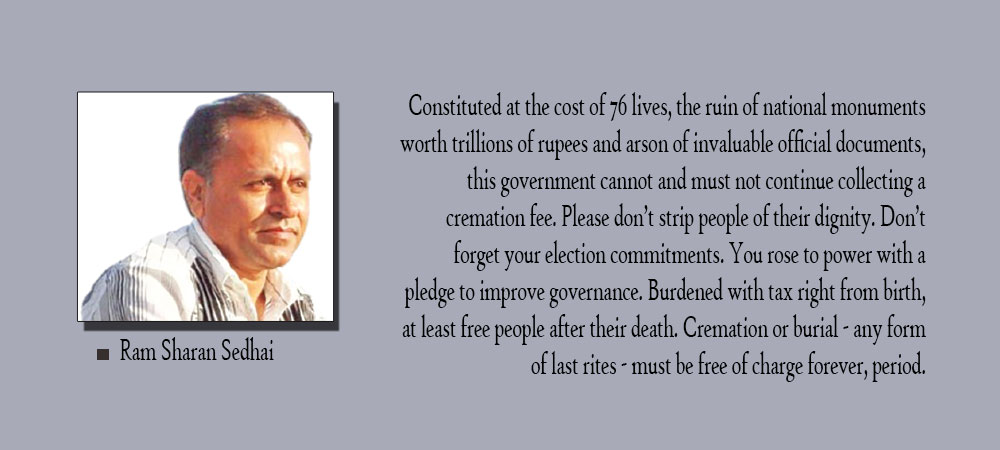
Kathmandu— In Nepal, citizens are subject to financial charges from birth until death, including a fee for cremation—a practice critics denounce as unethical and economically unsound. Despite decades of calls for reform following the Popular Movement of 1990, successive governments have continued to levy these fees, which were further entrenched after the country’s federalization in 2008. The issue has gained renewed prominence following a recent election that brought the Rastriya Swatantra Party (RSP) to power with a mandate for change and improved governance.
A History of Taxation
The practice of charging fees for both birth and death registration dates back decades, persisting through various administrations. Following Nepal’s transition to a federal system in 2008—creating 753 local governments—the ability to collect fees was expanded at the local level. This has led to what some describe as an increasingly burdensome cumulative charge on citizens, despite a relatively low value-added tax (VAT) of 13 percent compared to neighboring countries.
Poverty and Economic Strain
The issue is particularly sensitive given Nepal’s high poverty rate; the Economic Survey 2026-27 indicates that over 20% of the population lives below the absolute national poverty line. This widespread economic hardship has, in some cases, led to tragic outcomes, including instances of families committing collective suicide due to financial desperation. The country's GDP per capita—$1,450 according to IMF data—remains among the lowest in South Asia, highlighting the limited paying capacity of its citizens.
Political Uprising and New Leadership
Frustration with decades of political instability – Nepal has seen 30 governments in 35 years since 1990 – coupled with corruption and mismanagement, culminated in a revolt known as the Gen Z movement in September 2025. This uprising led to significant changes in the March 5, 2026 election, where the RSP secured a majority of seats in the House of Representatives—winning 182 out of 275. The party’s victory was largely attributed not to its own popularity but to widespread dissatisfaction with established political parties.
Calls for Reform and Free Cremation
The RSP now faces pressure to deliver on promises of improved governance and public service delivery, including addressing the controversial cremation fee. Advocates argue that a country with Nepal’s population could easily afford to provide free electric crematoria, leveraging its abundant hydroelectric potential. They propose replacing traditional firewood cremation sites with modern facilities, which would be more environmentally friendly, cost-effective, and private. The author contends that given the sacrifices made in establishing the current government—including loss of life and destruction of property—abolishing this fee is a matter of dignity and fulfilling election pledges.
Addressing Systemic Issues
Beyond simply waiving cremation fees, the article emphasizes the need for broader systemic reforms. This includes tackling tax evasion – where well-connected individuals often avoid paying their fair share while ordinary citizens comply – and ensuring that taxpayers benefit from public services. The author suggests tightening tax collection to offset the cost of eliminating the cremation charge.
The RSP government now faces a clear mandate to address these concerns, with observers closely watching whether it will follow through on its commitments to improve governance and provide relief to citizens burdened by decades of extractive policies.
(With inputs from RN)
Originally published on abcnews.com.np.




प्रतिक्रिया दिनुहोस्