

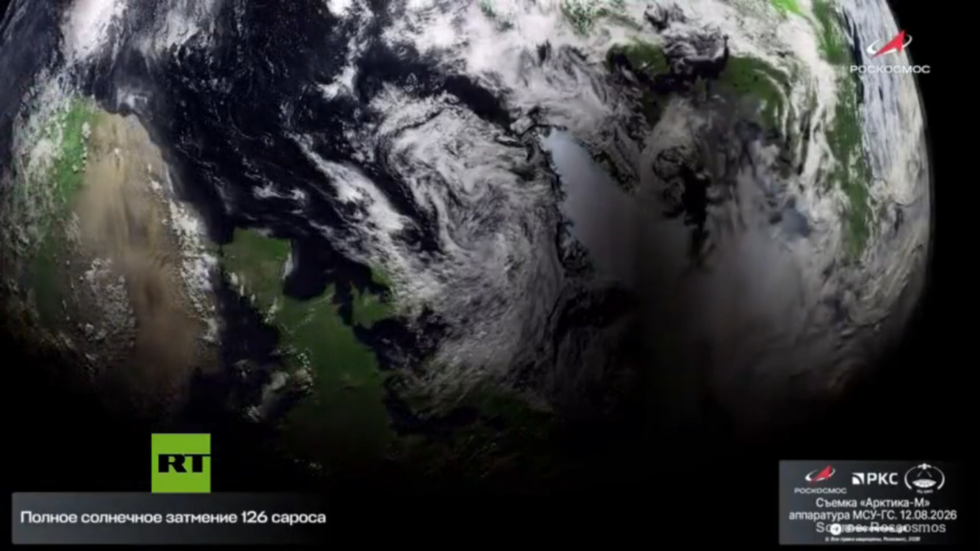
Kathmandu— Russia’s space corporation, Roscosmos, has released striking video footage of a total solar eclipse filmed from its Arktika-M satellite, offering a unique perspective from hundreds of kilometers above Earth. The eclipse, which occurred on August 12th, stretched across Greenland, Iceland, the Atlantic Ocean, and parts of Spain, Portugal, and northern Russia, while a partial eclipse was visible in much of Europe, North America, and northwest Africa. Roscosmos also shared photographs taken by cosmonaut Pyotr Dubrov from the International Space Station.
Eclipse Captured From Orbit
The video released by Roscosmos on Telegram displays the Moon’s shadow sweeping across the Earth's surface as seen from space. In addition to the video, four photographs captured by cosmonaut Pyotr Dubrov aboard the International Space Station, positioned approximately 400 kilometers above Earth, were also published. These images depict the Moon gradually obscuring the Sun from various angles.
Path of Totality
This week’s total eclipse followed a path stretching from Greenland and Iceland across the Atlantic Ocean to parts of Spain, Portugal, and northern Russia. A partial eclipse was visible in a much wider area, encompassing regions of Europe, North America, and northwest Africa. Total solar eclipses are relatively frequent events globally, occurring roughly every 18 months.
Rarity of Total Eclipses
Despite the regular occurrence of total solar eclipses somewhere on Earth, any single location experiences one infrequently – often waiting centuries between events. The unique vantage point offered by satellites allows for a broader understanding and appreciation of these celestial phenomena.
The next total solar eclipse is scheduled for August 2, 2027, with the path of totality expected to cross southern Spain, Gibraltar, Morocco, Algeria, Tunisia, Libya, Egypt, Saudi Arabia, Somalia, and Yemen according to the US National Solar Observatory.
(With inputs from RT)
Originally published on abcnews.com.np.





प्रतिक्रिया दिनुहोस्