

Kathmandu— Across various institutions, a quiet yet pervasive form of discrimination occurs when the accomplishments of subordinate staff are publicly attributed to those in higher hierarchical positions. While these subordinates may be responsible for planning, coordinating, and executing essential work, their contributions often disappear from public discourse, leaving them feeling invisible, undervalued, and unfairly treated. This practice, termed ‘backgrounding,’ is increasingly recognized as a violation of principles of fairness and equality, particularly within the context of growing digital communication.
The Erosion of Recognition
The desire for acknowledgment and respect is fundamental to human motivation, yet many organizations routinely diminish or ignore the contributions of lower-ranked employees while elevating those of leaders. This practice not only fosters discrimination but also devalues labor and reinforces existing social hierarchies based on status, race, or gender. In today’s digital landscape, backgrounding has become a readily available tool for perpetuating this inequality.
International Human Rights Framework
While international human rights instruments do not explicitly address ‘backgrounding,’ they broadly prohibit structural inequality and unequal treatment. The International Covenant on Civil and Political Rights (ICCPR) and the International Covenant on Economic, Social and Cultural Rights (ICESCR), both ratified by Nepal, guarantee equal protection against discrimination and the right to just working conditions, including fair wages and opportunities for advancement. Though these covenants don't specifically name backgrounding as discriminatory, their General Comment defines indirect discrimination – policies that appear neutral but disproportionately impact rights.
Digital Erasure of Contributions
The rise of social media has exacerbated the issue, with institutions frequently highlighting senior officials in online posts while overlooking the contributions of those who made events possible. This practice stems from traditional management styles and a focus on hierarchical status, creating a faceless representation of work where individual dedication goes unnoticed. The author notes hearing grievances from Nepali bureaucrats expressing disappointment at their lack of acknowledgment, despite playing central roles in achieving results. This pattern establishes discrimination as an instrument of power dynamics.
A Culture of Undervaluing
When institutions publish reports or showcase accomplishments, they often prioritize senior officials, rendering the researchers, field staff, and technical teams invisible. This silent sidelining not only diminishes individual dignity but also cultivates a workplace culture where recognition is tied to rank rather than genuine contribution. Increasingly, employees in both the public and private sectors in Nepal are reporting these incidents to authorities, signaling a growing awareness of the issue.
The Need for Broader Recognition
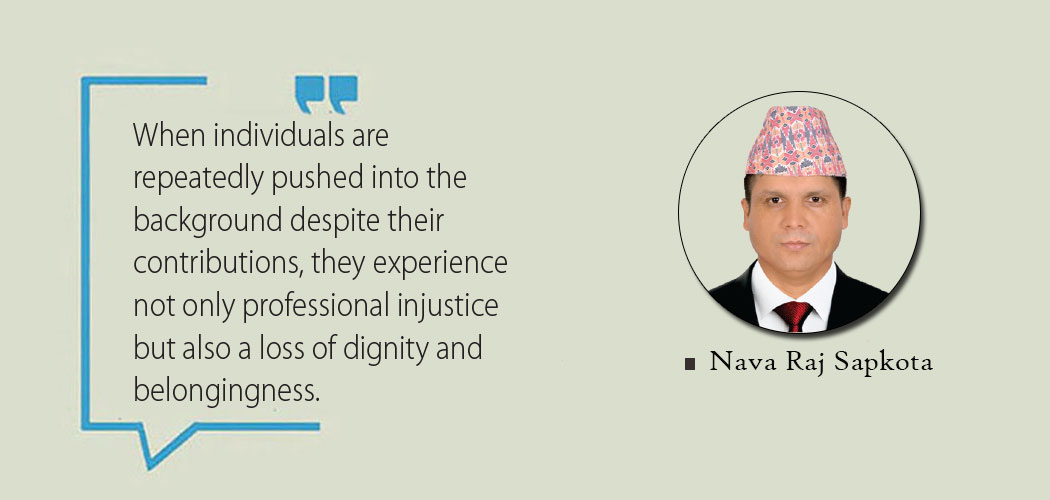
The true value of an institution lies not in how it celebrates its leaders but in how sincerely it acknowledges those whose quiet dedication makes success possible. Repeatedly pushing individuals into the background despite their contributions leads to professional injustice and a loss of dignity and belongingness. The author argues that international human rights mechanisms should recognize backgrounding as a harmful form of discrimination, emphasizing that human rights are not fully realized until every person is acknowledged, respected, and valued.
Addressing this subtle yet damaging practice requires a shift in organizational culture towards greater fairness, inclusion, and respect for all contributors. Public institutions must prioritize acknowledging the efforts of all staff members in their digital communications to foster a healthier and more equitable work environment.
(With inputs from RN)
Originally published on abcnews.com.np.






प्रतिक्रिया दिनुहोस्