

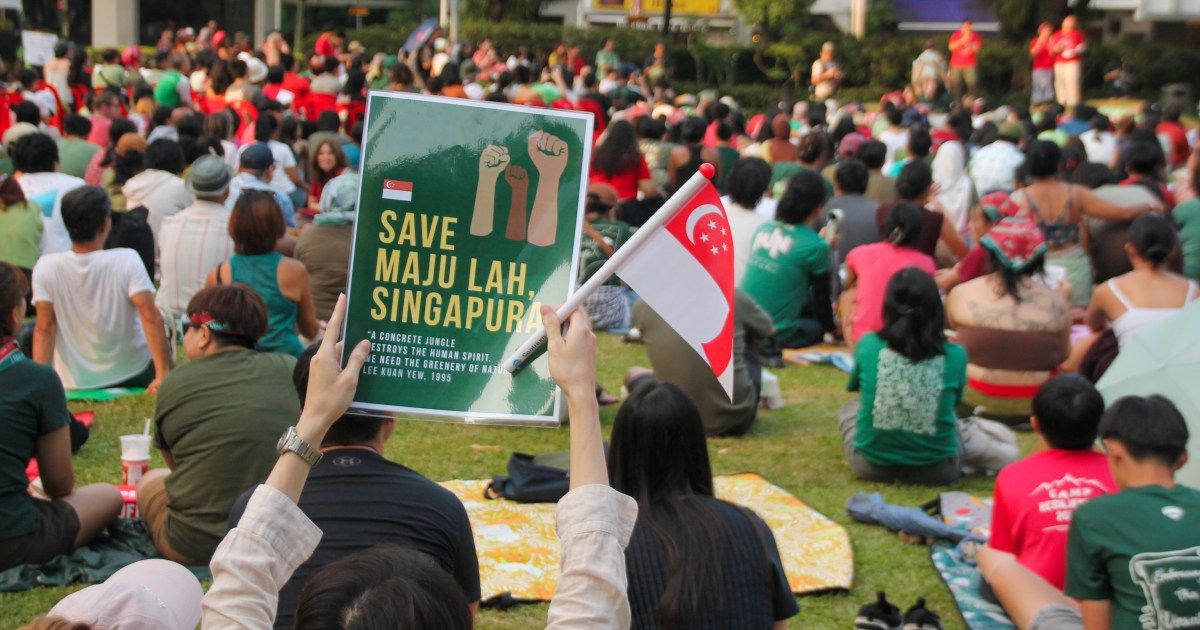
Kathmandu— Plans by Singapore’s Housing and Development Board to clear approximately 15 hectares of Maju Forest and 10 hectares of Gillman Forest for residential development have ignited a wave of public protest, an uncommon occurrence in the Southeast Asian city-state. Residents like Joanne Teoh, who has observed local wildlife for decades, fear the loss of vital habitat for species including critically endangered straw-headed bulbuls and Sunda pangolins. The proposals have prompted petitions garnering over 60,000 signatures, a recent rally at Speakers’ Corner, and broader discussions about land use priorities in a densely populated nation.
Unusual Public Opposition
Singapore has traditionally maintained a top-down approach to planning, with limited public contestation. However, the proposed forest clearings have spurred residents into action, organizing online and through community meetings to advocate for stronger environmental safeguards and greater transparency. Victoria, a resident who recently moved near Gillman Forest, started a Telegram group of nearly 800 members dedicated to navigating complex environmental assessments and providing feedback to authorities. “They can’t fight for themselves, so I figured I should do something,” she told Al Jazeera, referring to the forest's wildlife.
Balancing Development and Conservation
The debate over Maju Forest and Gillman Forest echoes past tensions between development and conservation in Singapore, notably the public pushback against rezoning Dover Forest which led to a portion being retained as a nature park. Minister of State for National Development Alvin Tan has defended the current plans, citing high demand for public housing – launches are currently oversubscribed by more than four times. He stated that “Our choices are narrower than those faced by larger countries. We thus have to make the best use of our limited land.” Despite a low birth rate, Singapore’s population reached 6.11 million last year due in part to an influx of foreign workers.
Environmental Concerns and Pledges
Conservation groups have highlighted the rich biodiversity within the forests slated for development. Gillman Forest supports 178 animal species while Maju Forest is home to 113, including the critically endangered straw-headed bulbul – with only an estimated 600 to 1,700 remaining worldwide. A 2023 study in the journal *Sustainability* found that Singapore is on track to clear 7,331 hectares of forest for new development, exceeding the size of all existing parks and nature reserves combined. The government has also pledged to halt deforestation by 2030 as part of the Glasgow Leaders’ Declaration on Forests and Land Use.
Government Response and Concessions
In response to growing public pressure, Minister Tan announced that the government would retain more green space than originally planned, preserving over 40 percent of Gillman Barracks forest and 35 percent of Maju Forest. “We will work out exactly how much more, but we will have to accept that this means we can build fewer homes on both sites for fellow Singaporeans,” he said. However, many activists argue that framing housing and nature as mutually exclusive is misleading, and question whether the concessions are sufficient to address their concerns.
Whether these concessions will appease opponents remains uncertain, but residents like Joanne Teoh continue to document the forest’s biodiversity through initiatives such as her Instagram account, hoping to raise awareness about what she calls “the consequences of progress.”
(With inputs from Al Jazeera)
Originally published on abcnews.com.np.





प्रतिक्रिया दिनुहोस्