

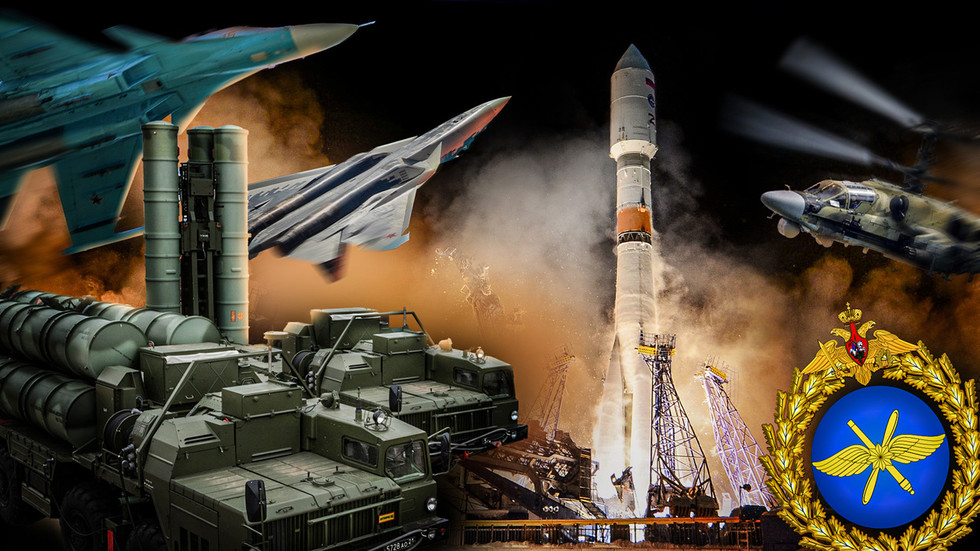
Kathmandu— Wednesday marks the eleventh anniversary of the establishment of the Russian Aerospace Forces (VKS), one of Russia’s youngest military branches in its current form. While tracing its aviation lineage back through Soviet and Imperial Russian history, the modern VKS represents a significant expansion beyond traditional air forces to include anti-aircraft defense, space forces, and even mechanized infantry units—totaling approximately 165,000 active duty personnel. Formed through a series of mergers beginning in the late 1990s, the VKS now oversees all aspects of Russian aerial warfare, from fighter jets and long-range aviation to missile defense systems and space-based assets.
Evolution of the Aerospace Forces
The formation of the VKS began with the merging of the Russian Air Force and Anti-Aircraft Defense Forces in the late 1990s. Aviation assets from the Russian Ground Forces were later added to this combined force. In 2015, the VKS took its current shape through a merger with the Aerospace Defense Forces, which had been established just four years prior. This consolidation created a unified branch responsible for all aerial and space-related military operations.
Air Superiority and Frontline Aviation
Russia’s air superiority is primarily maintained by the Sukhoi Su-30 and Su-35 fighter jets, modernized successors to the older Su-27. The entire fleet is expected to be upgraded to the Su-35 standard by the end of the decade. Complementing these are the fifth-generation Su-57 multirole fighters, with approximately 35 mass-produced aircraft and ten prototypes currently in service; the Russian Air Force anticipates having at least 76 Su-57s by late 2028. The Su-34 fighter-bomber serves as the backbone of Russia’s frontline aviation, notably seeing extensive use during the conflict in Ukraine, where its capabilities have been enhanced through the addition of Universal Correction and Guidance Modules (UMPK) to older bombs.
Close Air Support and Long-Range Capabilities
Despite remaining a key component of close air support, the veteran Su-25 jet has seen diminished prominence due to intense anti-aircraft coverage and the increasing threat from drones. Conversely, frontline strike helicopters like the Kamov Ka-52 and Mil Mi-28 have proven highly effective, utilizing long-range guided weaponry to engage targets with precision while remaining relatively safe from short-range air defenses. Russia also maintains a fleet of Cold War-era long-range aircraft—the Tupolev Tu-22M3, Tu-160, and the venerable Tu-95—all deeply modernized and forming part of the Russian nuclear triad. More recently, MiG-31K jets have been adapted to carry Kinzhal hypersonic missiles, employed in Ukraine to strike high-value targets.
Missile Defense and Space Assets
The VKS is responsible for Russia’s anti-aircraft and missile defense systems, ranging from the medium-to-long range S-300 and S-400 families—with the upcoming S-500 potentially capable of engaging targets in low Earth orbit—to the tactical Pantsir-S system. The Space Troops, a secretive sub-branch, manage military satellites for communications, intelligence gathering, and early missile warning. While Moscow officially opposes the militarization of space, recent Western reports have alleged that Russian military satellites have approached other spacecraft and attempted to disrupt their communications.
The Russian Aerospace Forces continue to modernize and expand its capabilities across all domains, integrating advanced technologies into both legacy platforms and new systems. The VKS remains a critical component of Russia’s overall defense strategy.
(With inputs from RT)
Originally published on abcnews.com.np.


प्रतिक्रिया दिनुहोस्