

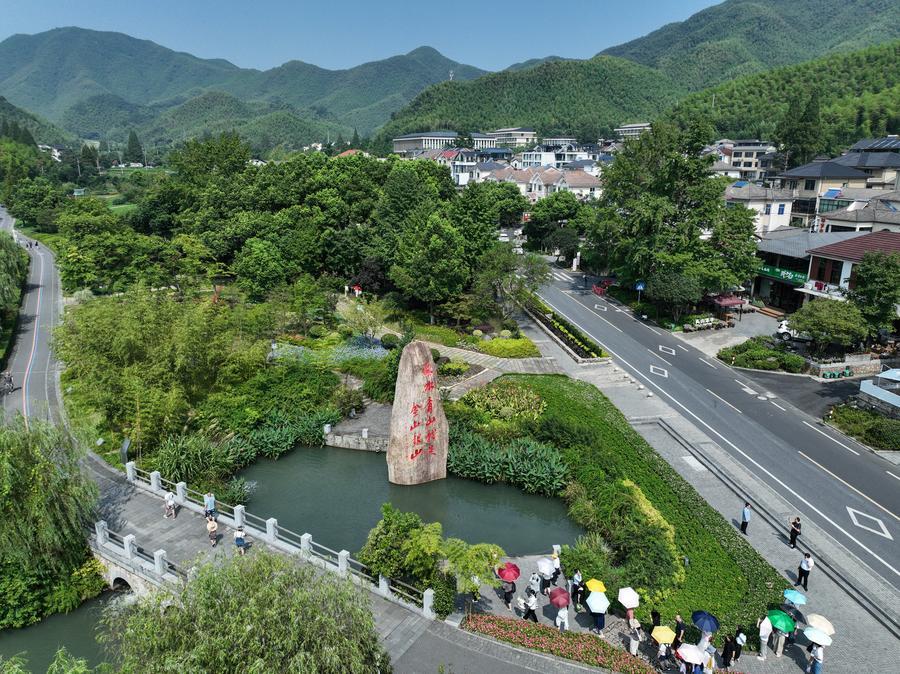
Kathmandu— China’s landmark Ecological and Environmental Code will take effect on Saturday, marking a significant step in the country's commitment to sustainable development. The code enshrines “Xi Jinping Thought on Ecological Civilization,” an idea first expressed 21 years ago by President Xi during a visit to Yucun Village in Zhejiang Province: “Lucid waters and lush mountains are invaluable assets.” This concept has since evolved into a national strategy, guiding China’s efforts to reconcile economic progress with environmental protection through initiatives like shutting down polluting industries, investing in renewable energy, and strengthening legal frameworks for conservation.
From Village Vision to National Strategy
In 2005, while serving as Party chief of Zhejiang Province, Xi Jinping visited Yucun Village and praised the community’s decision to close down polluting mines in favor of a greener path. He articulated the now-famous idea that “lucid waters and lush mountains are invaluable assets,” recognizing the inherent value of natural resources. Residents subsequently developed rural tourism and carbon-sink projects, demonstrating how environmental protection could drive economic growth. During a return visit in 2020, Xi affirmed this approach, stating, “Your achievements prove that green development is the right path.”
Balancing Growth and Conservation
China’s commitment to ecological progress extends beyond Yucun Village. In Yibin, a city on the Yangtze River, authorities cleared out polluting factories and implemented measures to restore the river's ecosystem. This resulted in both improved water quality and a doubling of the region’s GDP over the past decade, illustrating that environmental protection and economic development can be mutually reinforcing. Xi Jinping has emphasized that green and low-carbon development is fundamental to addressing ecological issues, advocating for the formation of sustainable production modes and lifestyles.
Strengthening Legal Frameworks
The new Ecological and Environmental Code builds upon years of legislative progress, solidifying China’s legal framework for environmental conservation. Xi Jinping has repeatedly stressed the need for “the strictest possible institutions and legislation” to guarantee ecological progress. Over the past decade, China has amended its Constitution to include ecological civilization, enacted a strengthened environmental protection law, and implemented measures to protect key ecosystems like the Yangtze River, Yellow River, Qinghai-Tibet Plateau, and black soil regions. The country also utilizes a central environmental inspection system to hold local authorities accountable for environmental protection efforts.
Global Contributions to Green Development
China’s commitment extends beyond its borders, with significant contributions to global green development initiatives. At the UN Climate Summit in 2025, Xi Jinping announced new Nationally Determined Contributions, including targets for reducing greenhouse gas emissions and increasing the share of non-fossil fuels in total energy consumption. China has also provided over 177 billion yuan in funding to developing countries to address climate change and facilitated projects like the “Africa Solar Belt” to bring electricity to underserved communities. Erik Solheim, a former UN Under-Secretary-General, noted that this integration of economic development and ecology championed by President Xi offers valuable ideas for the world.
The Ecological and Environmental Code represents a comprehensive effort to integrate environmental protection into all aspects of China’s development strategy, signaling a continued commitment to sustainable growth and global ecological progress.
(With inputs from Xinhua)
Originally published on abcnews.com.np.


प्रतिक्रिया दिनुहोस्