

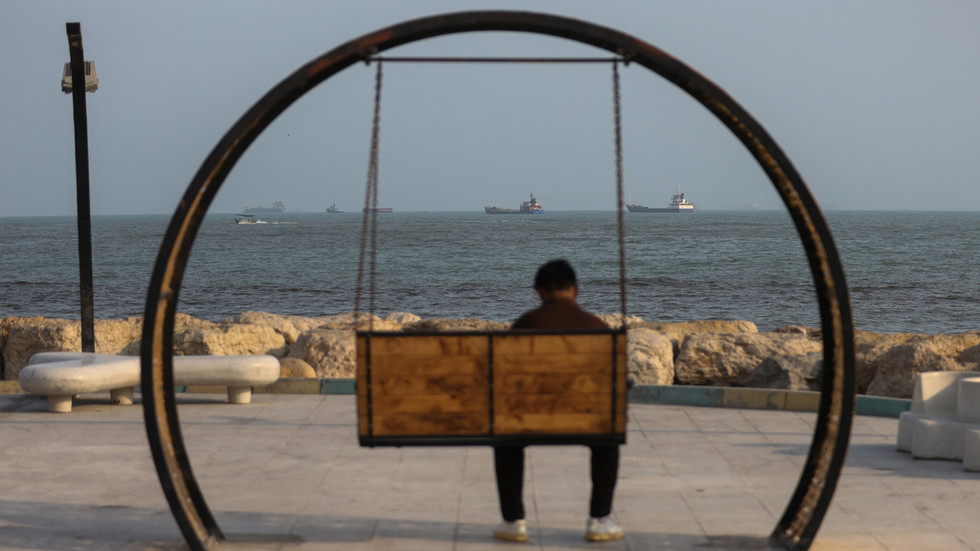
Kathmandu— Following President Donald Trump’s claim that he would declare the Strait of Hormuz a “territory of the US,” Iran has firmly asserted its ongoing and future control over the critical sea passage. The Iranian Foreign Ministry responded by urging Washington to acknowledge past “strategic defeats” and cease what it called “delusions.” This exchange follows a period of escalating tensions, including US-Israeli strikes on Iran, Tehran’s subsequent closure of the strait, and a resulting naval blockade that initially drove global oil prices higher.
Escalating Tensions and Blockade
The current standoff began with US-Israeli strikes against Iranian interests in late February, prompting Tehran to close the Strait of Hormuz. Washington responded by imposing a naval blockade on Iranian ports, disrupting traffic through one of the world’s most important energy corridors and initially causing global oil prices to surge as high as $120 per barrel. The situation has remained volatile despite attempts at de-escalation.
Iranian Conditions for Reopening
Tehran has outlined a series of conditions that must be met before it will reopen the Strait of Hormuz, including financial compensation for war damage, the lifting of economic sanctions, and the release of frozen Iranian funds. A permanent end to hostilities against Iran and its regional allies is also demanded. The Islamic Revolutionary Guard Corps (IRGC) has reinforced this stance, stating that any reopening hinges on full acceptance of these conditions by Washington.
Trump's Assertions and Negotiation Stance
Speaking at a police academy in New York, Trump claimed Iran was “very badly defeated” and announced his intention to declare the Strait of Hormuz as US territory. However, he also indicated that his administration is not prioritizing negotiations, preferring instead to maintain economic pressure on Tehran. He described current discussions as “semi-negotiating,” following disagreements over a ceasefire agreement.
Failed Ceasefire Efforts
A temporary 14-point memorandum of understanding had established a fragile ceasefire and provisions for the gradual lifting of the US blockade, aiming to restore commercial traffic through the Strait of Hormuz. However, fighting resumed in July after both sides failed to reach an agreement on implementing the deal. Deputy Foreign Minister Kazem Gharibabadi stated that “Once and for all, accept the reality: up to this point, you have suffered strategic and heavy defeats.”
Iran's Defiant Position
Gharibabadi emphasized Iran’s firm control over the Strait of Hormuz, stating it “will only be closed and opened under Iran’s command.” He dismissed the possibility of US seizure through military force or political pronouncements, asserting that Tehran “neither fears threats nor cowers before displays of power.” Gharibabadi added that the waterway “cannot be seized by tweet, nor by aircraft carrier, nor by issuing an order, nor by an election speech.”
As of Saturday, Iran maintains its blockade and continues to demand concessions from Washington before considering any reopening of the Strait of Hormuz. The situation remains tense with no immediate resolution in sight.
(With inputs from RT)
Originally published on abcnews.com.np.

प्रतिक्रिया दिनुहोस्