

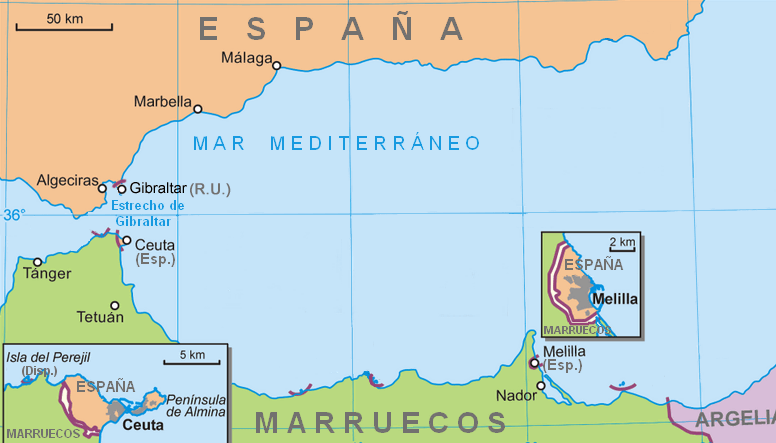
Kathmandu— In late July 2026, approximately 72,000 people crossed from Morocco into the Spanish enclave of Ceuta, overwhelming the city’s resources and prompting a response from Spanish police, military, and migrant services. While many quickly returned to Morocco, hundreds of unaccompanied minors remained, exposing vulnerabilities in Europe's border security and highlighting a growing trend: the use of migration as a tool for political leverage. The incident followed Spain’s decisions to regularize undocumented migrants and rule on the treatment of those arriving by sea, while also deepening ties with Algeria – a regional rival of Morocco – and proposing legislation regarding Western Sahara, all contributing to escalating tensions between Madrid and Rabat.
Escalating Tensions Preceded Mass Crossing
The mass crossing was preceded by several developments that strained relations between Spain and Morocco. In April, Spain began a process to regularize the status of 500,000 undocumented migrants, potentially increasing its appeal as a destination for those seeking immigration. A subsequent Supreme Court ruling stating that migrants arriving by sea would not face immediate removal further fueled this effect, prompting concern from Moroccan officials who anticipated problems. “We discussed this ruling and its impact. We explained that this ruling was going to create a problem. And it did create a problem,” said a senior Moroccan official.
Geopolitical Alignment Shifts Power Dynamics
Spain’s pledge to rebuild ties with Algeria, Morocco's regional rival, on July 20th provided further incentive for the crisis. This was followed by Spain advancing legislation on July 23rd granting expedited citizenship to Sahrawis born in Western Sahara – a move that aggravated tensions with Rabat. Simultaneously, Spain’s criticism of Israeli and US military operations in the Middle East strained relations with Washington, while Morocco developed closer ties with both Israel and the United States, receiving backing for its position on Western Sahara. The 2027 House Appropriations Committee report also lent credence to Morocco's claims over Ceuta and Melilla, bolstering Rabat’s confidence.
A History of Exploited Vulnerabilities
This isn’t an isolated incident; in 2021, after Spain admitted the leader of a Western Sahara independence movement for COVID-19 treatment, Morocco relaxed border controls allowing roughly 8,000 people to enter Ceuta. Spanish authorities labeled this “blackmail,” and responded with financial aid to Morocco for border policing. In 2022, Madrid reversed its longstanding position on Western Sahara, backing Morocco’s proposal. Experts note that the underlying vulnerability exposed in 2021 remained unaddressed, allowing it to be exploited again five years later.
Europe's Growing Exposure to Coercive Migration
The episode is part of a broader pattern where governments utilize migration as an instrument of statecraft. Russia and Belarus have similarly tested Europe’s borders, sending migrants toward Poland, Latvia, Lithuania, Finland, and Norway, often in response to EU sanctions or political disputes. These actions, while not overwhelming numerically, exploit existing political divisions within Europe and fuel support for anti-establishment parties. Libya and Turkey have also demonstrated the ability to leverage migration flows for political and financial gain, particularly amidst regional conflicts and instability.
The latest crisis in Ceuta underscores Europe’s vulnerability to external pressures and highlights the complex interplay between migration, geopolitics, and national interests. While Spain is currently negotiating with Morocco over migration and bilateral relations, the issue extends beyond a single border dispute, impacting broader European concerns about irregular migration and diplomatic leverage.
(With inputs from CounterPunch)
Originally published on abcnews.com.np.




प्रतिक्रिया दिनुहोस्