

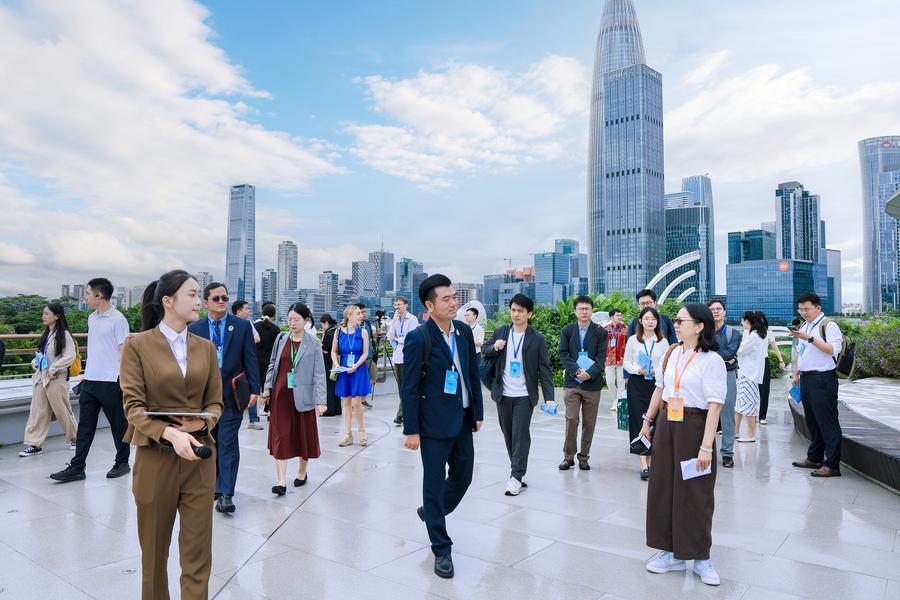
Kathmandu— Over sixty experts, scholars, and journalists from thirteen Asia-Pacific countries convened in Shenzhen, China on August 21st to discuss how a transition to green energy can shape the region's future. The event, themed “Asia-Pacific Youth Gathering: Building a Shared Future Through Energy,” focused on fostering dialogue around regional cooperation and the role of young professionals in driving sustainable development. Participants examined challenges related to energy access and resource distribution while highlighting successful initiatives like cross-border power projects and technological advancements.
Shenzhen as a Model for Green Innovation
The gathering took place in Shenzhen, a leading technology hub in Guangdong Province, chosen to showcase China’s commitment to green innovation. Delegates visited the 110-kV Chunhui Substation, China's first zero-carbon interactive substation, observing how renewable energy powers the city’s industrial and commercial sectors. This visit aimed to demonstrate practical applications of sustainable energy solutions and inspire further development in the region.
Regional Cooperation Key to Energy Access
Participants emphasized that addressing common challenges within the Asia-Pacific power network – including accessibility and resource imbalances – requires strengthened regional cooperation. Chhoeun Raksmey of Cambodia's Ministry of Industry, Science, Technology and Innovation noted the importance of collaborative efforts, stating, “As neighbors with different resources, it’s time for us to share our advantages, enhance bilateral and multilateral cooperation, and bring more tangible projects to the Asia-Pacific region.”
Cross-Border Power Projects Demonstrate Success
The event highlighted successful examples of cross-border energy collaboration. Yang Bo, a project commercial specialist at China Southern Power Grid Co., Ltd., shared details about the recently operational 500-kV cross-border alternating-current power link between China and Laos. This initiative has already begun delivering hydropower from northern Laos to the Guangdong-Hong Kong-Macao Greater Bay Area, with an expected transmission volume of approximately 600 million kWh by October’s end. Yang explained that this program allows Laos to benefit economically from its natural resources while establishing itself as a regional clean energy hub.
China's Role in Regional Green Development
China is actively participating in cross-border clean energy projects through initiatives like the Belt and Road Initiative and the Lancang-Mekong Cooperation mechanism. These efforts encompass wind, solar, hydropower, and energy storage technologies, contributing to broader regional green development. Chisa Jermwarayukorn, secretary-general of the Asia-Pacific Think Tank, noted that China is also sharing leading photovoltaic technology, power-grid equipment, intelligent dispatching systems, and energy-management solutions to improve reliability and efficiency across the region.
With Shenzhen preparing to host the 33rd APEC Economic Leaders' Meeting in November, discussions underscored the growing importance of green-energy cooperation among Asia-Pacific nations as they strive for a sustainable future.
(With inputs from Xinhua)
Originally published on abcnews.com.np.

प्रतिक्रिया दिनुहोस्