

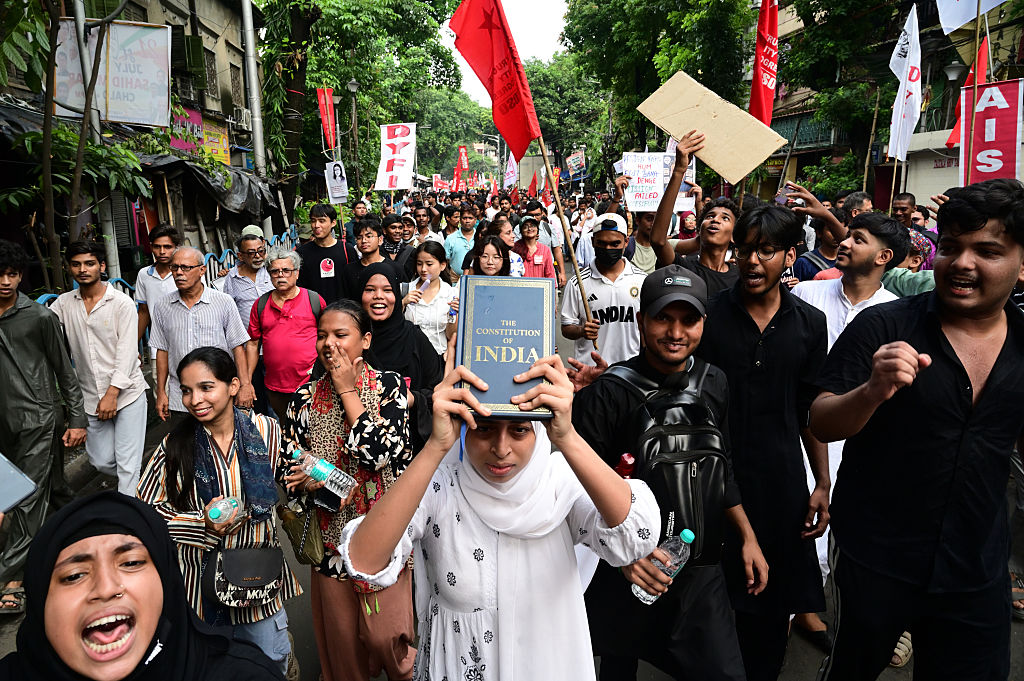
Kathmandu— In a significant shift, young people in India are challenging the culture of fear that has long protected Prime Minister Narendra Modi's Bharatiya Janata Party (BJP) government. This movement, sparked by a NEET paper leak and Chief Justice Surya Kant's controversial remarks, is pushing for a future beyond Modi's authoritarian policies. Renowned writer and activist Arundhati Roy sees in this generation a glimmer of hope, as they refuse to treat power as sacred and ridicule it openly.
Trigger of the Protests
The immediate trigger for the protests was a NEET paper leak, which led to widespread frustration among students. However, the anger extended beyond this incident to encompass broader issues such as unemployment, corruption, inequality, and systemic oppression. The controversy surrounding Chief Justice Surya Kant's remarks, which described unemployed young Indians as 'lazy' and 'cockroaches,' further fueled the movement. This sparked a reclaiming of the insult, with young people calling themselves 'cockroaches' and creating the Cockroach Janata Party on Instagram, marking the shift from online to real-world activism.
Challenging Power Dynamics
Young Indians are refusing to treat power as sacred, questioning and ridiculing it openly. This shift is significant because, in a culture of fear and compliance, people often police themselves. Journalists, students, and activists hesitate to speak up or join protests, but the new generation is breaking free from these constraints. Arundhati Roy, a renowned writer and activist, sees this as a post-fear phenomenon, where fear begins to lose its capacity to organize everyday behavior. This is evident in the movement's ability to challenge the status quo and force Education Minister Dharmendra Pradhan to resign.
Post-Fear Phenomenon
The post-fear phenomenon describes a political condition in which fear remains but begins to lose its capacity to organize everyday behavior. People may still be afraid, but they begin to act despite their fear. This is particularly evident in the way young Indians are confronting the government. They are using humor, ridicule, memes, and other forms of everyday defiance to challenge the BJP's image of strength and invincibility. The movement is not confined to these 'weapons of the weak'; it also includes direct confrontation, as seen in the protests at Jantar Mantar. The government's response, including the term 'dimagi Naxals,' has been met with mockery, further illustrating the shift in power dynamics.
Unorganized United Front
The rising movement does not fit neatly into classical Marxist categories of class struggle or conventional forms of political organization. Participants come from different classes, castes, genders, regions, and political traditions. This unorganized united front is fragile but offers political possibilities. The challenge now is for these movements to confront harder questions and define their goals. The movement poses a challenge to the Left and Ambedkarite political parties, many of which have been targets of Hindutva politics. Academics and other public intellectuals can use the freedom created by younger generations to defend broader freedoms.
The movement's success in forcing Education Minister Dharmendra Pradhan to resign and the formation of the Dimagi Naxal Janata Party on Instagram indicate the growing strength of this post-fear phenomenon. However, the future direction of the movement remains uncertain, as it must now define its goals and political direction.
(With inputs from Jacobin)
Originally published on abcnews.com.np.





प्रतिक्रिया दिनुहोस्