

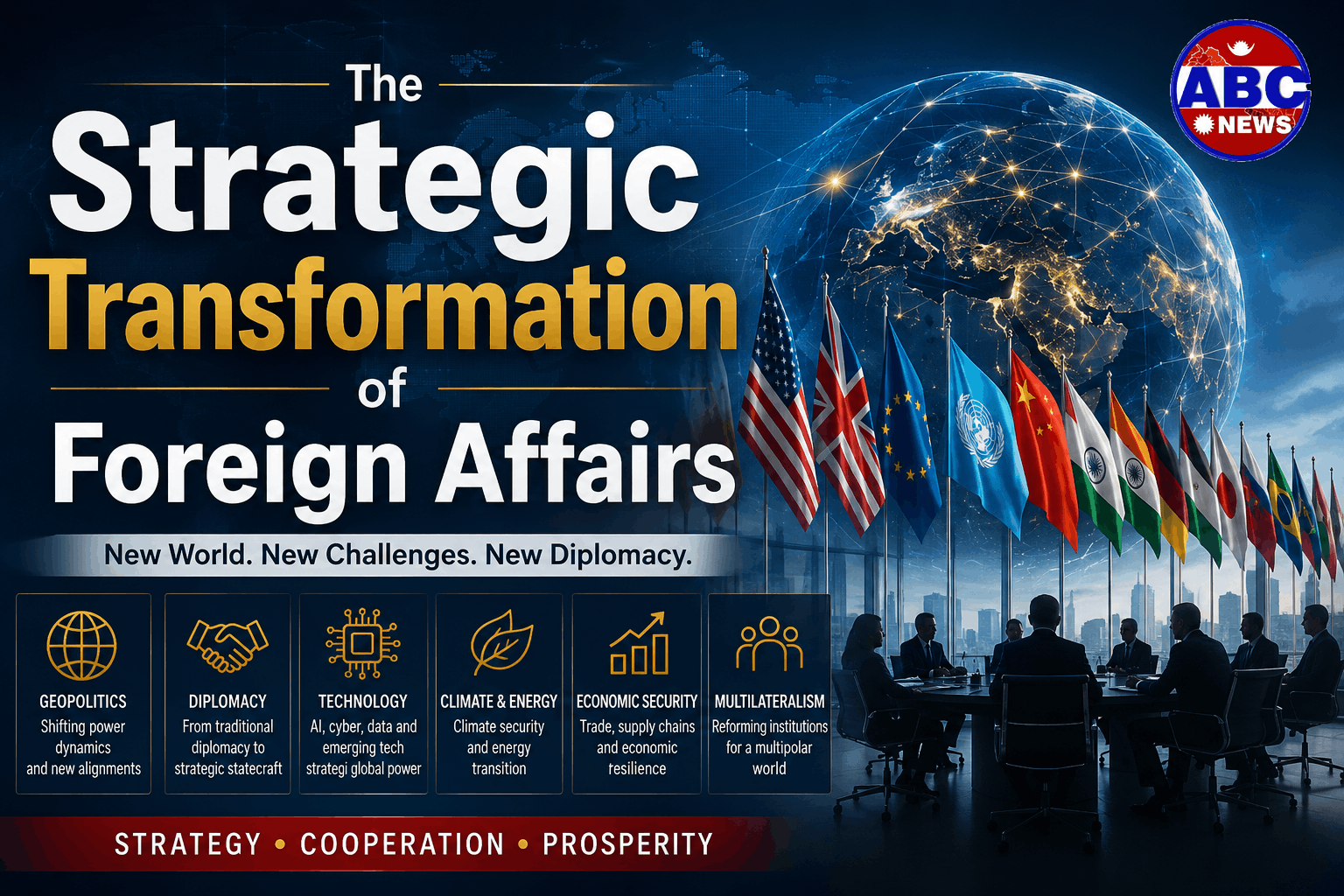
Editorial: The common narrative that foreign ministries are becoming weaker is fundamentally misleading. What is actually eroding is not the authority of foreign ministries but the capacity of states to adapt to a rapidly changing international system.
For much of the twentieth century, diplomacy revolved around military alliances, territorial disputes, political negotiations, and trade agreements. Foreign ministries served as the undisputed gatekeepers of a country’s international engagement. Today, that world no longer exists.
The twenty-first century has transformed diplomacy beyond recognition. Artificial intelligence, cybersecurity, semiconductor supply chains, climate finance, energy security, digital governance, biotechnology, migration, and economic resilience have become central issues of foreign policy. The geopolitical competition between the United States and China, the technological race for strategic dominance, Russia’s confrontation with the West, and the fragmentation of global supply chains all demonstrate one reality: diplomacy is no longer confined to embassies and ministries of foreign affairs.
Ironically, many governments continue to organize their diplomatic institutions as though the Cold War never ended.
The Crisis Is Institutional, Not Diplomatic
The growing international engagement of finance ministries, trade departments, central banks, environmental agencies, technology regulators, and energy authorities has led some observers to conclude that foreign ministries are losing relevance.
This diagnosis misses the point.
Foreign ministries are not becoming obsolete. Rather, governments have failed to redesign them for an era in which almost every ministry conducts international negotiations.
The real challenge is no longer conducting diplomacy abroad; it is coordinating diplomacy at home.
When multiple government agencies negotiate independently with foreign governments, international organizations, and multinational corporations without a coherent national framework, foreign policy ceases to be strategic. It becomes fragmented, reactive, and often contradictory.
The modern foreign ministry should therefore function less as an exclusive diplomatic actor and more as the strategic coordinator of the entire state’s international engagement.
Unfortunately, many governments—particularly in developing countries—have yet to embrace this transformation.
Information Is No Longer Power
For generations, foreign ministries derived much of their influence from their monopoly over information.
Diplomatic cables, confidential reports, and exclusive political intelligence gave diplomats a decisive advantage over other government institutions.
That advantage has largely disappeared.
Satellite imagery, open-source intelligence, artificial intelligence, real-time data, and digital communication have democratized access to information. Political leaders often receive international developments through digital platforms long before official diplomatic reporting arrives.
The question today is no longer who gathers information first.
The critical question is who can interpret complex global developments, anticipate strategic risks, and convert information into national policy.
Many foreign ministries remain structured for the first task while neglecting the second.
Diplomacy Requires Expertise Beyond Diplomats
The complexity of contemporary diplomacy has exposed another institutional weakness.
Negotiating climate finance requires climate scientists.
Artificial intelligence governance requires technology experts.
Semiconductor cooperation requires industrial economists.
Cybersecurity negotiations require digital security specialists.
Energy diplomacy demands engineers and market analysts.
Yet recruitment systems in many foreign ministries remain overwhelmingly centered on traditional diplomatic career tracks.
This institutional insularity has become one of the greatest obstacles to effective statecraft.
The future of diplomacy belongs to multidisciplinary institutions rather than exclusively diplomatic bureaucracies.
Political Instability Weakens Strategic Diplomacy
Institutional reform is only one part of the problem.
Political instability has increasingly undermined foreign policy continuity.
Frequent leadership changes, politically motivated ambassadorial appointments, shifting strategic priorities, and inconsistent diplomatic messaging have made long-term foreign policy increasingly difficult to sustain.
Foreign policy should not change every time a government changes.
Countries such as Singapore, South Korea, the United Arab Emirates, and increasingly Vietnam have demonstrated that sustained diplomatic success depends on institutional continuity rather than political turnover.
Without strategic consistency, even talented diplomats cannot compensate for an unstable political system.
Middle Powers Must Think Strategically
The consequences are particularly serious for small and middle-income states.
Countries like Nepal cannot compete through military power or economic scale.
Their greatest assets lie in strategic diplomacy, regional connectivity, climate leadership, human capital, renewable energy, and international credibility.
Yet these opportunities can only be realized if diplomacy is integrated across government rather than confined to a single ministry.
The era of isolated diplomatic institutions is over.
Governments that continue treating foreign ministries merely as protocol managers or embassy administrators risk becoming spectators rather than participants in the emerging international order.
The Foreign Ministry of the Future
The foreign ministry of the future should not be measured by the number of embassies it operates or the volume of diplomatic visits it organizes.
Its effectiveness should be measured by its ability to coordinate national strategy across every institution engaged internationally.
That requires structural reforms:
- Transform foreign ministries into strategic coordination hubs rather than isolated bureaucracies.
- Recruit multidisciplinary experts alongside career diplomats.
- Institutionalize inter-ministerial coordination mechanisms.
- Invest in strategic research, foresight, and scenario planning.
- Prioritize economic diplomacy, digital diplomacy, technology diplomacy, and climate diplomacy.
- Ensure ambassadorial appointments are based on competence rather than political patronage.
- Develop long-term foreign policy strategies that survive changes in government.
The Real Question
The debate should no longer ask whether foreign ministries are losing power.
That question belongs to another era.
The real question is whether states possess the institutional capacity to adapt to a world where diplomacy has become decentralized, technology-driven, multidisciplinary, and strategically interconnected.
Those that fail to adapt will not merely weaken their foreign ministries.
They will weaken the state itself.
In the twenty-first century, diplomacy is no longer simply about managing relations with other countries.
It is about managing the intersection of economics, technology, security, climate, innovation, and national resilience.
Countries that understand this transformation will shape the future.
Those that do not will find themselves reacting to a world increasingly shaped by others.




प्रतिक्रिया दिनुहोस्