

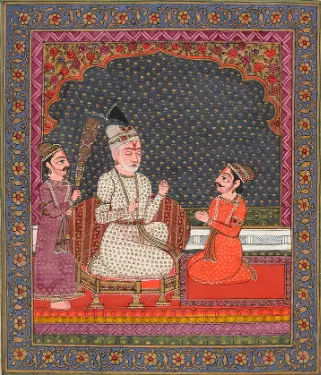
The greatest blindness is not the absence of sight, but the refusal to stand by the truth one already sees
“From families to corporate boardrooms, institutions weaken when favourites are protected, uncomfortable advice is ignored and those in authority choose personal loyalty over fairness”
What is the use of knowing dharma if one does not have the courage to stand by it? Few figures in the Mahabharata remind us as powerfully as Dhritarashtra that the greatest failures of life do not always begin with ignorance. Sometimes, they begin with knowing what is right and still lacking the strength to act upon it. Dhritarashtra’s tragedy was not that he could not see with his eyes. His deeper tragedy was that, again and again, he failed to stand with the truth that his conscience already recognised. His life therefore becomes more than the story of a king. It becomes a mirror for every parent, corporate leader and citizen who must choose between attachment and duty, silence and justice, personal affection and dharma.
Dhritarashtra’s tragedy shows that knowledge of dharma is meaningless without the courage to confront wrongdoing, restrain those closest to power and act before injustice becomes irreversible
Dhritarashtra was born into the Kuru dynasty and, as the elder brother of Pandu, stood close to the centre of power in Hastinapur. Yet his physical blindness altered his destiny and shaped the way others viewed his claim to authority. This early wound is important to understand, because personal pain often becomes dangerous when it is not disciplined by wisdom. Dhritarashtra’s sense of deprivation did not remain only a private sorrow. Over time, it influenced his judgment, his relationship with his sons, and his inability to act with fairness towards the Pandavs. His life teaches us that hurt, if left unexamined, can slowly turn into insecurity, and insecurity can distort one’s understanding of justice.
When Pandu withdrew from the throne, Dhritarashtra came to rule Hastinapur. Yet even as he occupied the seat of power, he did not always possess the moral steadiness that power demands. He was not without intelligence, nor was he unaware of right and wrong. In fact, his tragedy becomes sharper because he often knew the truth. He recognised Duryodhan’s jealousy. He understood the bitterness growing within the royal household. He knew that the rivalry between the Kauravs and Pandavs could destroy Hastinapur. But knowledge without courage remained helpless. A person may understand dharma, speak of dharma and even respect dharma, but unless he is prepared to act for dharma, that understanding remains incomplete.
As a father, Dhritarashtra loved Duryodhan deeply. But love, when separated from moral responsibility, can become a force of ruin. A parent’s duty is not only to protect a child, but also to correct him when desire turns into arrogance and ambition turns into injustice. Dhritarashtra repeatedly saw the dangerous direction in which Duryodhan was moving, yet he chose indulgence over discipline. He mistook affection for protection and protection for silence. This is one of the most important life lessons from his story. True love does not hide a loved one from the consequences of wrongdoing. True love guides, restrains and corrects, even when correction is painful.
Dhritarashtra was also surrounded by wise counsel. Vidur spoke with clarity and courage. Bhishma represented experience and duty. Gandhari understood the moral danger of Duryodhan’s path. Krishna himself made every effort to prevent war when peace was still possible. Therefore, Dhritarashtra cannot be seen as a man who lacked guidance. He lacked the will to follow guidance. This remains deeply relevant today. In families, organisations and public life, wise advice often exists. The real question is whether those in authority have the humility to listen and the courage to act. Wisdom has no power when authority chooses convenience over conscience.
The dice game reveals the depth of Dhritarashtra’s failure. He knew the tensions within the family. He understood Shakuni’s cunning. He could sense the danger of allowing resentment to enter the royal court in the form of a game. Yet he permitted events to unfold. When Draupadi was humiliated, the silence of the court became a moral wound in the history of Hastinapur. Dhritarashtra eventually intervened, but only after dignity had been attacked and injustice had already crossed its limit. His delayed action teaches us that justice must arrive when it is needed, not after the damage is done. Delayed justice can sometimes become another form of injustice.
This is why Dhritarashtra’s story cannot be limited to monarchy or ancient politics. It speaks to every space where responsibility exists. Many families weaken because elders confuse peace with avoidance. Many institutions suffer because people in authority know what is wrong but do not want to confront those close to them. Many individuals remain silent because speaking the truth may disturb comfort, relationships or personal interest. Dhritarashtra’s weakness was not that he openly celebrated adharma. His weakness was that he allowed adharma to grow while hoping that somehow disaster could be avoided. But wrong does not disappear because we refuse to confront it. Often, it grows stronger in the silence of those who know better.
This lesson is equally relevant to corporate leadership. A corporate leader who cannot restrain injustice within his own circle, whether in a court, company or institution, cannot preserve justice in the larger world. Organisations often suffer not because those at the top do not understand the problem, but because they avoid confronting it. When favourites are protected, when uncomfortable advice is ignored, when toxic behaviour is tolerated because the person is useful, and when rules bend for those close to power, the culture of the organisation begins to weaken. Dhritarashtra’s story reminds us that authority loses credibility when it protects attachment over fairness.
A second corporate leadership lesson lies in the relationship between performance and ethics. In many organisations, short-term results can sometimes blind decision-makers to long-term damage. A high performer may be excused for arrogance, a powerful executive may be shielded despite repeated misconduct, or a profitable decision may be defended even when it weakens trust. But no organisation can remain strong if success is separated from character. Dhritarashtra’s attachment to Duryodhan shows what happens when capability, ambition or loyalty is allowed to override dharma. For corporate leaders, the message is clear: performance cannot be separated from ethics, and loyalty cannot be allowed to overpower fairness.
His life also teaches the value of impartiality. A ruler cannot behave only as a father. A person in authority cannot act only as the guardian of one side. Dhritarashtra’s duty was to protect justice in Hastinapur, not merely the interests of Duryodhan. The Pandavs too belonged to the same lineage. They too deserved fairness. But Dhritarashtra’s attachment clouded his judgment. This lesson applies far beyond the Mahabharata. In any position of responsibility, fairness must not depend on personal closeness. When affection overpowers justice, trust begins to collapse. When rules change according to relationships, institutions lose moral authority.
There is also a powerful moral lesson in Dhritarashtra’s regret. He was often anxious and conflicted. He listened to Vidur and felt disturbed. He heard Sanjay’s narration of the war and felt sorrow. He sensed that the Pandavs stood on stronger moral ground, yet remained tied to Duryodhan’s ambition. His sorrow, however, could not undo his earlier weakness. Regret after destruction is not the same as courage before destruction. Feeling bad after a wrong has taken place does not absolve us if we had the power to prevent it. Moral strength lies in acting before consequences become irreversible. Dhritarashtra’s story is tragic because he was not ignorant of dharma, yet he remained too bound by attachment to act upon it.
Dhritarashtra’s life gives us the answer to the question with which we began. Knowledge of dharma is not enough unless it is supported by courage, fairness and timely action. His tragedy was not that truth was hidden from him, but that he could not stand with the truth when it demanded sacrifice. He reminds us that love without fairness becomes weakness, power without courage becomes helplessness, and knowledge without action becomes guilt. The lesson of Dhritarashtra is therefore timeless: the greatest blindness is not the absence of sight, but the refusal to stand by the truth one already sees.
Excerpts: Milleniumpost
THE WRITER IS THE CHAIRPERSON, BHARAT KI SOCH, Views expressed are personal




प्रतिक्रिया दिनुहोस्