

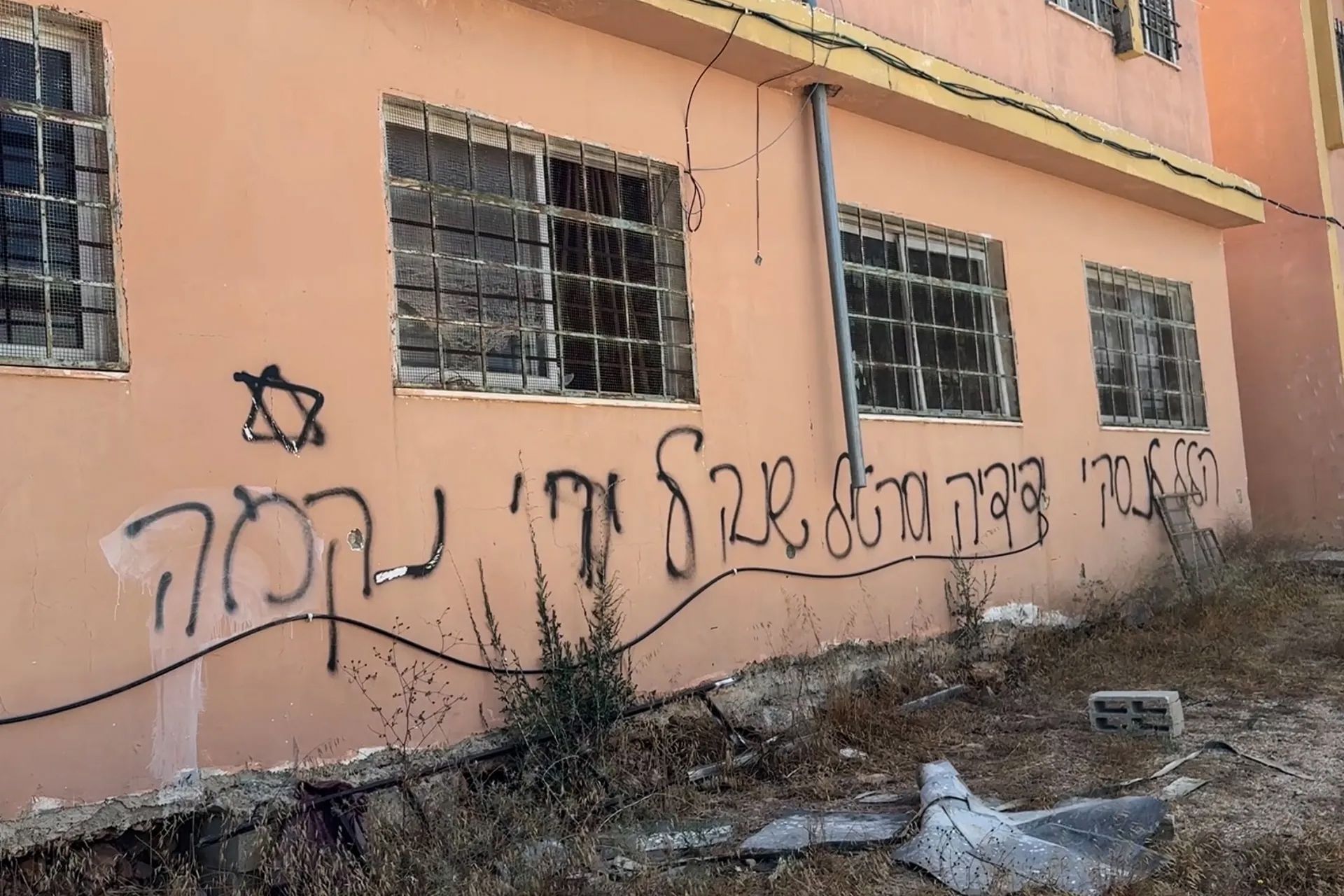
Kathmandu— Racist graffiti, including threats like “Burn in hell” and calls for expulsion, has appeared on walls across numerous Palestinian villages and towns in the occupied West Bank, signaling a surge in violence and intimidation by Israeli settlers. These markings accompany increasingly frequent attacks on homes and public buildings, with residents reporting a pattern of settler groups targeting communities, particularly since January, culminating in incidents like the burning of vehicles and defacing of property on August 4th in Jalud. The slogans are intended to instill fear, assert dominance, and ultimately drive displacement, according to Palestinian officials and researchers studying the phenomenon.
Pattern of Intimidation and Violence
Residents of Jalud, a village south of Nablus, describe a consistent pattern where defaced buildings are often followed by violent settler assaults. Misbah al-Haj Mohammed, a local resident, noted that some slogans even bear the names of settlers involved in previous attacks, appearing as a deliberate challenge to the community. Raed al-Haj Mohammed, head of the village council, characterized the messages as “racist and liquidationist,” linking them to the Hilltop Youth group, known for advocating Palestinian expulsion.
Ideological Roots of the Attacks
Researchers point to a deeply rooted ideological motivation behind the settlers’ actions. Azzam Abu al-Adas explained that slogans like “Death to Arabs” represent an explicit call for genocide within a vision of establishing a ‘zero-Arab state’ between the Jordan River and the Mediterranean Sea. He argues that this genocidal ideology has gained traction in Israeli society since the start of the war on Gaza, fueling beliefs that Palestinians must be either annihilated or permanently expelled. Walid Habbas added that these groups aim to punish Palestinian existence itself as an obstacle to complete land control.
Slogans as ‘Ownership Markers’ and Declarations
Beyond directly addressing Palestinians, researchers emphasize the slogans also serve as messages to other settlers and the Israeli state. Walid Habbas explained that the defaced walls become “banners” declaring reclaimed land, asserting ownership and signaling a lack of accountability. The inclusion of symbols like the Star of David on targeted buildings, such as a mosque in Qusra, is seen as a ‘sovereign signature’ – a claim of control. He described the open and unhidden nature of the graffiti not as recklessness, but as a deliberate display of confidence that perpetrators will not face consequences.
Escalation Fueled by Religious Justification
The use of religious texts to justify violence is also increasing, with settlers invoking biblical passages alongside threats. Abu al-Adas highlighted this escalation, while Habbas noted the targeting of essential elements like crops, mosques and homes as a deliberate attempt to disrupt Palestinian survival and connection to the land. The Price Tag movement, emerging in 2008, embodies this ideology, viewing Palestinians as occupiers who must ‘pay the price’ for their presence.
The frequency and brazenness of these attacks and accompanying slogans continue to raise concerns about escalating violence and the potential for further displacement of Palestinian communities in the occupied West Bank.
(With inputs from Al Jazeera)
Originally published on abcnews.com.np.





प्रतिक्रिया दिनुहोस्