

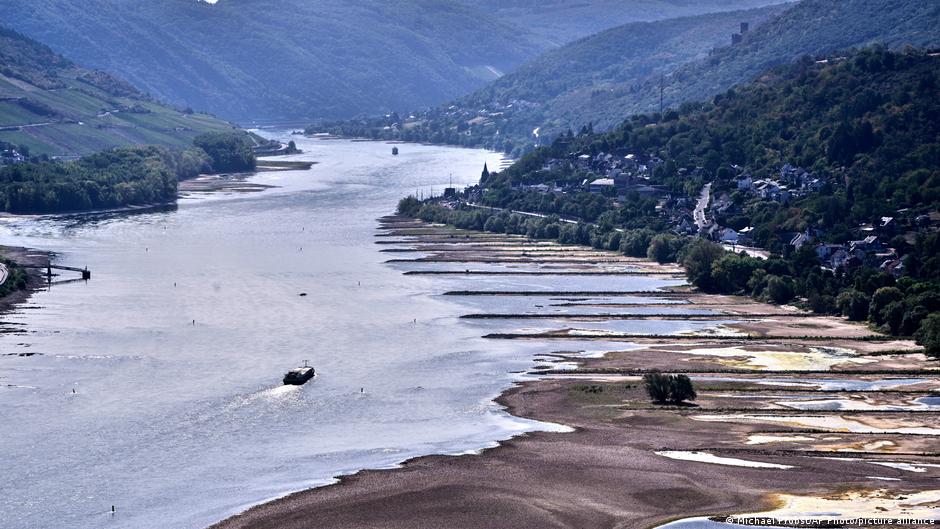
Kathmandu— Water levels on the Rhine River have remained critically low for weeks due to ongoing drought conditions, threatening economic activity in Germany. At Kaub, a key measuring point between Mainz and Koblenz, the river stood at just 16 centimeters (6.3 inches) on Monday, prompting cargo carriers to significantly reduce their loads – in some cases to one-fifth of normal capacity. The situation is impacting not only the Middle Rhine but also areas around Cologne, Düsseldorf, Duisburg-Ruhrort and Emmerich, raising concerns about a potential split in commercial traffic along the vital waterway.
Navigational Challenges Intensify
Ship operators are closely monitoring water levels at Kaub to determine safe cargo limits, with 40 centimeters considered the lowest level for standard commercial vessels. Jens Schwanen, head of the BDB association of inland shipping, warned that the Rhine may become impassable at Kaub before the end of the week, effectively dividing the river into two sections for commercial traffic. This would create separate shipping areas – one between North Sea ports and Cologne, and another utilizing tributaries like the Neckar, Moselle, Main, and Main-Danube Canal.
Economic Impact Looms
The drought arrives at a precarious time for Germany’s economy, already facing weak growth, high energy costs, and declining industrial competitiveness. Approximately 5% of goods transported within Germany rely on its rivers and waterways, including essential bulk materials like iron ore, coal, and petroleum products. In 2024, inland water transport accounted for 173 million tons of the total 3.28 billion tons of goods moved. Eurostat data from 2023 indicates that the Rhine corridor accounts for around 40% of freight by ton-kilometers. Previous droughts have demonstrated a clear link between low water levels and industrial decline, with the Kiel Institute for the World Economy calculating a roughly 1% drop in German industrial production for every 30 days of low water.
GDP Forecasts Revised Downward
The German Economic Institute (IW) now predicts a 0.4% decrease in gross domestic product, effectively negating the expected economic growth of 0.5%. IW economist Thilo Schäfer cautioned that “a prolonged disruption of navigability on the Rhine could completely stifle the tiny seed of growth we have.” Experts estimate potential losses of €1 to €2 billion ($1.2 to $2.3 billion) in the third quarter alone, with the steel, chemicals, and energy sectors particularly vulnerable. The shift to road and rail transport is proving problematic, as Germany’s infrastructure cannot accommodate the volume typically handled by a single barge without causing severe congestion and increased costs.
A New Normal for European Waterways?
Historically rare, extremely low water levels on major European rivers are becoming increasingly frequent due to climate change. Western Europe experienced its warmest June and July on record, with exceptionally low rainfall contributing to the current crisis – marking the third major low-water episode in eight years (following droughts in 2018 and 2022). The Rhine traditionally benefited from meltwater from Alpine snow and glaciers, but as these natural buffers diminish, severe low-water events are projected to occur every five to ten years by mid-century, according to Germany’s Federal Institute of Hydrology (BfG).
Government Response Underway
In response to the escalating situation, Baden-Württemberg joined four other German states in easing restrictions on truck movements on Sundays to alleviate congestion. Transport Minister Steffen Bilger announced measures last Thursday to bolster Germany’s supply chain, including streamlining regulations for heavy loads shifted to roads, halting non-essential roadworks, and improved coordination with DB Cargo, the rail freight arm of Deutsche Bahn.
Authorities continue to monitor water levels closely and implement short-term solutions to mitigate disruptions, but long-term strategies addressing climate change and waterway management will be crucial to ensure the Rhine’s continued viability as a critical transportation artery.
(With inputs from DW)
Originally published on abcnews.com.np.



प्रतिक्रिया दिनुहोस्