

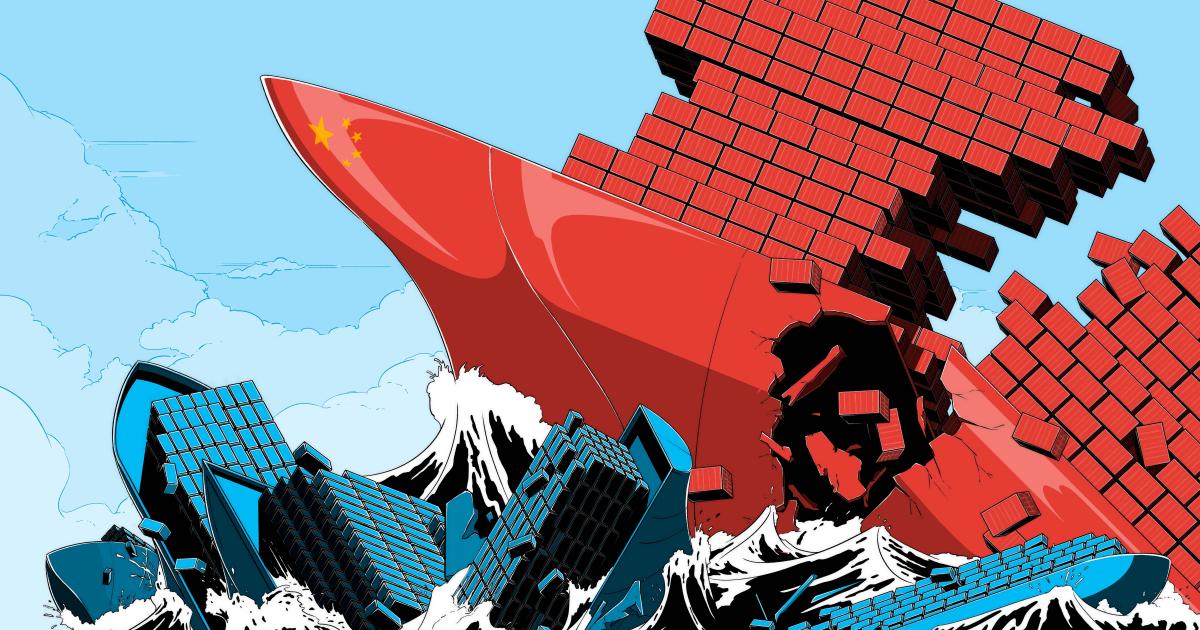
Kathmandu— For years, China’s commitment to expanding exports and its trade surplus has drawn criticism from advanced economies and developing nations alike. Now, that long-standing issue is escalating into a potentially catastrophic scenario: the global economy may soon be unable to absorb China's massive overcapacity. This situation, occurring at a time when governments are ill-equipped to manage economic fallout, could trigger a worldwide crisis if left unaddressed.
The Scale of Chinese Overcapacity
Over the past two decades, China has amassed the largest trade surplus in recorded history, reaching nearly $1.2 trillion in 2025 – a growth rate three times that of global goods trade. While this paradigm benefited China and provided short-term disinflationary effects globally, it is increasingly unsustainable and poses an underappreciated risk to the entire world economy. By 2030, China is expected to account for 45 percent of global industrial production, a concentration of power unprecedented since post-World War II America.
Subsidies and Unsustainable Practices
A significant portion of China’s gains in manufacturing market share are attributed to government subsidies, estimated at around 60 percent by the Organization for Economic Cooperation and Development. Chinese firms benefit from access to state-directed financial systems, allowing them to prioritize expansion over profit. This has led to a situation where nearly 30 percent of Chinese industrial firms operate at a loss, particularly in sectors prioritized under Xi Jinping’s “Made in China 2025” initiative. Local governments prop up these unprofitable companies to maintain employment and tax revenue, creating a cycle of unsustainable production.
The Limits of Demand
China's economic model is reaching its limits as the country has outgrown its ability to rely on export-led growth. While China’s economy was smaller, it could absorb exports due to sufficient global demand. Now, with a much larger economy, sustaining that rate of expansion is impossible without running out of customers. This issue extends beyond political backlash; it's a matter of simple arithmetic. The world may not be able to continue absorbing the sheer volume of Chinese-manufactured goods.
Global Repercussions and Potential Responses
A slowdown in China’s economy would send shockwaves globally, impacting major trading partners across Asia Pacific and beyond. While the United States is best positioned to stabilize the global economy, a crisis could also lead to increased protectionism as countries attempt to shield their domestic industries from Chinese exports. Germany, for example, has already seen a decline in goods exports to China and a surge in imports, prompting calls for stricter trade barriers. The EU is considering measures similar to those used by the United States to address China’s export glut.
A Looming Crisis or Course Correction?
China's leadership recognizes the problem and has signaled an interest in addressing it, adopting an anti-involution campaign and promoting domestic consumption in its 15th Five-Year Plan. However, a fundamental reorientation of China’s growth strategy toward sustainability remains elusive. Beijing continues to prioritize industrial output, creating what one economist calls an “absolute advantage” economy – competing simultaneously in high-tech sectors and low-value manufacturing.
While China's economy is resilient and its leadership has acknowledged the challenges, a significant shift in policy is needed to avert a potential global economic crisis. The coming years will be critical as Beijing navigates these complex issues and determines whether to embrace reforms or continue on its current trajectory.
(With inputs from Foreign Affairs)
Originally published on abcnews.com.np.






प्रतिक्रिया दिनुहोस्