

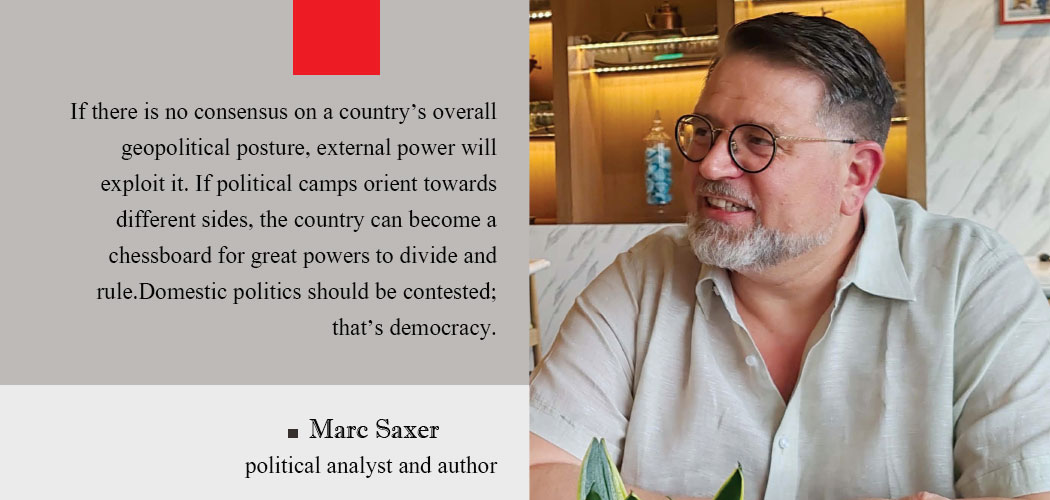
Kathmandu— A shift away from American dominance is ushering in an era of increased geopolitical competition and violence, according to political analyst Marc Saxer. In his recently published book, *Geopolitical Conflict in the Wolf World*, Saxer argues that the post-Cold War liberal order is collapsing, leading to a more chaotic multipolar world characterized by great power rivalry and disregard for international norms. He spoke with reporters in Kathmandu about the implications of this changing landscape, highlighting rising conflict levels, economic vulnerabilities, and the need for new approaches to global cooperation.
The Rise of a ‘Wolf World’
Saxer draws an analogy from 17th-century philosopher Thomas Hobbes, who described a state of nature as “a war of all against all,” where life is “solitary, poor, nasty, brutish, and short.” He applies this concept to the current global system, arguing that the end of the Pax Americana has unleashed forces of disorder. The Peace Research Institute Oslo data shows an increase in violent conflict and interstate war since World War II, indicating a worrying trend. Saxer emphasizes that this isn’t necessarily a new phenomenon—Asia, he notes, has long experienced a more competitive environment—but rather an intensification of existing tensions.
Erosion of the Liberal Order
The decline of the liberal order is not simply due to external pressures but also internal contradictions, Saxer contends. He points to structural issues within established democracies and the re-emergence of major powers like China and India as factors contributing to the shift. The United States, he argues, is overstretched militarily, financially, and politically, simultaneously facing challenges from Russia in Europe, Iran in the Middle East, and China in East Asia. This has led to a zero-sum game where resources are diverted and commitments strained. Furthermore, Saxer highlights the recent actions of an illiberal government in the US—referring to the Trump administration—which he says directly attacked both domestic and international liberal institutions, dismantling efforts to promote democracy, human rights, and free trade.
A Need for New Social Contracts
Saxer suggests that existing social contracts within many nations are becoming obsolete, particularly in Europe. He argues that current economic models are failing, requiring fundamental changes across multiple policy areas—from defense and energy to education and migration. The scale of these necessary reforms presents a significant political challenge, as even modest adjustments can trigger substantial upheaval. He believes the old social contract is over and new approaches are needed to navigate this changing world.
Implications for Smaller Nations
For smaller nations like Nepal, Saxer advises maintaining domestic consensus on foreign policy orientation to avoid becoming pawns in great power competition. He points to Mongolia’s “third neighbor policy”—engaging countries beyond its immediate neighbors—as a potential model for diversifying options and reducing vulnerability. Given Nepal's landlocked status and proximity to major powers, he stresses the importance of hedging risks and seeking alternative partnerships.
Shifting Dynamics in Geopolitics
Saxer warns that war is returning as an acceptable means of politics, and economic coercion is becoming increasingly common. He notes that export-led growth is becoming more difficult in a protectionist world, and technological advancements are being weaponized to hinder development. For many countries, he suggests, progress is now going backwards, requiring careful maneuvering between great powers to secure essential resources and maintain economic stability.
Saxer’s analysis paints a picture of a rapidly changing global landscape demanding new strategies for both established powers and smaller nations. He advocates for a proactive approach focused on adapting to the realities of a ‘wolf world’ rather than clinging to outdated models of international cooperation.
(With inputs from RN)
Originally published on abcnews.com.np.





प्रतिक्रिया दिनुहोस्