

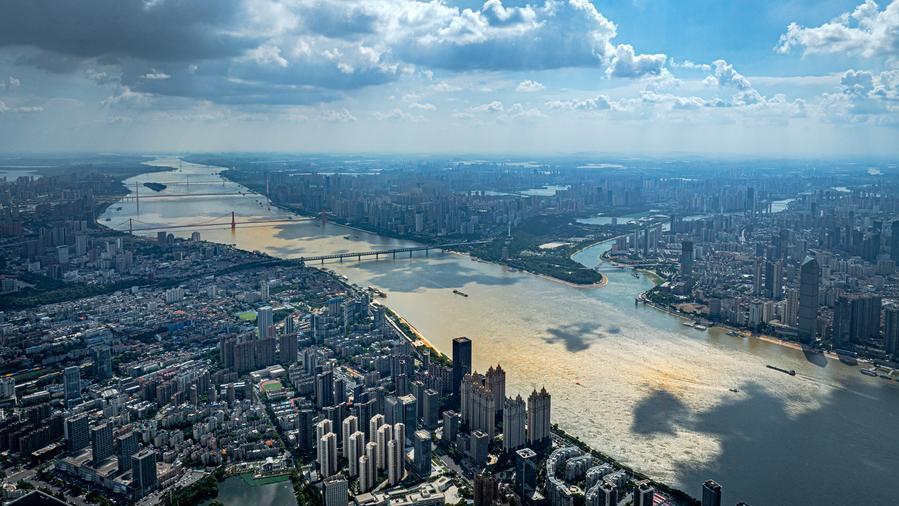
Kathmandu— As extreme heat becomes a growing global challenge, Chinese cities are pioneering innovative and sustainable cooling solutions. In Wuhan, a city known for its scorching summers, businesses like fitness clubs are now leveraging the Yangtze River to cool buildings, significantly reducing electricity bills and environmental impact. This initiative is part of a broader government-backed effort to explore lower-carbon alternatives to traditional air conditioning and meet China’s ambitious climate goals.
River Water Cooling Gains Traction
Wuhan's new river-water energy station began trial operations this summer, currently providing cooling to approximately 260,000 square meters of space, including a primary school and commercial complex. The system draws water from five meters below the surface of the Yangtze River, where temperatures range from 23 to 29 degrees Celsius – considerably cooler than the summer air which can exceed 35 degrees Celsius. After filtration, heat pumps utilize this temperature difference for cooling in the summer and heating in the winter before returning the water to the river. Project officials emphasize that the system is designed to minimize ecological impact, with water drawn from and returned to the Yangtze representing less than 0.01 percent of the river’s flow.
Expanding Beyond Traditional Air Conditioning
While centralized cooling systems are not new to China, their adoption has been limited by factors such as access to cooling sources and high distribution costs. However, experts like Fu Lin from Tsinghua University's School of Architecture see potential in combining central cooling with seasonal cold storage, utilizing off-peak electricity to create ice for summer use and leveraging existing heating pipelines for distribution. Other cities are also experimenting with unique approaches; Xuzhou is using water from an abandoned coal mine for residential cooling, while Jinan employs a 21-meter underground energy station to serve one million square meters of building space.
A National Push for Carbon Reduction
These initiatives align with China’s commitment to peak carbon dioxide emissions before 2030 and achieve carbon neutrality before 2060. The Wuhan project, once fully operational, is projected to save 7,374 tonnes of standard coal annually and cut carbon dioxide emissions by 18,000 tonnes – the equivalent of planting 1.05 million trees. China’s national climate change plan for the 2026-2030 period aims to reduce carbon dioxide emissions per unit of GDP by 17 percent from 2025 levels. Beyond technological solutions, cities like Wuhan and Chongqing are also opening civil defense facilities as public cooling spaces and constructing pocket parks to mitigate the urban heat island effect.
Global Implications of Extreme Heat
The growing need for sustainable cooling in China reflects a worldwide trend driven by increasingly extreme weather events. The World Meteorological Organization reported that July was the second warmest on record, with widespread heatwaves, drought, and wildfires impacting the Northern Hemisphere. UN Secretary-General Antonio Guterres has described extreme heat as a “society-wide threat” and urged countries to expand access to sustainable cooling solutions. Chen Yanhua, a senior engineer at CITIC General Institute of Architectural Design and Research Co., Ltd., notes that China’s shift towards utilizing local resources like river water and green spaces represents a move away from energy-intensive air conditioning toward more environmentally friendly and sustainable practices.
As temperatures continue to rise globally, the innovative cooling strategies being implemented in Chinese cities could serve as models for other urban centers seeking to mitigate the impacts of extreme heat and achieve their climate goals.
(With inputs from Xinhua)
Originally published on abcnews.com.np.





प्रतिक्रिया दिनुहोस्