

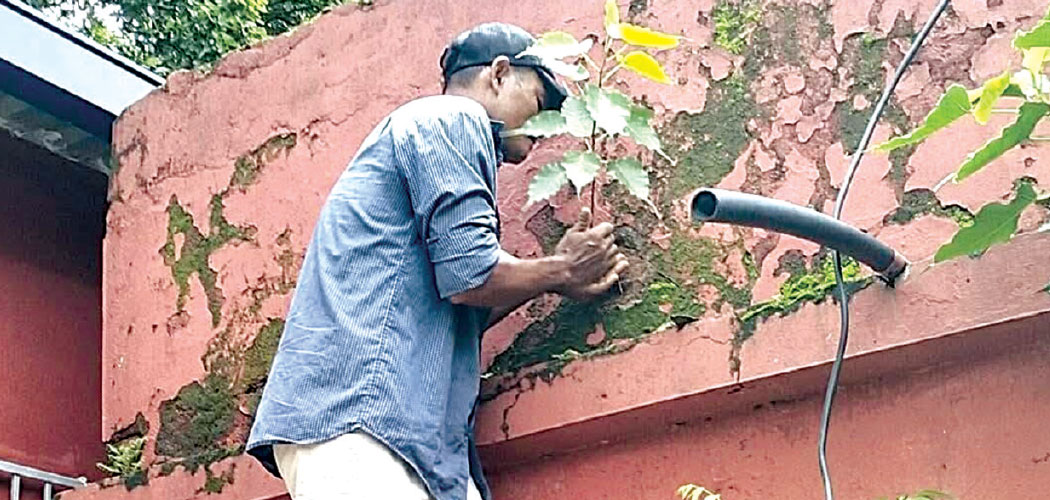
Kathmandu— Authorities in Nepal’s Makwanpur district have begun a project to rescue banyan and peepal saplings growing on government buildings and public spaces, addressing both potential infrastructure risks and the cultural importance of these species. The initiative, spearheaded by the Division Forest Office, aims to carefully remove the young trees from locations where their roots could damage structures and replant them in suitable environments after nurturing them in forest nurseries. Following its success locally, the program is now being expanded across Bagmati Province.
Addressing Structural Concerns
Banyan and peepal saplings, while culturally revered, can pose a threat to buildings if left unchecked. Their roots are known to infiltrate cracks in walls and foundations, leading to weakening of structures and potentially shortening their lifespan. The Division Forest Office identified this issue on government offices, public buildings, and along boundary walls within Hetauda, prompting the launch of the rescue effort. Approximately 300 saplings have already been collected from sites including the District Administration Office and the Ministry of Economic Affairs and Planning.
Cultural and Ecological Significance
The initiative is not solely focused on infrastructure protection; it also recognizes the deep cultural and ecological value of banyan and peepal trees in Nepali society. Rakesh Prasad Chandrabanshi, chief of the Division Forest Office, explained that the campaign is important “from the perspective of religious, cultural and biodiversity conservation.” These trees have traditionally been preserved and worshipped at public rest stops (chautaras), religious sites, and throughout urban areas. Furthermore, banyan and peepal provide vital habitat and food sources for a variety of wildlife including birds, bats, squirrels, and monkeys.
Provincial Expansion and Directives
Recognizing the benefits of the Makwanpur project, the Ministry of Agriculture, Livestock Development, Forest and Environment of Bagmati Province has directed all 15 Division Forest Offices within its 13 districts to implement similar programs. Madan Kandel, a chief of a division at the ministry, confirmed that a secretary-level decision was made to coordinate with agencies for safe sapling collection and nursery cultivation. The directive emphasizes the importance of preserving these trees due to their religious, cultural, and environmental contributions. Saplings raised in nurseries will be provided to community forest user groups, religious forests, and other appropriate locations based on demand.
The Ministry anticipates that this expanded effort will contribute significantly to both infrastructure maintenance and the preservation of Nepal’s natural and cultural heritage.
(With inputs from RN)
Originally published on abcnews.com.np.



प्रतिक्रिया दिनुहोस्