

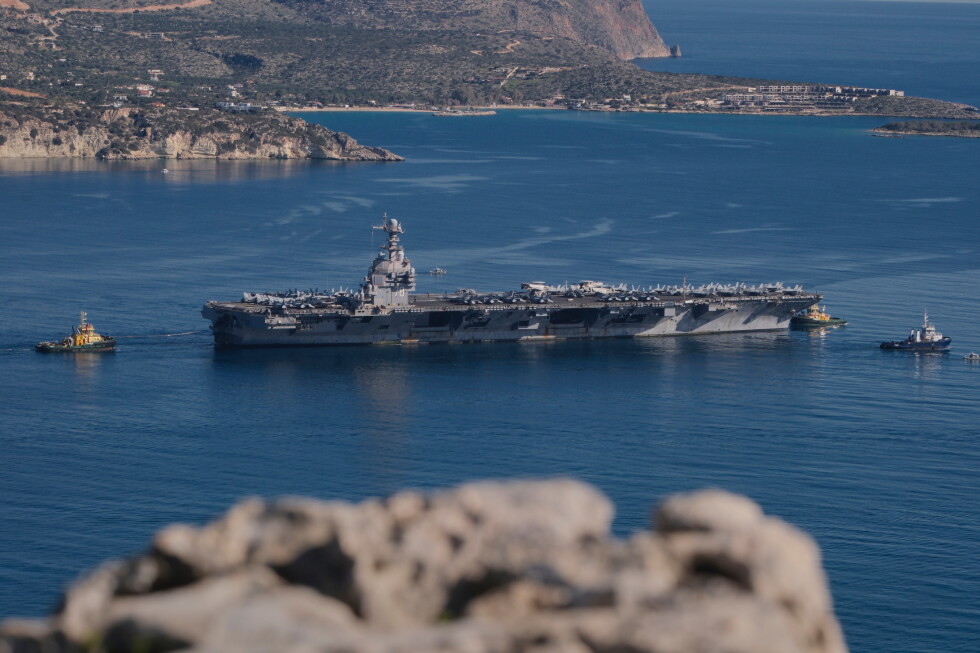
Kathmandu— President Donald Trump’s administration is prioritizing confrontation with Iran and focusing on the Western Hemisphere, leading to a reduction in U.S. naval presence in the Asia-Pacific region as China increasingly asserts its influence; the USS George Washington is being redeployed from the Pacific to the Middle East to relieve the USS Abraham Lincoln, which has had its deployment extended due to escalating tensions with Iran, raising concerns among allies and analysts about potential vulnerabilities.
Strain on US Carriers
The prolonged deployments of aircraft carriers like the USS Abraham Lincoln – exceeding 240 days at sea without interruption – are stretching both the vessels and their crews to their limits. Analysts point to growing mental health concerns and logistical challenges as sailors face extended periods away from home and limited rest and recreation opportunities. Robert Farley, who teaches national security at the University of Kentucky, explained that “People don’t get enough rest…R&R is part of keeping the crew healthy.” The USS Gerald R. Ford also recently completed an 11-month deployment, the longest since the Vietnam War, supporting operations against Iran and intervention in Venezuela.
Shifting Strategic Priorities
The redeployment of the USS George Washington reflects a broader shift in the Trump administration’s strategic priorities, prioritizing the Middle East and Western Hemisphere over the Asia-Pacific region. Greg Poling, director of the Southeast Asia Program at the Center for Strategic and International Studies, noted that this move is “doing the exact opposite” of previously stated goals to reduce U.S. involvement in the Middle East. This change has unsettled American allies in the Pacific, who are increasingly concerned about the unpredictability of the administration.
China’s Opportunity
The absence of a U.S. aircraft carrier in the Pacific provides China with an opportunity to demonstrate its growing power and influence in the region. Beijing views the U.S. military presence as a challenge to its ambitions, particularly regarding Taiwan, which China claims as its own. Bryan Clark, a defense analyst at the Hudson Institute, believes that China will use this situation to portray the U.S. as losing its dominance in the western Pacific and encourage regional countries to align with Beijing instead of relying on American security guarantees. Recent Chinese naval exercises near the Scarborough Shoal and off Japan’s coast underscore these efforts.
Future of Carrier Warfare
Some experts are questioning the long-term viability of aircraft carriers in modern warfare, given their vulnerability to drones and missiles. Michael Swaine, a senior research fellow at the Quincy Institute, suggests that smaller ships and submarines may be more effective in striking targets than fighter jets launched from carriers. Top Navy officials, including Chief of Naval Operations Adm. Daryl Caudle, have expressed interest in reducing reliance on large aircraft carriers and utilizing newer, smaller vessels.
Maintenance Bottlenecks Loom
Even if the USS Theodore Roosevelt is deployed to the Middle East to allow the USS George Washington to return to the Pacific, the increased demand for maintenance could create significant bottlenecks at the nation’s two carrier shipyards. Clark predicts that this will likely result in a reduced overall carrier presence in the coming years as vessels queue up for repairs and overhauls.
The U.S. Navy faces a complex balancing act between addressing immediate security concerns in the Middle East and maintaining its long-term strategic interests in the Asia-Pacific region, with potential implications for regional stability and alliance dynamics.
(With inputs from AP)
Originally published on abcnews.com.np.

प्रतिक्रिया दिनुहोस्