

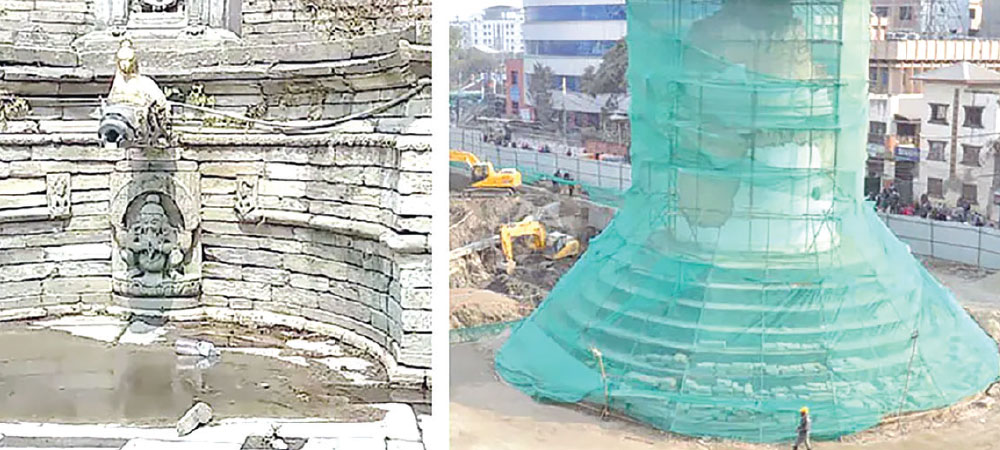
Kathmandu— The 2015 Barpak-Gorkha earthquake caused widespread devastation across Nepal, claiming 8,786 lives and injuring over 22,000 people. The disaster also severely damaged the nation’s rich cultural heritage, impacting approximately 920 monuments. While significant progress has been made in rebuilding many of these sites, concerns are growing among heritage experts about the quality of reconstruction and whether original materials and traditional craftsmanship have been adequately preserved, raising questions about what it truly means to ‘restore’ Nepal's history.
Extent of Earthquake Damage
The 2015 earthquake resulted in extensive damage across Nepal, destroying approximately 469,000 houses and impacting nearly 2,900 structures of cultural or religious significance. The Post Disaster Need Assessment (PDNA) documented the scale of loss, revealing that 133 heritage sites had completely collapsed, 233 were heavily damaged, and another 554 sustained partial damage. Kathmandu Valley alone accounted for 33 collapsed monuments, with an additional 107 suffering heavy damage.
Reconstruction Progress and Concerns
After years of effort, 825 of the 920 affected heritage sites have been reconstructed according to the Department of Archaeology (DoA). However, a central debate revolves around whether these reconstructions are truly restorations or merely replicas. Heritage experts and activists express concern that the failure to prioritize the reuse of original materials compromises the authenticity and historical value of the rebuilt structures. Sandeep Khanal, Chief of the World Heritage Conservation Section of the DoA, confirmed that 825 monuments have been reconstructed as of last fiscal year.
The Importance of Original Materials
Prof. Dr. Sudarshan Raj Tiwari, an architect and heritage conservation researcher, argues that true heritage conservation necessitates the use of old materials, skills, and construction methods whenever possible. He estimates that up to 90 percent of materials from ruined sites could be reused but are often discarded in favor of new ones. Ganapati Lal Sharestha, a local heritage activist, echoes this sentiment, stating that reconstruction is not just about rebuilding structures but also preserving their history, cultural meaning, and the memories they hold. He cited Kasthamandap as a positive example where original materials were conserved.
Challenges with Funding and Accountability
Saubhagya Pradhananga, Director General of the DoA, acknowledges that decreasing budgets pose challenges to completing remaining reconstruction work. The 62nd Annual Report of the Office of the Auditor General also highlighted issues with procurement practices, noting that the DoA has been paying for demolition and new construction as separate items without properly verifying the reuse of salvaged materials. Sharestha recounted struggles during the Rani Pokhari restoration project, where initial plans to use reinforced concrete were successfully protested by activists concerned about preserving authenticity.
Ongoing Preservation Needs
While the new Dharahara Tower is operational, the remains of the original structure remain unprotected. Similarly, Sundhara, another historic site within the complex, has not been fully restored. The restoration of Juddha Barun Yantra in Basantapur stands out as a positive example where prioritizing original materials proved successful.
The Department of Archaeology allocated Rs. 627.4 million for heritage reconstruction and preservation in the current fiscal year, but continued funding will be crucial to completing ongoing projects and ensuring the long-term protection of Nepal’s cultural treasures.
(With inputs from RN)
Originally published on abcnews.com.np.

प्रतिक्रिया दिनुहोस्