

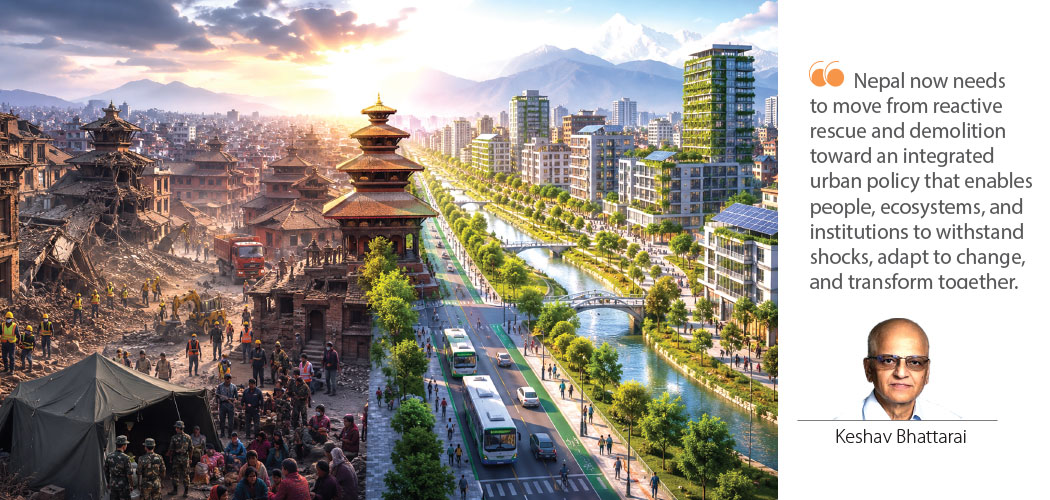
Kathmandu— The Kathmandu Valley is grappling with a complex web of interconnected challenges – from recurring floods and earthquakes to water shortages and air pollution – stemming from rapid urbanization outpacing the capacity of its ecology and infrastructure. Recent incidents, such as the July 2026 flooding of a government holding center for displaced families in Kirtipur, highlight systemic failures in risk assessment, land governance, and intergovernmental coordination. Experts argue that piecemeal approaches are insufficient and call for an overhaul of urban management policy to create a metropolitan resilience system integrating multi-hazard planning, humane housing, shared governance, and dedicated financing.
Systemic Failures Exacerbate Urban Vulnerability
Current urban policies in Kathmandu often address issues like flooding and earthquakes on an ad hoc basis, failing to account for the interconnectedness of these challenges. The 2026 Kirtipur flood exemplified this failure; displaced families were relocated from vulnerable riverbank settlements only to find themselves in another flood-prone area, losing their shelter and belongings once again. This incident revealed a breakdown in multiple areas including risk assessment and humanitarian responsibility. The valley’s bowl-shaped topography and rapid urbanization – replacing natural drainage with impervious surfaces – further exacerbate the risks.
Seismic Activity and Climate Change Intensify Threats
Beyond flooding, Kathmandu faces significant seismic risks; the 2015 earthquakes killed nearly 9,750 people and destroyed over half a million homes. While reconstruction efforts have improved building practices, dense settlement patterns, narrow roads, and weak structures remain critical concerns. Furthermore, climate change is increasing rainfall intensity, as demonstrated by catastrophic rainfall in September 2024, which overwhelmed Kathmandu’s urban systems. Scientific analysis concluded that these disasters are not purely natural events but rather the result of hazards interacting with exposure, inadequate services, and fragile governance.
A Call for Justice-Centered Relocation Policies
Informal settlements in Kathmandu present unique planning challenges, but addressing them should not involve treating poverty as a criminal offense. Many residents of these settlements are low-income workers vital to the metropolitan economy who lack access to affordable housing near employment and services. Drawing inspiration from practices observed in Tanzania, where landless squatters were relocated with community consent and government support, experts advocate for negotiated, risk-informed relocation accompanied by affordable housing, services, and social protection. Nepal’s Right to Housing Act guarantees appropriate shelter and protection from life-threatening conditions, placing a responsibility on all levels of government to implement this right.
Towards Integrated Metropolitan Resilience
Effective resilience requires moving beyond hazard maps and ward-level data that combine physical risks with socioeconomic vulnerabilities. Every public facility – holding centers, schools, hospitals – should undergo publicly disclosed multi-hazard assessments before occupation. A unified authority representing all municipalities, provincial agencies, and the federal government is crucial for managing basin-wide risks, enforcing common standards, coordinating emergency operations, and publishing annual resilience accounts. River setbacks should be scientifically defined, and restored river corridors can serve multiple purposes: flood retention, ecological parks, pedestrian routes, and public open spaces.
By 2050, Kathmandu will face increasing development pressure, more intense rainfall, rising temperatures, water insecurity, and continued migration; the decisions made in the next decade will determine whether these pressures are managed effectively or result in repeated humanitarian disasters.
(With inputs from RN)
Originally published on abcnews.com.np.





प्रतिक्रिया दिनुहोस्