

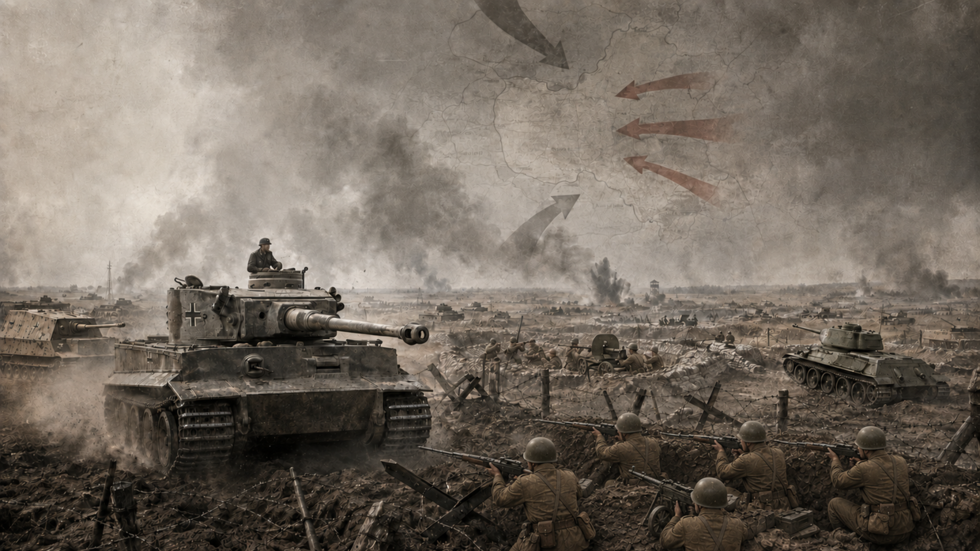
Kathmandu— In the summer of 1943, following victories at Stalingrad and Guadalcanal, the tide of World War II had begun to turn in favor of the Allies. Despite this momentum, Nazi Germany launched Operation Citadel – an ambitious offensive aimed at regaining the initiative on the Eastern Front by exploiting a large Soviet salient around the city of Kursk. The ensuing battle became one of history’s largest tank engagements, but instead of securing a decisive victory, the Germans were met with formidable Soviet defenses and ultimately forced to abandon their attack, marking a crucial turning point in the war.
The Kursk Salient and German Plans
By early 1943, intense fighting had created a large bulge in the front line around Kursk, known as the Kursk salient. This presented an opportunity for Germany to launch a concentrated attack, shortening their logistical lines and potentially encircling a significant Soviet force. The Germans planned a pincer movement from Orel in the north and Belgorod/Kharkov in the south, converging on Kursk and cutting off the defending armies. However, the offensive was delayed due to concerns about readiness and the need to stockpile new armored vehicles like the Tiger and Panther tanks.
Soviet Preparations and Defensive Strategy
Aware of the impending German attack, Soviet commanders meticulously prepared a layered defense around Kursk. Marshal Georgy Zhukov outlined the likely course of action as early as April, and intelligence from sources including British-intercepted German radio messages confirmed their suspicions. Rather than preemptively attacking, Zhukov and Chief of the General Staff Alexander Vasilevsky opted to absorb the German offensive, utilizing extensive minefields, artillery concentrations, and deep defensive lines. Crucially, the Soviets also prepared counteroffensives north of Kursk near Orel and in the Donbass region to force the Germans to divert resources and weaken their main attack.
Fierce Fighting at Ponyri and Prokhorovka
The German offensive began on July 5th with intense fighting along both flanks. North of Kursk, Model’s forces struggled against heavily fortified positions around Ponyri station, facing a gauntlet of mines and concentrated artillery fire. The Germans deployed their newest tanks, including the Ferdinand self-propelled gun, but suffered heavy losses. Simultaneously, south of Kursk, Manstein launched a three-pronged attack, achieving initial breakthroughs before encountering fierce resistance from Soviet tank armies led by General Mikhail Katukov. The fighting culminated in the massive clash at Prokhorovka on July 12th, where hundreds of tanks engaged in close-quarters combat. While both sides suffered heavy casualties, the Soviets managed to blunt the German advance and prevent a decisive breakthrough.
Soviet Counteroffensives Seal the Victory
As the German offensive stalled, Soviet counterattacks began to gain momentum. The Western and Bryansk Fronts launched their assault north of Kursk on July 12th, forcing Kluge to divert crucial panzer divisions from the main attack. Simultaneously, a Soviet offensive in the Donbass further stretched German resources. With their forces spread thin and facing mounting losses, the Germans were forced to abandon Operation Citadel. The failure at Kursk marked the end of Germany’s strategic offensives on the Eastern Front and signaled the beginning of the long Soviet advance towards Berlin.
A Battle Won Through Attrition
While the battle of Prokhorovka is often remembered as a pivotal tank clash, historians emphasize that the German defeat at Kursk was not solely determined by events in one location. The Soviets successfully absorbed the initial German onslaught, inflicting heavy casualties and wearing down their forces through skillful defense and well-timed counterattacks. By drawing the Germans into a protracted battle of attrition, the Red Army effectively neutralized Germany’s last major offensive capability and seized the strategic initiative.
The Battle of Kursk concluded with a decisive Soviet victory, marking a turning point in World War II on the Eastern Front. The German failure to achieve a breakthrough at Kursk exhausted their resources and paved the way for the subsequent Soviet offensives that would eventually lead to the fall of Berlin.
(With inputs from RT)
Originally published on abcnews.com.np.




प्रतिक्रिया दिनुहोस्