

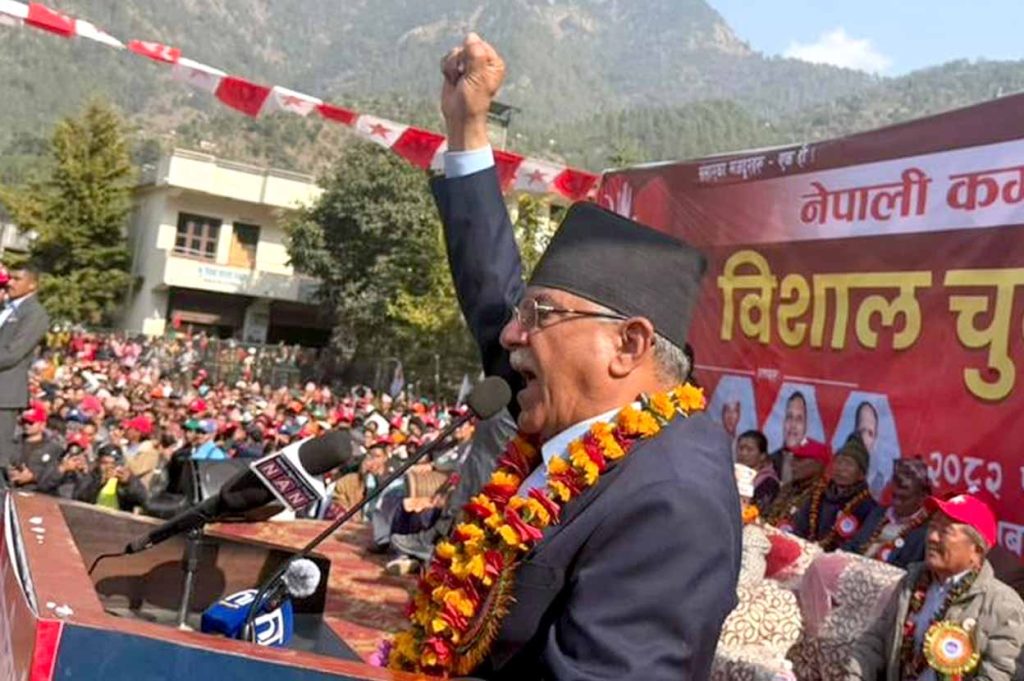
Kathmandu — The collapse of the ruling alliance between the Nepali Congress (NC) and the CPN-UML has triggered a fresh wave of political instability across Nepal’s provinces, with government reshuffles already underway in Karnali and Sudurpashchim. Yet, despite rapid political developments, the final shape of the new provincial power-sharing arrangement remains uncertain.
The primary reason, according to senior political leaders, is the absence of NCP coordinator Pushpa Kamal Dahal ‘Prachanda’, who is currently in Sri Lanka attending a gathering of Asian socialist and leftist parties. Until he returns, no decisive agreement on the future political course is expected.
Provincial Governments Once Again Reflect Federal Politics
Nepal’s federal system has repeatedly demonstrated that provincial governments rarely function independently of Kathmandu’s political equations. Since the 2022 general elections, every major change in the federal coalition has been followed by a reshuffling of provincial governments.
Coalition realignments at the center have led to repeated changes in chief ministers, cabinet compositions, and governing alliances across all seven provinces, highlighting the deep dependence of provincial politics on national-level power negotiations.
The latest breakdown of the NC-UML partnership has once again pushed provincial governments into uncertainty.
Sudurpashchim: The Political Battleground
Sudurpashchim Province has emerged as the immediate focus of Nepal’s shifting political landscape.
Chief Minister Kamal Bahadur Shah dismissed all UML ministers from his cabinet, effectively ending the coalition government. In response, UML formally withdrew its support, reducing the Congress-led government to a minority.
The decisive player, however, is the NCP.
With its current strength in the Provincial Assembly, the NCP can comfortably form a government either with the Nepali Congress or with the UML. This has made the party the central force in ongoing negotiations.
Three possible scenarios are currently being discussed:
- A left alliance led by the NCP.
- A new coalition between the Nepali Congress and the NCP.
- A broader coalition involving all three major parties.
While NCP leaders insist that discussions are continuing with both Congress and UML, Congress leaders have expressed reservations about forming an all-party government.
Karnali: Government Change Without Political Clarity
Political uncertainty is equally visible in Karnali Province.
The Nepali Congress and the NCP have jointly registered a no-confidence motion against UML Chief Minister Yamalal Kandel. However, the filing of the motion does not automatically indicate that the two parties have finalized a new governing alliance.
Sources suggest that although the NCP is unlikely to insist on leading the provincial government itself, it has also not formally committed to supporting a Congress-led administration.
This indicates that the no-confidence motion is currently more a political pressure tactic than evidence of a finalized coalition agreement.
Prachanda Keeps Both Political Options Open
The NCP leadership appears to be deliberately maintaining strategic flexibility.
Senior party leaders have publicly stated that their first preference remains cooperation among the country’s three largest parties. If such an arrangement proves impossible, the party is prepared to consider alternative alliances.
This approach allows Prachanda to preserve leverage with both the Nepali Congress and the UML simultaneously.
Political observers describe this as a calculated bargaining strategy rather than an ideological commitment to either bloc.
By avoiding an early commitment, the NCP has positioned itself as the kingmaker in the evolving political equation.
Why UML Prefers a Left Alliance
Within the UML, there appears to be growing consensus that the breakdown of relations with the Nepali Congress presents an opportunity to rebuild left unity.
Several UML leaders reportedly believe provincial governments could serve as the starting point for broader cooperation between UML and the NCP.
Sudurpashchim, in particular, is viewed as the province where such an experiment could begin, with the UML reportedly willing to support an NCP-led government.
Some leaders even argue that successful provincial cooperation could eventually lay the foundation for renewed left unity at the national level.
Congress Faces a Strategic Dilemma
The Nepali Congress now finds itself in a politically delicate position.
Having ended its partnership with the UML, the party has rejected proposals for an all-party government, arguing that a democracy requires a functioning opposition rather than a government comprising all major political forces.
However, Congress has left the door open for cooperation with the NCP.
Its decision to jointly file the no-confidence motion in Karnali has been interpreted by many as a signal that a Congress-NCP alliance remains a realistic option.
Why Prachanda’s Return Matters
Although second-tier leaders from the major parties continue informal discussions, senior political figures acknowledge that the final decisions rest with Prachanda.
His return from Sri Lanka is therefore expected to mark the beginning of high-level negotiations that could determine not only the future governments in Karnali and Sudurpashchim but also the broader direction of Nepal’s national politics.
Until then, discussions are expected to continue, but no formal agreements are likely to be announced.
Broader Political Implications
The current provincial realignments extend far beyond changes in cabinet positions.
They represent the first major test of Nepal’s post-NC-UML political landscape and could shape the country’s next phase of coalition politics.
If the UML and the NCP ultimately join hands in the provinces, it may signal the beginning of a broader left realignment with long-term national implications.
Conversely, if the NCP aligns with the Nepali Congress, Nepal could witness the emergence of a new democratic coalition capable of reshaping the balance of power at both provincial and federal levels.
For now, political negotiations remain fluid. The arithmetic has been calculated, informal consultations continue, and multiple coalition models remain under discussion. Yet the decisive political endorsement is widely expected to come only after Pushpa Kamal Dahal ‘Prachanda’ returns to Kathmandu, making his next round of consultations a pivotal moment for both provincial governance and Nepal’s broader political trajectory.



प्रतिक्रिया दिनुहोस्