

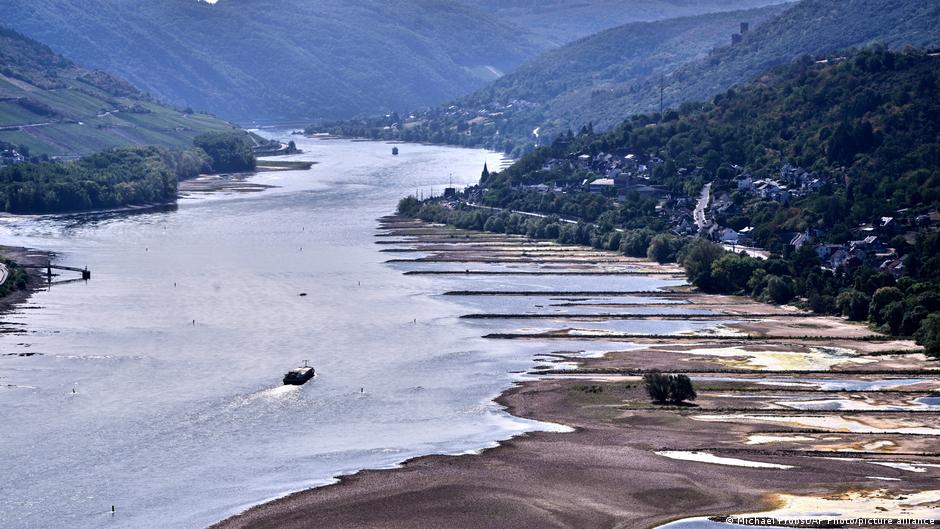
Kathmandu— Water levels on the Rhine River have remained critically low for weeks due to ongoing drought conditions, threatening significant disruption to Germany’s industrial supply chains. As of Monday lunchtime, the river measured around 16 centimeters (6.3 inches) at Kaub—a key monitoring point between Mainz and Koblenz—prompting carriers to drastically reduce cargo loads or suspend passage altogether. The situation comes as Germany grapples with weak economic growth, high energy costs, and declining industrial competitiveness, raising concerns about a further downturn.
Rhine Water Levels Reach Critical Lows
The Federal Waterways and Shipping Administration (WSV) reported the Kaub reading of 16 centimeters on Monday, though the navigable channel is roughly a meter deeper. However, 40 centimeters is considered the minimum for standard commercial vessels at that point. Ship operators are using these readings to determine safe cargo levels, with many recently reducing loads to as little as one-fifth of normal capacity. Low water levels aren’t limited to the Middle Rhine; areas around Cologne, Düsseldorf, Duisburg-Ruhrort and Emmerich are also experiencing historic lows.
Economic Impact Looms
Germany relies on its rivers and waterways for approximately 5% of goods transportation, primarily bulk materials like iron ore, coal, sand, and petroleum products. In 2024, inland water transport—including the Rhine—carried 173 million tons of goods out of a total of 3.28 billion tons. The Rhine corridor, from Rotterdam to the German-Swiss border, accounts for around 40% of freight by ton-kilometers according to Eurostat data. Previous droughts have demonstrated the economic consequences; the Kiel Institute for the World Economy calculated that each 30 days of low water on the Rhine reduces Germany's industrial production by about 1%. The German Economic Institute (IW) now predicts a 0.4% drop in gross domestic product, potentially erasing this year’s expected growth.
Potential River Split and Mitigation Efforts
Jens Schwanen, head of the BDB association of inland shipping, warned that the Rhine may become impassable at Kaub before the end of the week, effectively splitting the river for commercial traffic. This would create two separate shipping areas: one from North Sea ports to Cologne via the Rhine and Western German canal system, and another utilizing tributaries like the Neckar, Moselle, Main, and the Main-Danube Canal. Shifting cargo to trucks and rail is being considered, but Germany’s roads lack the capacity to handle the volume typically carried by a single barge without significant congestion and increased costs. Baden-Württemberg has joined four other German states in easing restrictions on Sunday truck movements, while Transport Minister Steffen Bilger announced measures to streamline heavy load transport, halt unnecessary roadworks, and improve coordination with DB Cargo.
Climate Change and Future Risks
Scientists believe climate change is increasing the frequency, duration, and severity of low-water events on European rivers. Western Europe experienced its warmest June and July on record, coupled with exceptionally low rainfall, driving down water levels on the Rhine, Danube, and Seine. The current crisis marks the third major low-water episode in eight years—following droughts in 2018 and 2022—and Germany’s Federal Institute of Hydrology (BfG) projects that severe events like 2018 could occur every five to ten years by mid-century as Alpine glaciers retreat and snow cover declines.
Authorities continue to monitor the situation closely, implementing short-term measures to mitigate disruptions while long-term strategies addressing climate change impacts on waterways are increasingly urgent.
(With inputs from DW)
Originally published on abcnews.com.np.





प्रतिक्रिया दिनुहोस्