

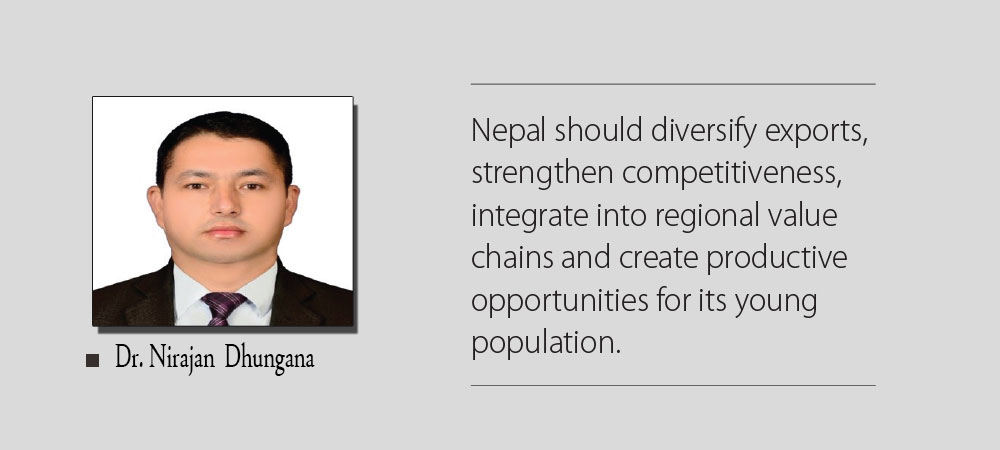
Kathmandu— As Nepal prepares for a significant political visit to Beijing, attention is turning to whether this engagement can unlock sustained double-digit economic growth for the country. With Nepal and China entering a new phase of cooperation under the Belt and Road Initiative (BRI), the focus has shifted from simply needing infrastructure to leveraging it for industrialization, structural transformation, and long-term prosperity. The upcoming visit by Rastriya Swatantra Party chair Rabi Lamichhane offers a timely chance to deepen economic ties and shape BRI engagement around productive investment, export competitiveness, and job creation, judged not by political gestures but by tangible progress toward Nepal’s long-term development.
Structural Vulnerabilities Despite Trade Integration
Despite decades of integration into global trade frameworks through organizations like the World Trade Organisation (WTO) and the South Asian Free Trade Area (SAFTA), Nepal’s economy remains structurally vulnerable. A widening trade imbalance, a heavy reliance on remittances from overseas workers, and an ongoing outflow of young people seeking employment abroad highlight weaknesses in the country’s productive base and a shortage of quality jobs. Unless remittance-driven consumption is balanced by sustained expansion in domestic production and exports, Nepal risks increasing import dependence and experiencing economic pressures similar to ‘Dutch disease.’
China’s Industrial Transition Presents Opportunity
With China undergoing its own industrial transition—characterized by rising wages, technological upgrades, and a move towards higher-value production—opportunities are emerging for labor-intensive manufacturing to relocate to lower-cost economies. Nepal should view this shift as a chance to attract some of the 6.5 million Nepali migrant workers currently working abroad. The country should aim to become a hub for export-oriented industries, capitalizing on its available labor force, hydropower potential, and strategic location between China and India.
Beyond Infrastructure: A Sector-Led Approach
A sector-led approach is crucial to reshaping Nepal’s BRI strategy. Projects like the cross-border railway, major road corridors, and power transmission links should not be seen as ends in themselves, but rather as foundations for integrated economic corridors that connect transport infrastructure with industrial parks, Special Economic Zones, agro-processing facilities, logistics networks, and export-oriented manufacturing. The key lesson from China’s own transformation is the importance of institutional coordination—strategically linking transport networks, industrial clusters, special zones, export promotion, technology transfer, investment attraction, and pragmatic industrial policy.
Financing for Productive Capacity
Nepal should prioritize investments that expand future productive capacity rather than simply increasing liabilities. BRI projects must be assessed based on their ability to generate income, foreign exchange earnings, and economy-wide productivity gains sufficient to justify their financial and fiscal costs. A Nepal–China Economic Transformation Partnership could provide a framework for coordinated programs linking investment, technology transfer, skills development, trade facilitation, industrial upgrading, and access to Chinese and regional markets.
The Need for Market Access and Oversight
A successful strategy requires building market access from the outset, as investors are unlikely to scale production without credible pathways to domestic, Chinese, Indian, and wider regional markets. To improve implementation, Nepal and China should consider establishing a High-Level Economic Transformation Commission composed of economists, industrial experts, business leaders, financial institutions, and policymakers. This commission would assess projects based on comparative advantage, productivity, export potential, employment generation, technology transfer, debt sustainability, and long-term economic returns.
If Nepal approaches the upcoming talks with a clear economic vision focused on structural transformation rather than simply seeking project funding, Lamichhane’s visit could mark a turning point in Nepal–China cooperation.
(With inputs from RN)
Originally published on abcnews.com.np.




प्रतिक्रिया दिनुहोस्