

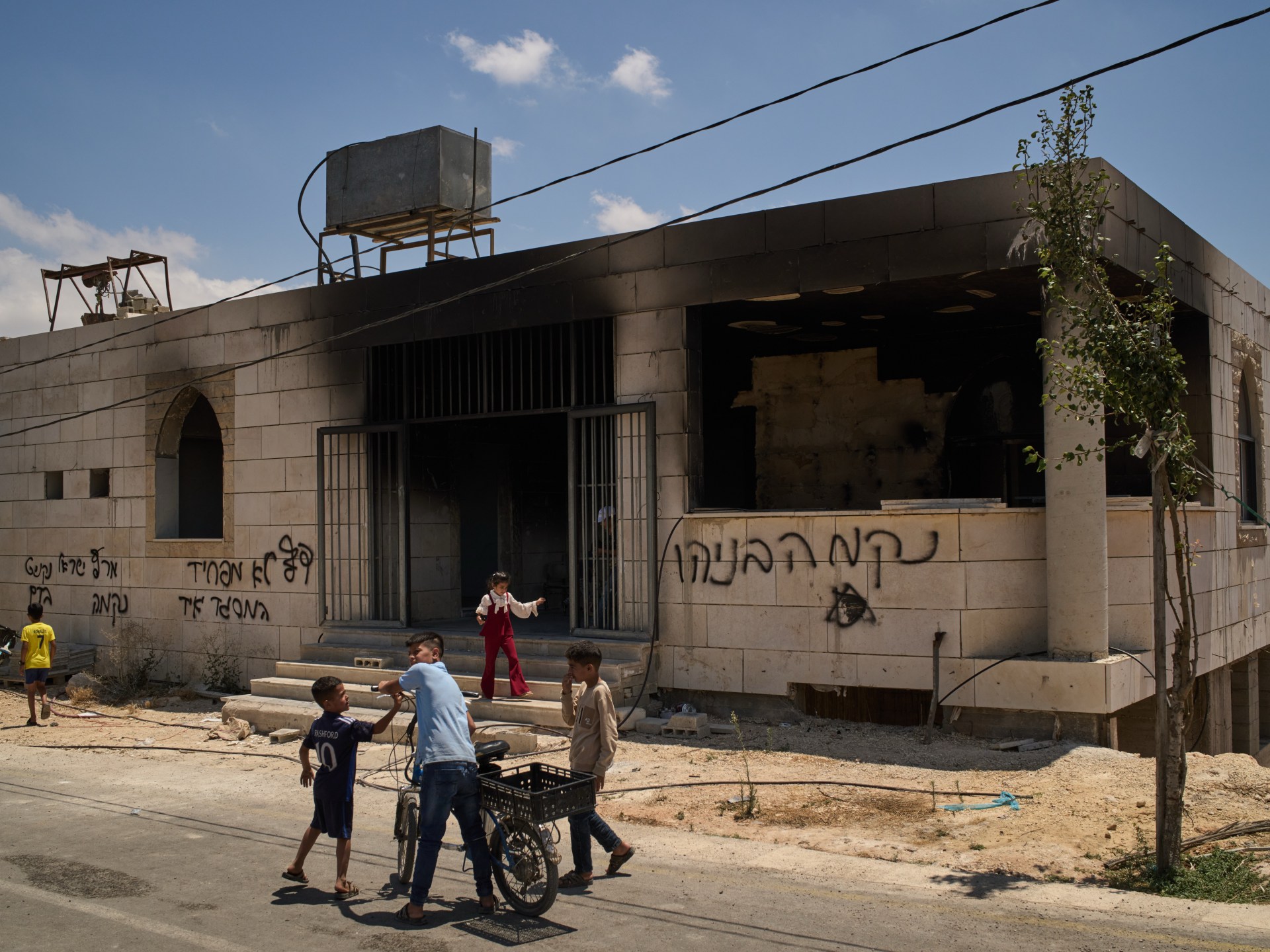
Kathmandu— Waves of attacks on Palestinian communities in the occupied West Bank, often supported by Israeli forces, have intensified over the past month following an initial incident near Nablus. These assaults include sieges of villages like Qusra, where families are cut off from essential supplies, and widespread damage to homes, businesses, and farmland. The escalating violence has prompted comparisons to pogroms – historically defined as organized violence against a group for racial or religious reasons – with UN officials, human rights groups, and even some Israeli military commanders using the term to describe the events unfolding in the territory.
Escalating Violence and Displacement
According to the Palestinian Colonization and Wall Resistance Commission, approximately 780,000 Israeli settlers now live across the West Bank and occupied East Jerusalem, residing in 192 settlements and 400 outposts. These settlements are considered illegal under international law and often expand through the harassment of Palestinians, including theft of livestock, disruption of essential services, and property damage. A recent pattern involves establishing outposts near Palestinian villages, besieging homes, and ultimately displacing residents with the support – or at least inaction – of Israeli forces.
Defining a Pogrom
While there is no formal legal definition under international law, dictionaries offer varying definitions of “pogrom.” The British Collins Dictionary specifically includes state-backed violence in its definition. Experts note that the term originated with violent mob attacks on Jewish communities in 19th-century Russia. UN Special Rapporteur on the Occupied Palestinian Territories Francesca Albanese has directly described recent Israeli attacks against Palestinians as “pogroms against defenceless civilians.”
Official Acknowledgement of ‘Pogrom’ Tactics
The use of the term 'pogrom' isn't limited to observers; it has been adopted by some within the Israeli establishment itself. Following a particularly violent attack on the Palestinian town of Huwara in February 2023, then-commander of the Israeli military in the occupied West Bank, Yehuda Fuchs, referred to the events as a “pogrom.” The US State Department also recorded the incident as such. B’Tselem, an Israeli-Palestinian human rights group, has repeatedly described actions in the West Bank as pogroms, arguing that settler attacks are contributing to the displacement of Palestinian communities and represent a state-sponsored effort at ethnic cleansing. Yair Dvir, a spokesperson for B’Tselem, stated that “settler violence is not a new phenomenon…But over the past three years, it has become more violent, more systematic and, most importantly, part of a state mechanism intended to ethnically cleanse large parts of the West Bank.”
International Concern and Reports
The UN Office for the Coordination of Humanitarian Affairs (OCHA) recorded over 1,330 settler-related attacks on Palestinians in the West Bank from January to late July, averaging six per day – the fastest pace in two decades. A UN-appointed commission of inquiry has found that Israeli authorities have repeatedly failed to prevent these attacks and, in some instances, directly enabled them through protection and funding. OCHA also reported that settler violence, demolitions, and evictions forcibly displaced more Palestinians in the first four months of this year than in all of 2025, with 107 communities comprising 5,900 people completely or partially displaced since January 2023.
The situation remains volatile, with ongoing settler violence and Israeli military operations continuing to displace Palestinians and raise concerns about the future stability of the region. The Lemkin Institute for Genocide Prevention continues to monitor events and report on instances of escalating violence.
(With inputs from Al Jazeera)
Originally published on abcnews.com.np.



प्रतिक्रिया दिनुहोस्