

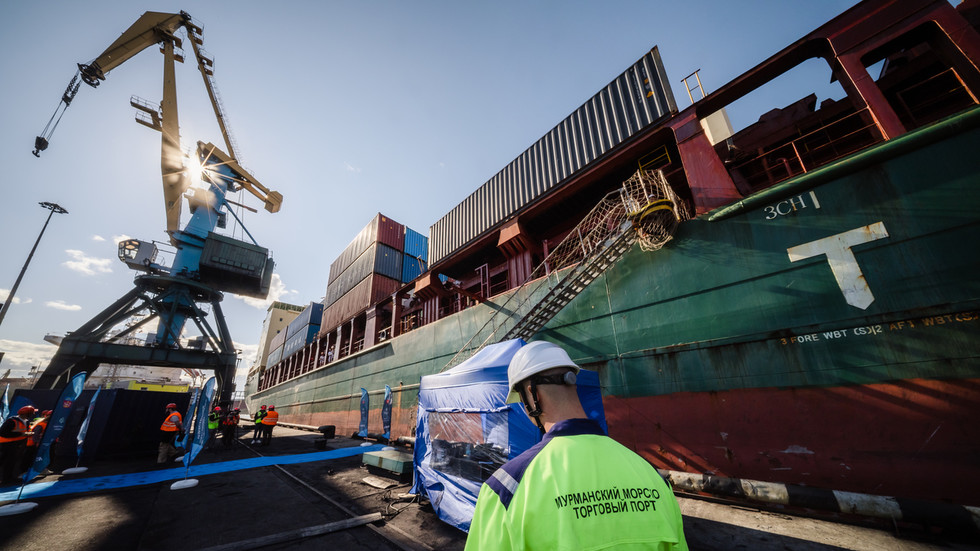
Kathmandu— A Chinese container ship, Xin Xin Hai 1, arrived at Russia’s northern port of Murmansk via the Northern Sea Route (NSR) on Wednesday, signaling an expansion of trade links between Russia and China. The shipment, carrying 500 containers of automotive components, is part of Beijing's “Ice Silk Road” initiative, a polar counterpart to its Belt and Road infrastructure project. Rosatom, the Russian state atomic energy corporation overseeing development of the NSR, announced the arrival, highlighting the route’s potential as a shorter maritime link between East Asia and Europe. The move comes amid increased interest in Arctic shipping due to disruptions in traditional routes caused by geopolitical instability.
The Northern Sea Route's Growing Importance
The NSR traverses Russia’s Arctic waters and exclusive economic zone, relying on Russian ports and icebreakers for navigation. Rosatom manages the route’s development, infrastructure, and maritime safety. NewNew Shipping Line has been operating along the NSR since 2023, initially serving ports in Russia's Far East and Baltic regions, but this recent voyage marks its first direct container shipment to Murmansk from China. The route offers a potentially significant reduction in shipping time – around two weeks – between China and Europe compared to voyages through the Suez Canal.
China’s ‘Ice Silk Road’ Initiative
Beijing views growing cooperation with Moscow as integral to its “Ice Silk Road” initiative, aiming to establish a robust trade corridor across the Arctic. Chinese Consul General in St. Petersburg Luo Zhanhui stated that China is prepared to continue supporting collaboration between companies and further develop this route. NewNew Shipping Line plans to deploy six new Arctic-class container ships on the NSR, with four entering service in October and two more expected by June 2027, potentially enabling two voyages per month between Chinese and Russian ports.
Investment and Regional Trade
Ke Jin, CEO of NewNew Shipping Line, has expressed interest in investing in Russian Arctic ports, including Murmansk and Arkhangelsk, and acquiring a stake in the port of Ust-Luga. The Murmansk Region already sees China as a major trading partner, accounting for approximately 40% of its foreign trade in 2025, with the region maintaining trade relations with 48 countries according to Governor Andrey Chibis. Russia has been utilizing the Arctic corridor for energy exports since 2010, including LNG shipments from the Yamal LNG project beginning in 2017.
Geopolitical Factors Driving Interest
The increased interest in the NSR is also linked to recent geopolitical events. Disruptions caused by conflict in the Middle East, particularly impacting shipping through the Persian Gulf and Red Sea, have prompted countries to explore alternative routes. South Korea recently launched a trial container voyage to Europe via the NSR, and India plans its first cargo shipment along the route in 2027.
The Northern Sea Route is poised for increased traffic as Russia and China continue to develop infrastructure and expand shipping capacity, potentially reshaping global trade patterns.
(With inputs from RT)
Originally published on abcnews.com.np.




प्रतिक्रिया दिनुहोस्