

Kathmandu— Violent clashes in Kaptanganj, Sunsari district of Nepal on July 26th resulted in four deaths – Om Prakash Mehta, Jay Prakash Mehta, Ganesh Yadav, and Rabindra Kumar Mehta – and left over two dozen injured, alongside significant property damage. The conflict began with a dispute over religious flags and escalated following an altercation during a procession, exposing deep-seated communal vulnerabilities in the Terai-Madhes region. While immediate responses contained the violence, observers warn that without addressing underlying structural issues, the area risks becoming trapped in a cycle of recurring unrest.
Escalation Of Tensions
The Kaptanganj incident was triggered by two events on the same day: the replacement of a Muslim religious flag on a public electricity pole with a Hindu one, and a late-night procession featuring loud music. When residents requested the volume be lowered, verbal arguments quickly escalated into physical violence and ultimately led to police firing. This pattern mirrors previous communal conflicts in the Terai-Madhes region, indicating a shift from broader political rights towards localized disputes over symbolic dominance.
The Role Of Space And Symbolism
Experts note that public spaces are never neutral, but rather actively constructed and contested. In Kaptanganj, the electricity pole became a symbol of religious identity when it displayed a flag, and its replacement was seen as an act of desecration. The loud music from the procession served as a further assertion of dominance over a vulnerable community. This dynamic is exacerbated by the rapid spread of information in the digital age, which can amplify local friction into larger symbolic flashpoints.
Cross-Border Influences
The conflict in Kaptanganj reflects broader trends observed across the border, where aggressive displays during religious processions – including motorcycle rallies and provocative slogans – are increasingly common. These practices assert dominance and reshape public spaces, and they readily cross geopolitical boundaries in interconnected borderland ecosystems. The region is particularly susceptible to these influences due to its porous borders and shared cultural heritage.
Moving Towards Preventive Peacebuilding
Containing immediate violence through police mobilization and curfews offers only temporary relief; a sustainable solution requires addressing the underlying structural issues that fuel conflict. Experts advocate for a shift from reactive crisis management to proactive peacebuilding, encompassing cross-border dialogues, joint media verification networks, early warning systems, interfaith governance frameworks, and interventions to address socio-economic precarity. A key component of this approach is strengthening human rights-based policing with improved training, equipment, and accountability.
Restoring Civic Spaces
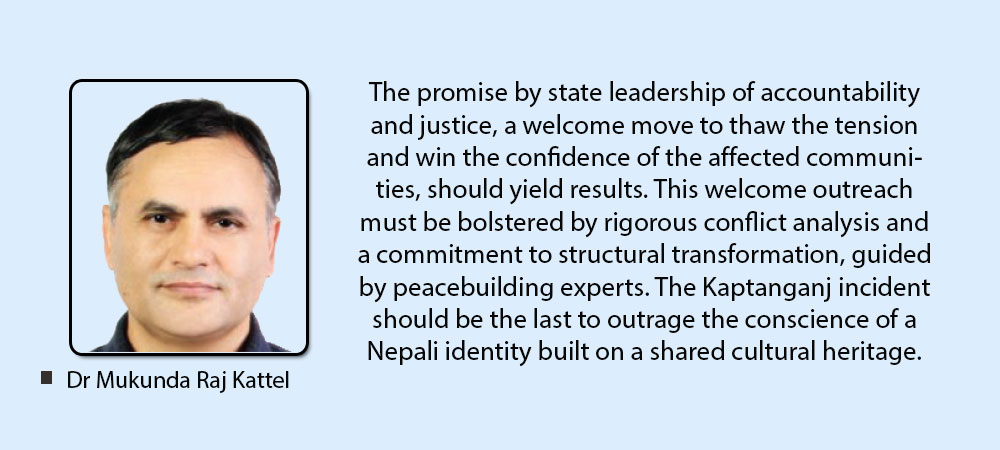
Preventive peacebuilding also necessitates cultivating a shared civic virtue that recognizes diversity as a common good. This involves reclaiming public spaces – such as electricity poles and town squares – as neutral utilities accessible to all communities, rather than allowing them to be weaponized for sectarian expression. The promise of accountability and justice from state leadership is seen as a positive step, but must be coupled with rigorous conflict analysis and long-term structural transformation.
The Kaptanganj incident serves as a stark reminder of the fragility of peace in the Terai-Madhes region, and underscores the urgent need for sustained efforts to address underlying tensions and build a more inclusive future.
(With inputs from RN)
Originally published on abcnews.com.np.


प्रतिक्रिया दिनुहोस्