

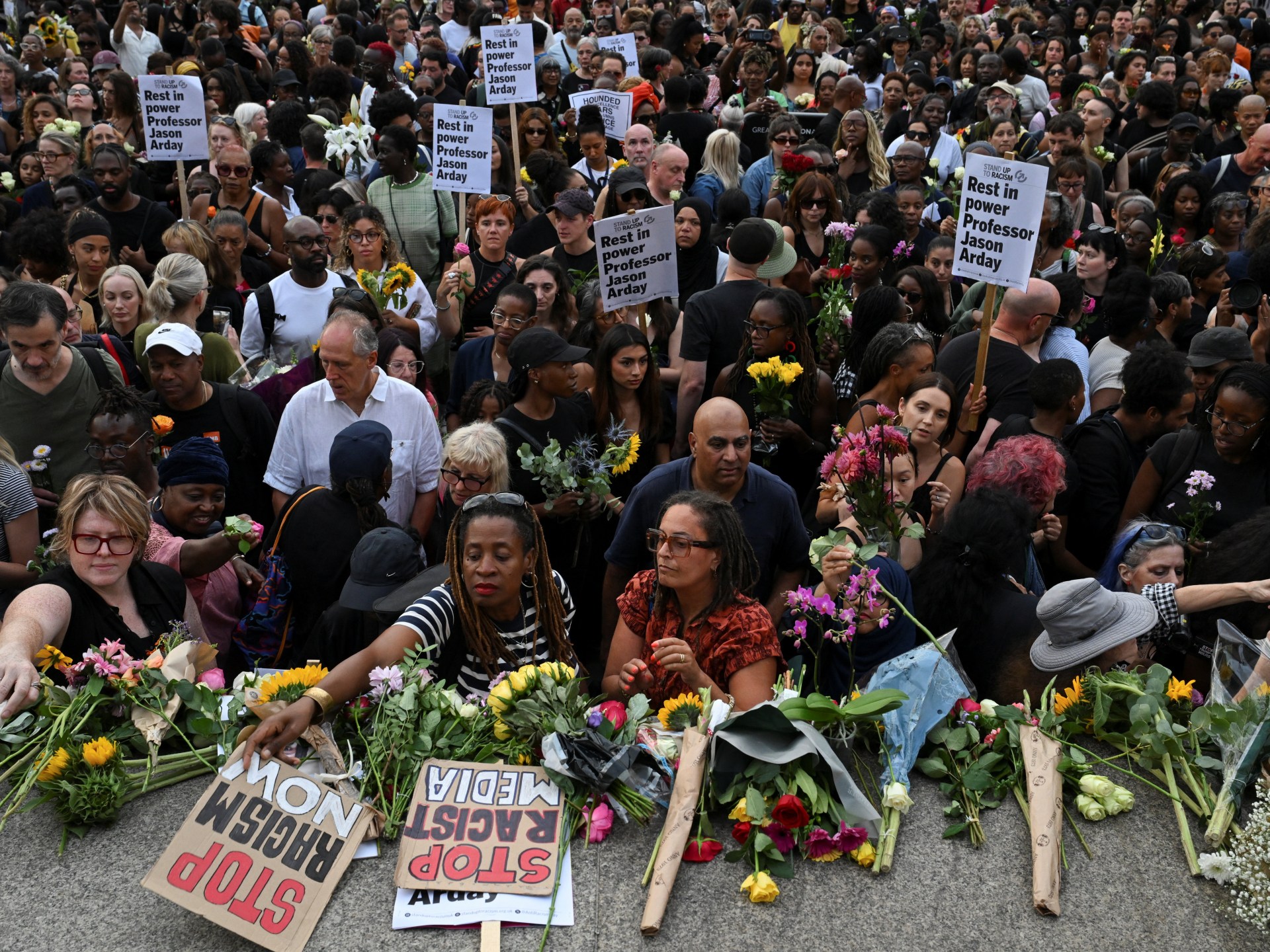
Kathmandu— Tens of thousands of mourners gathered in London's Trafalgar Square on Monday to honor Jason Arday, a former Cambridge University professor who died last Friday after weeks of media scrutiny surrounding allegations of plagiarism. The 41-year-old, who was the youngest Black professor at Cambridge, had denied the claims and resigned earlier this month citing the toll the accusations took on him and his family. Many attendees blamed what they described as a “racist” media campaign for Arday’s death, carrying signs demanding accountability and an end to biased reporting.
Vigil Draws Thousands in London
The vigil saw an estimated 30,000 people dressed in black filling Trafalgar Square, many bringing flowers as a tribute to Arday. Mourners expressed both grief and grievance, feeling compelled to show respect for the professor and stand in solidarity against what they perceived as unfair treatment. Paul Vincent, a social worker at the vigil, described it as “a gathering of grief and of grievance,” adding that the case had become exploited for ideological purposes.
Allegations and University Response
The controversy stemmed from allegations that Arday plagiarized portions of his 2015 doctoral thesis and misrepresented details in his biography. He resigned from Cambridge on August 5th, stating the “relentless accusations” had profoundly impacted him and his family. While Liverpool John Moores University, which awarded his doctorate, cleared him of plagiarism, Cambridge initially dismissed the allegations as a smear campaign before launching its own review following continued public attention.
Calls for Public Inquiry
A petition calling for a public inquiry into the media’s conduct has garnered over 96,000 signatures. Organized by the Good Law Project, it argues Arday's death was a direct result of press harassment and that his race played a significant role. The petition highlights perceived disparities in media scrutiny compared to other academics facing similar allegations, specifically mentioning George Holmes and William O’Reilly, both white men. According to NewsCord, 249 articles about Arday were published in UK media in the 22 days before his death, with 188 appearing after his resignation.
Outpouring of Support from Public Figures
The vigil attracted numerous prominent Black British figures including politicians Diane Abbott and Dawn Butler, filmmaker Misan Harriman, and singer Beverley Knight. Abbott recalled seeing Arday a week before his death, noting he was already visibly affected by the campaign against him, and stated she believed it drove him to take his life. Butler apologized on behalf of those who failed to protect Arday, framing the issue as a battle between good and evil, while Knight described witnessing the “destruction of a brilliant man” fueled by jealousy and hatred.
Family Statement and Concerns for Autistic Individuals
A statement from Arday’s family was read at the vigil, thanking those who had offered support and describing him as a selfless individual dedicated to uplifting others. They stated that the public cruelty he endured was unbearable. The family shared Arday's own words: “Every human life has a purpose…Imagine what might happen if we were all united in the just cause of valuing all human beings equally.” Prior to his death, Simon Baron-Cohen, director of Cambridge’s Autism Research Centre, had warned that autistic individuals are at higher risk of suicide and expressed concern about the relentless bullying Arday was facing.
Arday's family has requested privacy during this difficult time. The Metropolitan Police are treating his death as “unexpected” but not suspicious, with the cause yet to be released.
(With inputs from Al Jazeera)
Originally published on abcnews.com.np.

प्रतिक्रिया दिनुहोस्